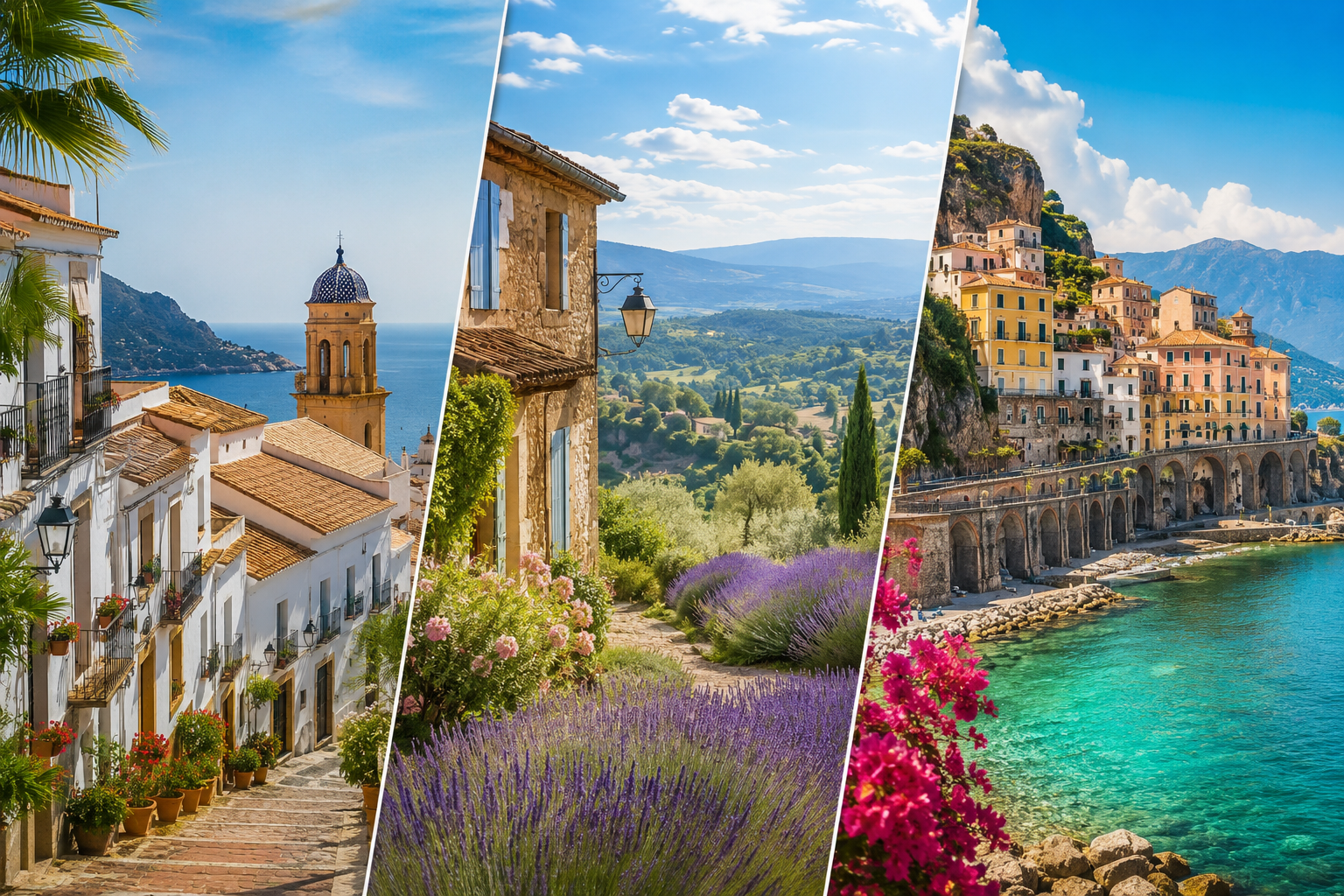



Spain remains the first choice for overseas buyers in 2026, and the reasons haven’t changed much: the flights, the climate, the established communities. What has changed is the paperwork around the purchase.
Three things moved this year. Valencia cut its transfer tax. The Supreme Court struck down the national short-term rental registry. And the EU’s travel authorisation scheme slipped again. None of it stops you buying property in Spain, but all of it affects what you pay and what you can do with the place afterwards.
This guide covers the costs, the legal steps and the rules as they stand in August 2026, with the regional differences that matter most to your budget.
In short: Buying property in Spain is open to any nationality, with no restrictions on foreign ownership. Budget 10–15% on top of the price for tax and fees, and allow six to eight weeks from accepted offer to completion. The rules that change most are regional: transfer tax, rental licensing and community consent all vary by autonomous community.
Contents
Get expert answers before you buy in Spain
Join live online sessions on property, legal, tax, visas and finances — with time to ask your own questions.
Why buying property in Spain still makes sense in 2026
Despite the headlines about tax rises and rental crackdowns, Spain continues to welcome overseas buyers. The most alarming proposal, a 100% purchase tax on non-EU non-resident buyers, was submitted to parliament in May 2025. It has never been debated or voted on, and the government’s own January 2026 housing package left it out.
That matters more than the coverage suggests. As our analysis of Spain’s proposed property taxes sets out, a bill that has sat untouched for 15 months is not a buying cost. It’s worth watching, not budgeting for.
What hasn’t changed is Spain’s appeal. You get established international communities, airports serving every major UK and European city, modern healthcare and real legal safeguards during the purchase process.
The difference in 2026 is that preparation counts for more. Regional tax rates diverge sharply. Rental rules are enforced far more tightly than they were. Communities of owners now hold a formal veto over new holiday lets.
Step one – define where and what you want
Coastal hotspots, inland villages, islands, major cities. Each draws a different buyer, and the tax bill differs by thousands depending on which one you pick.
Our regional guide to where to buy in Spain sets out the main options:
- Costa Blanca and Costa del Sol for established international communities
- Murcia and Almería for better value per square metre
- The Balearics for prestige, at the highest transfer tax rates in Spain
- The Canary Islands for year-round rental demand and the lowest purchase taxes in the country
- Inland Spain for space and affordability
Then comes property type. Spain’s housing stock runs from new-build apartments and golf villas to village townhouses, cave homes and rural fincas.
New developments suit you if energy efficiency and low maintenance matter. Resale homes offer character and often better value per square metre. Your choice should follow how you plan to use the place: holiday home, rental investment or permanent base.
What buying property in Spain really costs
Overseas property search
Find properties that fit your plans
Choose where you want to buy, your budget and how many bedrooms you need. We’ll take you straight to matching properties on the Your Overseas Home Property Portal.
Start your property search
Your selections carry through to the results
The most common mistake overseas buyers make is underestimating the purchase costs.
Budget an extra 10–15% on top of the price. That covers taxes and fees:
- On a resale home: property transfer tax (ITP), charged by the region
- On a new build: VAT at 10% on the mainland (IGIC at 7% in the Canaries), plus stamp duty (AJD) of roughly 0.5–1.5% on the deed
- Legal fees: around 1–2% of the price
- Notary and land registry fees: usually a few thousand euros combined
One point trips people up. On a resale purchase you pay ITP, not AJD. Stamp duty attaches to new builds and to mortgage deeds, and since the 2018 Supreme Court ruling Spanish lenders have generally borne the AJD on the mortgage deed themselves. Your bank should confirm that in writing.
Transfer tax varies far more than people expect
ITP is set by each autonomous community, and the spread is wide enough to change where you look.
| Region | ITP on a resale home | Worth knowing |
|---|---|---|
| Madrid | 6% | Lowest standard rate in Spain |
| Canary Islands | 6.5% | New builds pay IGIC at 7%, not 10% VAT |
| Andalusia | 7% flat | Single rate since 2021 |
| Valencian Community | 9% | Cut from 10% on 1 June 2026. 11% above €1m |
| Catalonia | 10% | Rises to 11% above €1m |
| Balearic Islands | Progressive scale | Climbs into the 11–13% range at the top brackets |
On a €300,000 (£258,000) resale home, that’s €18,000 (£15,500) in Madrid against €27,000 (£23,200) in Valencia. Reduced rates exist for younger buyers, large families and protected housing, but they nearly always require Spanish residency, so most overseas buyers pay the general rate.
The Valencian cut is recent enough that plenty of published cost guides still show 10%. If you’re buying on the Costa Blanca and completed before 1 June, the old rate applied.
Ongoing costs after completion

Spain’s annual property tax (IBI) typically runs between 0.4% and 1.3% of the cadastral value, set by your municipality rather than the region.
Rental income is taxable even if you never set foot in Spain. Residents of the EU or EEA pay 19% on net income and can deduct allowable expenses. Non-EU residents, including UK nationals, are generally taxed at a flat 24% on gross income with no deductions. Non-resident owners also file an imputed income return on an empty property, which the tax office does not remind you about.
Currency is the cost most buyers overlook. A 2% move between offer and completion on a €300,000 purchase is roughly £5,000 either way. Many buyers we help fix their rate as soon as the price is agreed rather than gamble on the market: our guide to Currency Transfer and Property Purchases Explained covers how that works.
The legal process explained
Spain’s system differs from the UK’s, but it’s structured and predictable. A typical resale purchase runs like this:
- Make and agree an offer
Submit your offer through the estate agent and, once agreed, the property is taken off the market.
- Sign the reservation agreement
You sign a reservation contract confirming the price and terms while legal checks begin.
- Pay the deposit (usually around 10%)
You pay a deposit, typically around 10%, which legally commits both buyer and seller to the transaction.
- Instruct your lawyer to carry out legal due diligence
Your lawyer verifies ownership, checks for debts and ensures the property is legally compliant.
- Sign the Escritura before a notary
The final deed is signed before a notary, who oversees the legal transfer of ownership.
- Complete payment and receive the keys
You pay the remaining balance, settle taxes and fees and receive the keys to your new property.
Completion usually takes six to eight weeks from accepted offer. In our experience the delays come from missing paperwork rather than the system itself, which is why instructing a Spanish lawyer early pays for itself.
Before any deposit changes hands, your lawyer should confirm legal ownership, check for outstanding debts and verify the property is correctly registered. A structural survey isn’t compulsory, and many buyers commission one anyway on older or rural properties.
You’ll also need an NIE number, your Spanish tax identification number, before completion. Without it you can’t buy, open a bank account or pay tax. Many buyers apply during an early viewing trip.
Residency and visas in 2026

Buying does not give you the right to live in Spain full time. The rules follow your nationality and how long you intend to stay.
EU citizens can move and register as resident once settled, subject to basic income and healthcare requirements.
Non-EU citizens, including UK nationals, can visit for 90 days in any 180-day period without a visa. That limit is now tracked biometrically under the EU’s Entry/Exit System, which completed its rollout across Schengen external borders in April 2026 and has caused real queues at airports through the summer.
ETIAS, the online pre-travel authorisation, is not live and has no launch date. The EU removed its late-2026 target in July 2026 after the agency building the system concluded the timeline wasn’t achievable, and 2027 now looks the realistic outcome. When it does start, it will cost €20 (£17), last three years and exempt under-18s and over-70s. Our guide to the EES and ETIAS rules tracks the position. Neither system grants residency; both simply regulate short visits.
For longer stays you need a national visa. The two most common routes for our readers:
- Non-lucrative visa, for retirees and others living on passive income. Roughly €2,400 (£2,065) a month for the main applicant in 2026, plus around €600 (£515) per dependant. No work of any kind is permitted, including remote work.
- Digital nomad visa, for remote workers earning from outside Spain. The 2026 threshold is €2,849 (£2,450) a month, set at 200% of the minimum wage, which rose in February 2026. Scrutiny has tightened, and you can no longer switch into it from inside Spain.
The golden visa closed on 3 April 2025 under Organic Law 1/2025. Buying property no longer opens any residency route, whatever the price. Existing holders keep their rights.
Renting out your property – what changed in 2026
If rental income is part of the plan, the position shifted significantly this year.
Spain’s national short-term rental registry, created by Royal Decree 1312/2024 and mandatory from 1 July 2025, was struck down by the Supreme Court in ruling 620/2026 of 19 May 2026. The court found the state had no competence to run a national registry over the top of existing regional ones. The national registration number is no longer required to list on Airbnb or Booking.
That’s less of a reprieve than it sounds. Three obligations survive:
- Your regional tourist licence (VUT, VFT, HUT, ETV or VV depending on the region) is now the binding registration, and it’s what the platforms check.
- Community consent. Since 3 April 2025, starting a new holiday let in a shared building needs the express approval of three-fifths of owners. Check the community minutes before you make an offer, not after.
- Guest registration. Every guest must be reported to the Interior Ministry within 24 hours of check-in.
Several cities, including Barcelona, Madrid and Seville, have frozen or banned new licences outright. A property can hold a valid regional licence and still be unrentable because the building voted against it. Longer-term lets are simpler and remain regulated under Spain’s Urban Rental Law.
After you buy – management and responsibilities
Ownership doesn’t end at completion. You’ll arrange building insurance, pay annual IBI and, in most developments, community fees.
If you’re not in Spain full time, a property management company can handle maintenance, guest arrivals and compliance. Budgeting around 1% of the purchase price a year for maintenance is a sensible starting point.
What should I do next?
Where you go next depends on how far along you are.
Still deciding where: browse property for sale in Spain by region to see what your budget buys, and download the Spain buying guide for the full process.
Planning a viewing trip: line up your independent lawyer and apply for your NIE before you travel. Both take longer than people expect.
Close to making an offer: talk to a Spain property expert about the region’s tax position, and speak to a currency specialist about fixing your rate before you commit to a price.
Summary
Buying property in Spain in 2026 is straightforward if you prepare properly. Foreign ownership is unrestricted and the legal framework is robust. Budget 10–15% above the purchase price, and check the ITP rate for your specific region, because the difference between Madrid and the Balearics runs into tens of thousands. Completion typically takes six to eight weeks. Buying gives you no residency rights, so plan your visa route alongside the purchase. And if you intend to let the property, confirm the regional licence and the community’s position before you pay a deposit.
FAQs about buying property in Spain
The main pitfalls usually stem from lack of preparation rather than hidden traps in the system itself. Buyers sometimes underestimate the total purchase costs, which can add 10–15% on top of the agreed price, skip independent legal checks or fail to confirm that the property is correctly registered and free of debts. Others overlook regional rental rules or community restrictions if they plan to let the property, and many forget about currency fluctuations, which can significantly affect the final cost in pounds. Appointing an independent lawyer early and understanding the full process before paying a deposit dramatically reduces these risks.
Buying a property in Spain does not automatically give you the right to stay long term. If you are an EU citizen, you can move freely and apply for residency once you settle there. If you are a non-EU citizen, including a UK national, you can stay for up to 90 days in any 180-day period without a visa, but longer stays require an appropriate visa such as a non-lucrative visa or digital nomad visa. Owning a property can support a residency application, but it does not replace the need for one.
Yes, UK citizens can buy property in Spain without restriction, and the purchase process is the same regardless of nationality. You will need an NIE number and a Spanish bank account to complete the transaction, but there are no ownership bans or additional barriers for British buyers. The main change post-Brexit relates to how long you can stay in Spain without a visa, not your ability to purchase property there.
For many overseas buyers, Spain continues to offer strong lifestyle appeal, reliable infrastructure and property prices that often compare favourably with other Western European destinations. Whether it is “worth it” depends on your goals: if you are focused purely on short-term rental income, you must research local licensing rules carefully, but if you are buying for lifestyle, long-term living or gradual capital growth, Spain remains one of the most accessible and well-understood overseas markets. Clear objectives and realistic budgeting are what ultimately determine whether it makes sense for you.
You might also like: