





Cyprus makes buyers feel at home before they land. English is widely spoken, the cars drive on the left and the euro is simple to use. But a good Cyprus property viewing trip checklist matters more than the warm welcome. It turns a pleasant week in the sun into a decision you can act on.
This guide covers what to sort before you fly. It shows what to check on the ground and what to ask while you are there. It is for buyers who are serious about the island.
Plan it well and you can view homes across two or three areas. You will meet the right people and come home with a real shortlist, not a camera roll of maybes.
Key takeaway: A Cyprus property viewing trip is a planned few days spent visiting homes in person, usually with a local agent. It suits buyers who have settled on a region and a budget. One caveat: the island is divided, so this checklist covers the Republic of Cyprus in the south. Book flights and a hire car early, line up viewings in advance and leave time to walk each area.
Contents
- Why the entry rules make Cyprus easy to plan in 2026
- When is the best time for a Cyprus viewing trip?
- Before you fly: what to book and prepare
- Your Cyprus property viewing trip checklist
- Getting around: plan your route
- What to check at each property
- Questions to ask the agent
- What should I do next?
- Summary
- Frequently asked questions
- Sources
Why the entry rules make Cyprus easy to plan in 2026
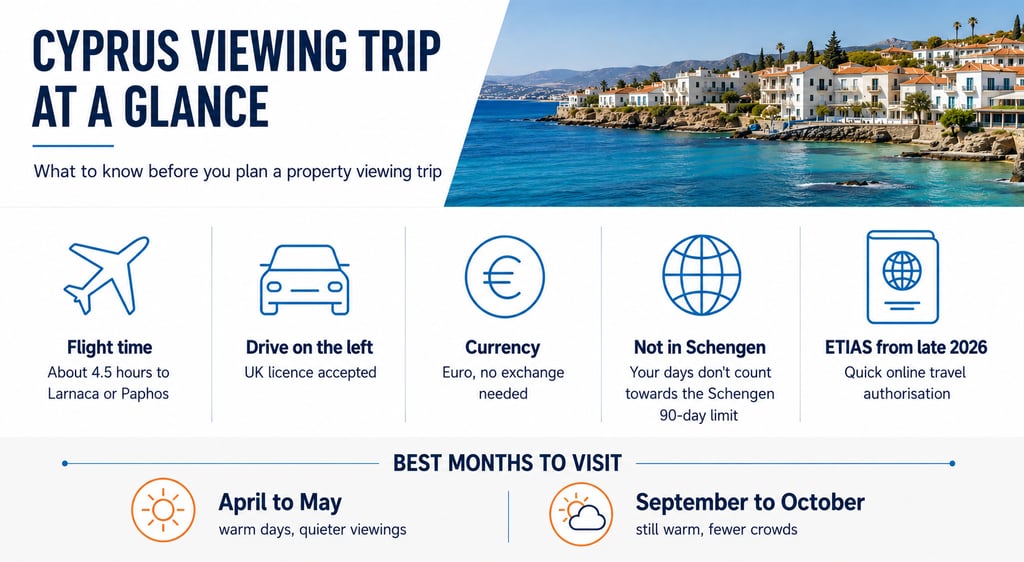
Cyprus is in the EU but not in the Schengen area. That has a practical upside for buyers. The EU Entry/Exit System (EES) brought in biometric checks at Schengen borders during 2026. It does not apply when you enter Cyprus, and the island eased checks for UK arrivals over the summer. Your time in Cyprus does not count towards the Schengen 90-day limit either. That helps if you also plan to view homes elsewhere in Europe.
The European Travel Information and Authorisation System (ETIAS) should go live in the last quarter of 2026, and it will cover Cyprus. It is not a visa. You apply online before you travel, it costs €20 (£17), and it lasts three years. Under-18s and over-70s pay nothing. For a viewing trip of a few days, none of this is a barrier. Check the latest Cyprus entry requirements on gov.uk and the official EU ETIAS guidance before you book. Timings can still move.
When is the best time for a Cyprus viewing trip?
Cyprus works year-round, but the shoulder seasons suit house-hunting best. Spring runs from April to May, and autumn from September to October. Both bring warm days, fewer crowds and cheaper flights. Spring also has a run of local festivals. That is a good way to feel out an area before you commit.
| Season | What to expect | Good for viewing? |
|---|---|---|
| Spring (Apr–May) | Warm, green, festivals, mild sea | Excellent – calm and easy to get around |
| Summer (Jul–Aug) | Hot, above 32°C, busy resorts, peak prices | Manageable but tiring for full days |
| Autumn (Sep–Oct) | Warm, quieter, sea still swimmable | Excellent – good weather and value |
| Winter (Nov–Mar) | Mild coast, some resorts quieter | Fine if you want the agent’s full attention |
Travelling outside school holidays keeps costs down. It also gives agents more time with you. A shoulder-season trip shows how a town runs day to day, not just at its summer peak.
Before you fly: what to book and prepare
A little groundwork makes the trip far more useful. Sort these out in advance:
- Flights. Direct routes from London, Manchester, Birmingham and Edinburgh reach Larnaca (LCA) in around four and a half hours. Paphos (PFO) is handy for the west.
- A hire car. Book early. Cyprus drives on the left, so a UK licence is easy to use.
- Your regions. Narrow down where you want to look. Start with our guide to where to buy in Cyprus, region by region.
- Your agents. Contact them ahead of time and confirm viewings. See our advice on finding an estate agent in Cyprus.
- Your money. A purchase means a large transfer, and the rate you get affects what you pay. Many buyers we help set a plan with a currency specialist such as Smart Currency Exchange before they commit. That way, a shift in the pound does not change their budget. See our money-saving tips for buying in Cyprus.
- Your must-haves. Write down your non-negotiables, so a good sea view does not distract you from what matters.
Your Cyprus property viewing trip checklist
Take this with you and work through it at each home. It keeps every viewing on the same footing. It also stops the days blurring into one.
- Photos and a short video of each room, plus the street and the approach
- Notes on aspect: which way the terrace faces and how much sun it gets
- Mobile signal and a rough broadband check inside the property
- Distance to the nearest shop, pharmacy, clinic and airport
- Parking, storage and any shared or communal costs
- Condition of the roof, windows, plumbing and any signs of damp
- For apartments, the state of the building and its communal areas
- Whether the property has its title deed in place (more on this below)
- Noise at different times, if you can visit twice
- Your honest first impression, scored out of ten before you leave
Getting around: plan your route
Cyprus is compact, but the best homes are spread out. It is about a two-hour drive from the eastern resorts near Paralimni to Paphos in the west. Trying to cover the whole island in a day is a false economy.
Most agents specialise in one district: the west, Limassol in the centre, or the east. If you are torn between areas, split your stay. Give a local agent in each region a full day. Public transport is thin outside the main towns, which is why a hire car earns its keep. Our guide to transport in Cyprus covers the practicalities.
| Area | Main bases | Who it tends to suit |
|---|---|---|
| West | Paphos, Coral Bay, villages such as Tala and Peyia | Buyers who want the coast plus village life |
| Central | Limassol | Buyers after a coastal city with a marina and amenities |
| East | Protaras, Paralimni, Ayia Napa, Larnaca | Buyers who want resort and beach areas near the airport |
What to check at each property
Two checks matter more than any other, so build time in for both. The first is the title deed. Some older resale homes have had deeds delayed. You want to know the position before you fall for a place. Our explainer on title deeds in Cyprus sets out what to look for.
The second is a survey. A home can look sound and still hide damp, drainage or wiring problems. It is worth speaking to a specialist. Our tips for hiring a surveyor in Cyprus explain how to find a good one. You need not arrange either during the trip. Seeing the property in person helps you brief them well.
Questions to ask the agent
Good agents will not pressure you, and the best answer plainly. Ask about the title deed status and any communal charges. Ask why the seller is moving and how long the home has sat on the market. Ask what similar homes nearby have sold for. Check the running costs across a full year, not just the summer. If you like a place, ask what happens next, so you understand how the Cyprus buying process works before you make an offer.
What should I do next?
Got a region and a budget in mind? The next step is to line up viewings. Shortlist two or three areas and contact agents early. Give yourself enough days to do each one justice. When you are ready to talk numbers, set up your currency plan with Smart Currency Exchange so the rate does not move against you. Still deciding where to look? Browse our Cyprus listings and start building your shortlist before you fly.
Summary
A Cyprus property viewing trip rewards planning. Cyprus sits outside Schengen, so entry stays simple in 2026, though ETIAS is due late in the year. Spring and autumn are the easiest seasons to view. Book flights and a hire car early. Narrow your regions and confirm viewings before you fly. On the ground, use the same checklist at every home. Check title deeds, arrange a survey and ask agents direct questions. Sort your currency plan before you commit, and you will come home with a shortlist you can act on.
Frequently asked questions
For now, UK passport holders do not need a visa for a short stay in Cyprus. You can travel on a passport alone. ETIAS should launch in the last quarter of 2026 and will apply to Cyprus, but it is not yet live. It will cost €20 (£17), and you apply online before travel. Check the latest rules before you book.
Three to five days suits most buyers focused on one region. If you are torn between the east and west, allow longer and split your stay. Give a local agent in each area a full day. Build in a buffer day, so a delayed viewing does not derail your plans.
Spring, from April to May, and autumn, from September to October, are the strongest windows. You get warm weather, fewer crowds, cheaper flights and more of your agent’s time. Summer is hot and busy, which makes back-to-back viewings tiring. Winter is quieter and can suit buyers who want undivided attention.
Usually, yes. Public transport is thin outside the main towns. The homes worth seeing often sit in villages or between resorts. Cyprus drives on the left, so a UK licence is easy to use. Book early, especially in the shoulder seasons when demand rises.
Sources
- UK government, foreign travel advice for Cyprus (entry requirements): https://www.gov.uk/foreign-travel-advice/cyprus/entry-requirements
- European Union, official ETIAS guidance: https://travel-europe.europa.eu/etias_en
- Feature image credit: Jose HERNANDEZ Camera 51 / Shutterstock.com