



Will your income in France be enough for a comfortable lifestyle? See what French government statisticians say, and Penny, our expat writer already there.
When I first considered moving to France after my kids left home, I became slightly obsessed with numbers. I knew what my pensions would produce, what income my investments might generate and roughly what I’d have left at the end of each month. I spent a ridiculous amount of time with spreadsheets. It all seemed terribly sensible.
However, as time went on, it became obvious that I was starting from the wrong place. Rather than asking “Will I have enough money?”, I should have been asking myself what a good life would look like, and whether my budget could stretch to meet it.
If you’re considering moving to France and, like me, up to your ears in numbers, it may help to take a quick look at the official figures.
What do the numbers actually say?
France’s National Institute of Statistics and Economic Studies (INSEE) – the country’s equivalent of the UK’s Office for National Statistics – collects detailed information on incomes and standards of living. Using INSEE’s data, the independent Observatoire des inégalités has calculated that the median income for a single person in France is around €2,146 per month. It defines someone as being “rich” once their income reaches twice that figure, or €4,292 per month after tax, while the poverty threshold is around €1,073 per month. Those are not official government definitions, but they provide a useful yardstick against which to judge our own expectations.
If you’re moving from outside the European Union, there’s another figure to bear in mind. France doesn’t have a retirement visa as such. Most retirees apply for a long-stay visitor visa, and although the French authorities don’t publish a fixed income requirement, applicants are generally expected to demonstrate that they can support themselves without working, with resources broadly comparable to the French minimum wage. At today’s rates, that equates to a little over €22,400 gross a year.
Your Overseas Home’s latest Cost of Living Index suggests that France is around twenty per cent cheaper overall than the UK. Groceries are considerably cheaper, eating out is better value and many day-to-day costs are lower. I recognise those figures from my own experience, but I don’t think they’re really the main story, since they don’t really answer my original question. Would, say, an income of €1,750 a month buy a life you enjoy…….?
The strange thing about living in France
My own experience has been that it would.
I live comfortably on around €1,750 a month, although I should immediately add a few caveats. I own my home, I don’t have children living with me and I don’t have extravagant tastes. Even so, I don’t think my comfort comes simply from France being cheaper than Britain. It comes from living differently.
The bigger surprise has been discovering how quietly France has changed my habits.

You start wanting different things
Without consciously deciding to do so, I gradually started cooking almost everything from scratch. I buy what’s in season because that’s what looks best on the market stalls. I snack far less than I used to. I can’t remember the last time I bought a ready meal or the last takeaway coffee. Somewhere along the way my relationship with food changed.
It wasn’t that I set out to economise, quite the opposite.
Cooking stopped feeling like another task squeezed in after work and became part of the pleasure of the day. I find myself wandering around markets wondering whether today’s tomatoes are better than last week’s, or whether the apricots have finally replaced the peaches. There is a rhythm to eating seasonally that I’d almost forgotten existed.
As a consequence, my grocery bill shrank. But more importantly, I started eating better.
Perhaps that’s one of the things France does particularly well. It doesn’t necessarily encourage you to spend less. It simply nudges you towards spending differently.
The luxury of ordinary days
The same thing happened with travel.
In England I always seemed to be planning the next escape. There was another weekend away, another short break, another holiday to look forward to. Looking back, I sometimes wonder whether I was trying to compensate for everyday life rather than simply enjoy it.
Living in France, particularly in the south, changes that equation.
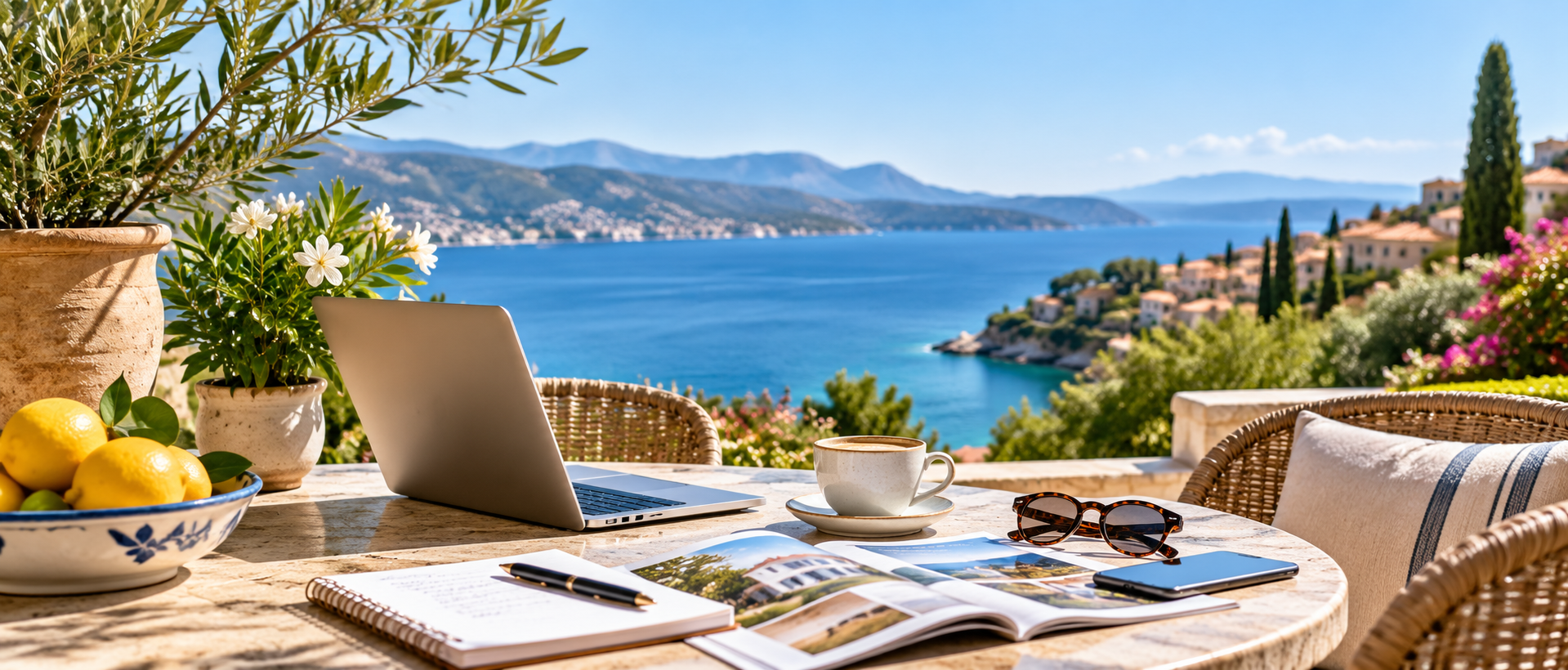
When an evening walk can be beside the Mediterranean, or you can take the dog down to the river before breakfast, or spend Saturday morning wandering around a village market before sitting outside with a coffee, ordinary life starts borrowing some of the pleasures that used to belong exclusively to holidays.
I travel much less now, not because I can’t afford to, but because I don’t feel quite the same need to escape. That, I think, has been one of the biggest surprises of all.
Where I happily spend money
If there is one area where I don’t mind pushing the boat out, it’s food.
Not expensive ingredients simply because they’re expensive, nor Michelin-starred restaurants. Those have their place, but they’re not what makes me happiest.
France still does an excellent fixed-price lunch if you know where to look, although I have to admit that everyday restaurants aren’t always what they once were. There are plenty of burgers and pizzas now, just as there are almost everywhere else.
But give me a bustling village market over another Lidl every time.
I realise that sounds faintly romantic, but markets are about much more than shopping. They’re where neighbours stop to chat, where stallholders tell you the strawberries will be better next week, where someone persuades you to taste an olive you’ve no intention of buying, and where you come home with flowers that weren’t on your shopping list simply because they looked too beautiful to leave behind.
Could I buy the same vegetables more cheaply elsewhere?
Quite possibly.
Would I enjoy buying them as much?
Almost certainly not.
Does France feel less obsessed with money?
People sometimes ask whether France feels like a more unequal society than Britain.
Statistically, there are certainly significant differences in wealth. INSEE’s research shows that households with both high incomes and substantial assets are much more likely to own property, inherit wealth and receive investment income than the average household. Wealth exists, and in some places it exists in extraordinary quantities.
Yet that isn’t really how everyday life feels to me.
Perhaps it’s simply the people I’ve met, but there seems to be much less interest in displaying wealth. Even here on the Côte d’Azur, where there is certainly no shortage of money, it feels faintly vulgar to talk about it. Cars are, for most people, simply a means of getting from A to B. Some people are passionate about them, of course, but outside a handful of very obvious places you can’t reliably judge someone’s income by what they drive.
In Britain, I sometimes felt there was an unspoken pressure to keep upgrading, replacing and acquiring. Here, people seem rather happier wearing the same linen shirt for years, keeping the same car until it really has reached the end of its life and spending their money on long lunches with friends instead.

The luxury of enough
I sometimes wonder whether that is one of the reasons it is easier to live comfortably on what would be regarded as quite an ordinary income.
Modesty still seems to carry a certain social value. Nobody appears especially interested in keeping up with the neighbours. Conversation revolves around food, family, gardens, local fêtes, walking, the weather and where to find the best melon, rather than who has bought the newest kitchen or the latest car.
Of course, this isn’t the whole picture. Housing costs vary enormously from one part of France to another. Anyone relying on a UK pension has to live with the uncertainty of exchange rates, and private health insurance can be a significant expense before you enter the French healthcare system. None of those realities disappear simply because tomatoes taste better.
But if someone were to ask me today whether you need to be wealthy to retire happily in France, my answer would still be no.
You need enough, certainly. Enough to pay the bills without worrying every month. Enough to cope when the roof leaks or the boiler gives up. Enough to enjoy the occasional indulgence.
What I rather think France changes is your idea of what “enough” actually means.
Every now and then I find myself sitting on my terrace with a coffee, looking towards the sea and wondering what I’d have been doing at the same time ten years ago. Probably hurrying somewhere. Probably buying something. Probably planning the next holiday because everyday life felt slightly lacking.
These days I’m more likely to be wondering whether the tomatoes will be better at tomorrow’s market than they were today.
Objectively, I may not have any more money than I once did, but subjectively, I feel considerably wealthier.