



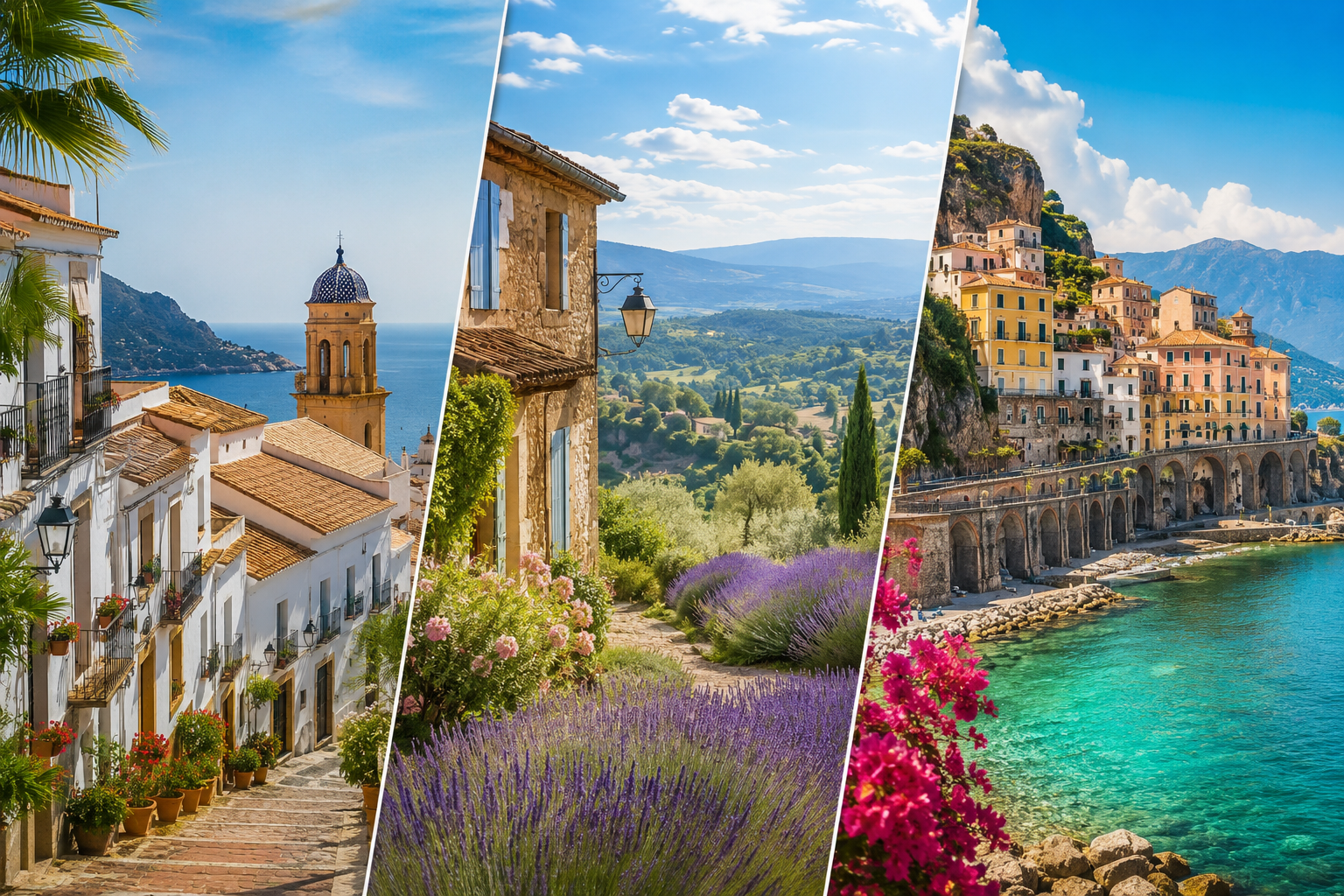
Three neighbouring countries, three very different rhythms of daily life. Here’s how bureaucracy, family life, transport and food actually compare in 2026 – and what’s changed for British buyers since Brexit.
Spain, France and Italy sit side by side on the map, yet anyone who has lived in more than one of them will tell you how differently each country actually works. The paperwork, the school run, the trains and the dinner table all follow their own local logic – and a so-called united Europe hasn’t smoothed any of it out.
In short: all three countries now require a visa for non-EU nationals planning to live there full-time, since short stays are capped at 90 days in any rolling 180-day period across the whole Schengen area rather than per country. Bureaucracy has become considerably more digital in Spain, France and Italy alike, though Italy still has a reputation as the most exacting of the three. Spain and Italy suit families who eat and socialise late; France favours a quieter, earlier household routine and famously serious dining. All three have modernised their high-speed rail networks in the past few years, competition has pushed Spanish train fares down by around a fifth on some routes, and between them France and Italy hold more Michelin stars than any other countries in Europe.
Contents
Living there after Brexit: what’s changed
Nothing has altered the calculation for British buyers quite as much as Brexit. UK nationals are now treated as third-country nationals across the EU, which means two things matter more than they used to: how long you can stay without a visa, and what it takes to move there properly.
For short stays, the rule is 90 days in any rolling 180-day period, and that allowance is shared across the entire Schengen area – time spent in Spain counts against the same total as time spent in France or Italy, so you can’t simply hop between the three to reset the clock. Since 10th April 2026, this has been enforced through the EU’s new biometric Entry/Exit System (EES) at the border, which logs every crossing electronically. A further layer, the ETIAS travel authorisation (a straightforward online form costing €20 / £17 and valid for three years), is expected to follow in 2027.
Non-EU nationals planning to live in Spain, France or Italy full-time will need a national visa, applied for before travel. The three main routes look like this:
| Country | Main route | Typical income requirement | Key condition |
|---|---|---|---|
| Spain | Non-Lucrative Visa | €28,800 / £24,480 a year for a single applicant, plus around €7,200 / £6,120 per dependant | Private Spanish health insurance with no co-pays; at least 183 days a year in Spain |
| France | Long-stay visitor visa (VLS-TS “visiteur”) | Broadly in line with the French minimum wage, around €1,443 / £1,226 net a month | Must be validated online after arrival; no right to work in France |
| Italy | Elective Residency Visa | Around €31,000 / £26,350 a year for a single applicant, roughly €38,000 / £32,300 for a couple | Income must be genuinely passive; consulates have wide discretion and refusals aren’t rare |
Spain’s non-lucrative visa is the natural route for retirees and other self-sufficient buyers, renewed in two-year blocks after the first year, with permanent residency available after five years. Note that Spain’s property-linked golden visa closed in April 2025, so this and the newer digital nomad visa (for remote workers) are now the main options. France’s visitor visa is unusual in that it doubles as a residence permit once validated online. Italy’s elective residency route is the strictest to qualify for, since consulates set the bar on passive income themselves rather than working from a fixed legal figure.
None of this applies to anyone who was already legally resident in Spain, France or Italy before 1st January 2021 – those buyers retain their rights under the Withdrawal Agreement and should simply hold the relevant residence document. For everyone else, a good immigration adviser and an early start on paperwork are worth the investment, and Smart Currency Exchange can help make sure the funds behind a visa application, whether that’s proof of income or a property deposit, move between pounds and euros without losing value to a poor exchange rate.
Bureaucracy: has it got any easier?
Spanish, French and Italian bureaucracy has long had a reputation among British buyers, not always undeserved. The good news is that all three have quietly digitised a great deal since the late 2010s.
In Spain, the Cl@ve system now lets residents handle tax returns, social security and residence paperwork online, alongside the older FNMT digital certificate. Catalonia and other well-organised regions have generally made this easier still, though a missing photocopy can still mean a wasted trip and another appointment. Renewing a driving licence, for instance, involves a practical assessment at a medical centre – not something to take lightly if you’re more used to the M25 than a simulator with two steering wheels.
France’s FranceConnect single sign-on has grown from around eight million users in 2019 to roughly 45 million today, and the country’s Baromètre du numérique found that 73% of French people completed an online administrative procedure in 2024, a record. The tax office still has its own particular pace, but a great deal that once required an in-person visit can now be done from a laptop.
Italy remains the most demanding of the three to navigate. Anyone applying for residency, a driving licence or a school place should expect several visits and plenty of questions, and it’s not unusual to be asked outright why you want to live in Italy in the first place. Once that’s established, though, staff are generally helpful. Digitally, Italy has moved fast: over 41 million adults now hold an active SPID digital identity, roughly 82% of the eligible population, alongside nearly 50 million electronic ID cards. It’s a reminder that Italian bureaucracy is thorough rather than backward – it simply likes to ask “why” before it says yes.
Family life and children

If you’re moving with children, the differences in daily rhythm are worth thinking through as much as the paperwork.
Spanish children are taken to restaurants from birth and are generally well behaved at the table, if noisy – Spanish family life runs loud and cheerful, with everyone talking at once. School days are long, with after-school clubs running until eight or nine in the evening, followed by homework and a late supper, so bedtimes rarely arrive before eleven. It makes for a sociable, late-running household that some British families take a term or two to adjust to.
France runs on a noticeably quieter register. Meals are treated seriously from an early age, children eat what the family eats, and mealtime manners are non-negotiable. Bedtimes are earlier and more consistent than in Spain, and French children are generally introduced to a wide range of food early, so fussy eating is less common. For families used to a firmer routine, France often feels the most familiar of the three.
Download the France Buying Guide
Italy sits closer to Spain in tempo – families with young children out for pizza at ten in the evening isn’t unusual – but with a distinctly protective, sometimes indulgent, parenting style. School lunches are typically a proper three-course affair (pasta, then a meat or fish dish, then dessert), and children are fed accordingly at home too. It’s worth knowing, if you’re weighing this up, that Italy expects a medical certificate of good health before children can join most clubs or sports teams.
Getting around: trains and roads
All three countries have invested heavily in rail since the days when Spain’s AVE ran largely unchallenged. Renfe’s high-speed network now competes with Ouigo (SNCF’s budget brand) and iryo, a Trenitalia-backed operator, plus Renfe’s own low-cost Avlo. The effect on fares has been real: independent research has found ticket prices down by around a fifth on the Madrid–Barcelona and Madrid–Valencia routes since competition arrived, with punctuality holding up well across operators. It’s still considerably cheaper than the equivalent UK trip, and far more reliable.
France’s TGV remains the network other countries measure themselves against. SNCF carried a record 168.4 million TGV, Ouigo and Eurostar passengers in 2025, up 3.5% on the year before. Road quality outside the motorways is generally good, though rural areas can still mean a longer, quieter drive between towns, and French drivers keep to the rules more than their southern neighbours, if not always to the speed limit on the autoroute.
Italy’s Frecciarossa remains one of the country’s two leading high-speed operators, sharing the market with the private Italo – a rivalry often held up as one of the most successful examples of rail competition anywhere in Europe. Journey times between major cities are excellent, though delays do happen on both operators, particularly on the Adriatic corridor, so it’s worth building in some slack. Italy’s motorways are well maintained thanks to tolling, but secondary roads in parts of Tuscany and further south in Puglia can be rougher going, and a confident, decisive driving style serves you better than an overly cautious one on Italian roads generally.
Food and dining culture
This is where each country’s character comes through most clearly. According to the MICHELIN Guide, France currently holds 654 starred restaurants, more than any other country in the world; Italy follows with 394, and Spain with 307. All three, though, are best understood away from their star-rated restaurants.
Spanish food culture runs on late hours: a quick breakfast at home, a second one around mid-morning with coffee and a small sandwich, lunch between two and four in the afternoon, tapas from early evening, and dinner rarely before nine. Regional cooking is the backbone of it, using largely the same ingredients as elsewhere in the country but transformed by local technique and seasoning. It’s worth steering away from tourist-menu tapas bars, where the food is often reheated and underwhelming, in favour of wherever the locals actually eat.
French cuisine treats the table with something close to reverence, and even a modest local restaurant away from the big cities can produce a memorable meal for a fraction of the cost of a starred one. The trade-off is that in more remote areas, where towns are spread further apart, the choice can be limited and quality more variable.
Italian food, at its best, is built on tradition rather than invention – home-style “casalinga” cooking, gently prepared over hours, still beats most restaurant menus. The advice that’s served Italian residents well for years still holds: look past the smartest-looking frontage, find the busy, unassuming place down a side street, and go with whatever’s being served that day.
Which country suits you?
There’s no single right answer, and it depends as much on personality as on paperwork. Spain suits buyers who want a warm, sociable pace of life and don’t mind noise with their sunshine. France rewards those who value routine, quieter evenings and serious food without needing to chase a Michelin star to find it. Italy asks more of you administratively, but repays the effort with a slower, family-centred culture and some of Europe’s best home cooking once you’re properly settled in.
Whichever you choose, the practical groundwork – visas, healthcare, and moving your money safely from pounds into euros at a fair rate – matters just as much as falling in love with the lifestyle. Smart Currency Exchange works alongside Your Overseas Home to help buyers plan currency transfers around visa applications, deposits and completion dates, so the numbers behind the move are as sound as the decision itself.