




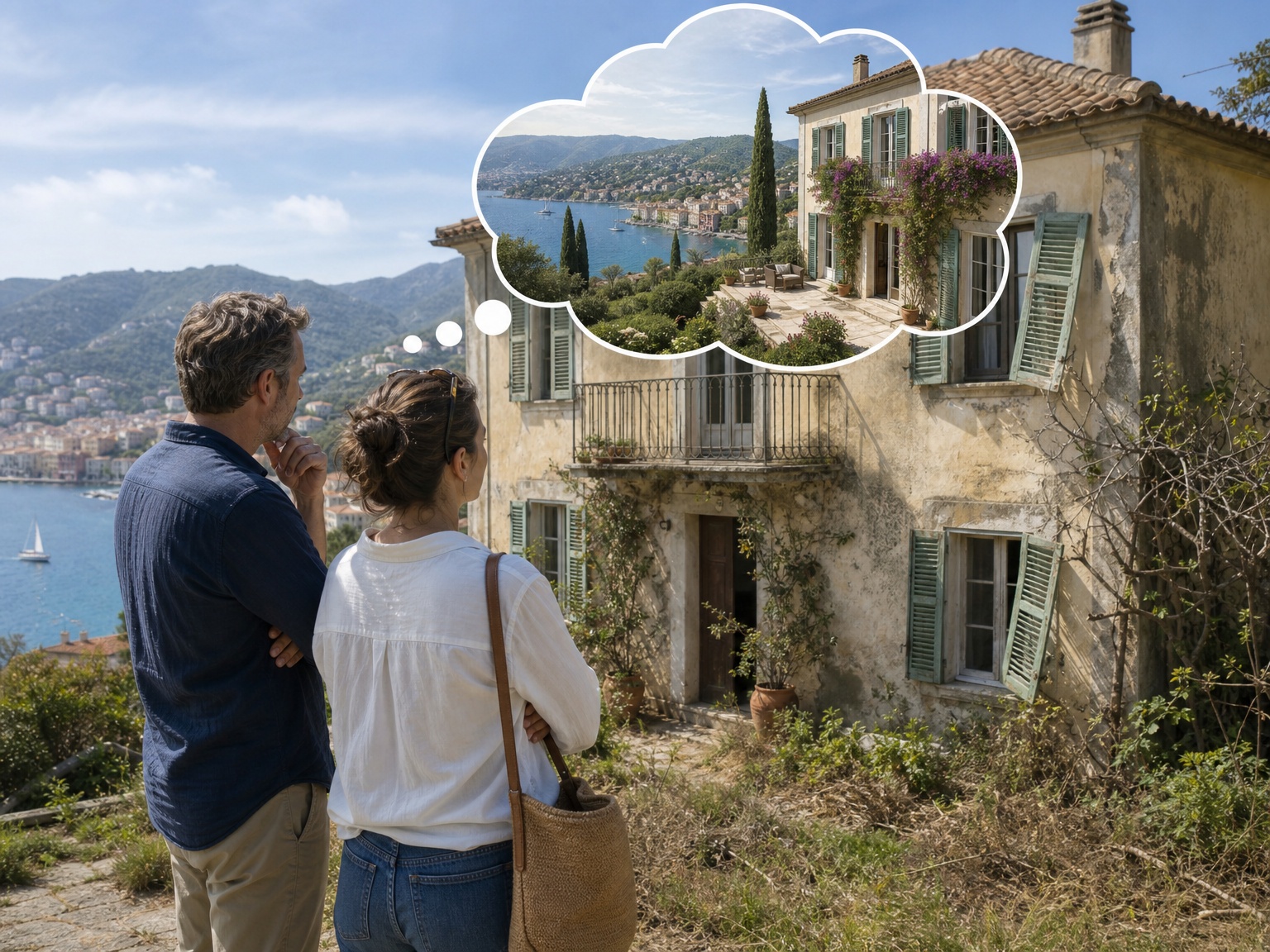
Transform your search for the ideal home overseas by embracing imagination and recognising true property potential.
Most property searches begin with a fantasy.
Then, somewhere along the way, that fantasy acquires a sea view, a swimming pool, original features, a guest annexe, walking distance to restaurants, convenient access to an airport that’s served by Ryanair and an interior decor that suits their taste. Before long, buyers aren’t searching for a home at all. They’re searching for a property that doesn’t exist.
The irony is that this pursuit of perfection often causes people to overlook the very homes that could make them happiest. Meanwhile, somebody else bought a house with peeling paint, an ugly kitchen and a neglected garden and ended up creating exactly the life they wanted.
Buying abroad requires a degree of imagination.
More importantly, it requires a willingness to distinguish between the things that matter and the things that merely catch the eye during a viewing. The properties that deliver the best lifestyle don’t always photograph beautifully or tick every box on a property portal. Quite often, they are the ones that reveal their qualities more slowly.
Contents
Don’t let perfect become the enemy of good
A few years ago, I found myself standing in a house in the south of France looking at a bathroom that would have sent many buyers running for the exit. The tiles were dated and cracked, the fittings had seen better days and the whole room looked as though it had been untouched for decades. I didn’t care.
Had I viewed the property ten years earlier, I might have focused on this bathroom. Experience, however, has taught me that some things are easy to change and some are not.
This old house is now my home, and if the experience has taught me anything, it is how surprisingly easy it is to change some aspects of a property and how completely impossible it is to change others.
I can replace windows. I can repaint shutters. I can rebuild terraces, redesign gardens and gradually undo some of the more questionable decorating decisions made by previous owners. What I cannot do is move the house to a different location, improve the orientation, alter the view or transplant it into a village I like better.
An ideal feeling, not just an ideal home
That sounds obvious, yet buyers routinely reject properties because of features that can be altered relatively easily while overlooking the things that really matter.
When I bought this house, quite a few things were wrong with it. Parts of the exterior needed attention. Several areas had clearly not been touched for years. There was a long list of repairs and improvements waiting for me.
But none of that worried me because the fundamentals were right. The house sat where I wanted it to sit. It looked towards the sea. It had the proportions, character and atmosphere I had been looking for. Those qualities would still matter in ten years’ time, whereas the state of the bathroom would not.
Property hunters often assume they are buying a house. In reality, they are buying a lifestyle and a feeling. The house matters, of course, but so does the walk to the bakery on a Sunday morning, the village square where people gather in the evening, the landscape outside the window and the feeling you get when you turn the corner and see your home sitting where it belongs.
Those things rarely appear on a specification sheet, yet they often have a far greater influence on long-term happiness than any fitted kitchen ever will.
Separate real problems from superficial flaws
None of this means buyers should throw caution to the wind.
Some flaws genuinely deserve concern, while others merely require a little imagination. The difficulty is that cosmetic imperfections often provoke a stronger emotional response than serious technical issues. People notice faded paint immediately. They notice old-fashioned floor tiles. They notice an overgrown garden or a kitchen that looks as though it belongs in another decade. What they often fail to notice is the roof, the drainage, the condition of retaining walls or signs that water may be finding its way into the building.
Experience tends to reverse those priorities.
The older I get and the more time I spend dealing with property, the less interested I become in decoration and the more interested I become in the bones of a building. A tired kitchen may look dreadful in photographs but can function perfectly well for years. An overgrown garden can be tamed with a good pair of secateurs. Even fairly extensive wiring, plumbing and cosmetic work often feels manageable when spread over months or years.
What’s less ideal in a home
Structural movement is a different matter. Significant water ingress, unstable retaining walls, problematic neighbours, legal irregularities, difficult access or expensive infrastructure problems have a habit of consuming both money and energy. These are the issues that deserve careful investigation because they can fundamentally alter the economics of a purchase.
The distinction matters because some of the most attractive opportunities on the market are properties that suffer from little more than neglect. They have been inherited, rented out for years or simply allowed to drift.
They look unloved, which can make them surprisingly easy to overlook. Yet beneath the clutter, dated décor and overgrown vegetation there is often a perfectly sound building waiting for somebody to recognise its potential.
The aim should not be to find a flawless property. The aim should be to find one with good fundamentals and manageable problems.
Character lives in the imperfections
One of the stranger consequences of modern renovation is that houses in different countries increasingly resemble one another.
You can walk into a renovated property in France, Spain, Portugal or the UK and find the same kitchen units, the same flooring and the same carefully selected palette of fashionable neutrals. Sometimes the results look excellent. Sometimes they erase the very qualities that made the property distinctive in the first place.
Many international buyers choose to purchase overseas because they want something different from modern suburban housing. They are drawn to old stone walls, timber beams, handmade tiles, worn steps and the sort of architectural details that develop naturally over decades rather than appearing overnight in a showroom.
Those imperfections are not defects. They are evidence of a building having lived.
Those imperfections are not defects. They are evidence of a building having lived a life.
The Japanese concept of wabi-sabi celebrates beauty in age, authenticity and imperfection. Rather than pursuing flawless surfaces and uniformity, it encourages an appreciation of things that bear the marks of time. While the concept originates on the other side of the world, it feels surprisingly relevant to older European properties.
Over the past year I’ve found myself spending a considerable amount of time trying not to make parts of my own house look too perfect. That may sound absurd. After all, renovation is supposed to improve things. Yet old buildings rarely benefit from being treated as though they were newly constructed. Strip away every irregularity, every weathered surface and every sign of age and you often strip away much of the building’s personality as well.
A weathered shutter can possess more charm than a brand-new replacement. An old stone floor may tell a more interesting story than an immaculate modern alternative. Even walls that carry the marks of previous generations can contribute to a sense of place that no designer can manufacture from scratch.
The goal, therefore, is not necessarily to eliminate every imperfection. More often, it is to decide which imperfections deserve preserving.
‘Overlooked’ is opportunity
The most attractive properties on property portals tend to attract the greatest attention. Professional photography, stylish furniture and fresh decoration help buyers imagine themselves living there, which is precisely why such properties often generate intense competition.
The overlooked property next door operates under very different conditions. Whatever the reason, buyers scroll past it and move on to something more polished.
That reluctance can create opportunity.
One of the advantages of considering imperfect properties is that they often allow buyers to prioritise the things that matter most. Many people discover that they can afford either the perfect house in a less desirable location or a slightly imperfect house in the location they genuinely want. Faced with that choice, the second option often proves the wiser one.
Property priorities
A property that needs decorating, landscaping or modernisation may come with a lower purchase price and less competition from other buyers. More importantly, it may provide access to a village, coastline, neighbourhood or landscape that would otherwise sit beyond the budget. In that sense, a willingness to see beyond superficial flaws can sometimes unlock opportunities that would remain hidden to buyers searching for perfection.
There is also a more personal reward. Improving a property over time creates a different relationship with it. Instead of inheriting somebody else’s vision, you gradually create your own. You choose which original features to preserve. You decide where to spend your money and where to exercise restraint. The house evolves alongside your life rather than arriving fully formed on the day you collect the keys.
For many people who move abroad, that process becomes one of the most enjoyable aspects of ownership.
The reality is that very few buyers find perfection. What they find instead is a property with good bones, a great location and enough potential to become something special. Given enough time, imagination and patience, that often turns out to be a much better outcome.