




If you use AI to research property abroad, it can cut through an unreasonable amount of information. You may be comparing regions, listings and visa routes at the same time. Buying costs and legal terminology may sit in a second language.
AI can make that research considerably easier. Give it the right job and it can organise a shortlist, explain unfamiliar terms and compare information you already have. It can also turn a vague concern into a useful question for your lawyer or agent.
The important distinction is between using AI to help you research and using AI as the source of the answer. Those are not the same thing. A contract, tax bill or right to live in a country needs firmer ground.
Key takeaway: AI is most useful as a research assistant. Use it to organise information, compare options, explain terminology and prepare better questions. For visa rules, taxes, legal requirements and live figures, trace the answer to a current primary source. When your own circumstances matter, confirm it with an accountable professional.
Contents
- How to use AI to research property abroad well
- Give AI information to work with
- The line that matters: research assistant or authority
- Where AI research becomes risky
- What our 2026 buyer survey found about AI
- Who sees AI as useful?
- A worked example: Spanish residency through property
- What AI cannot replace
- What should I do next?
- Summary
- Frequently asked questions
- Sources
Overseas Property Buyer Survey
Read the full 2026 buyer survey results
See the complete findings from Your Overseas Home’s 2026 survey of overseas property buyers.
How to use AI to research property abroad well
The best uses of AI have one thing in common. The tool helps you process information rather than asking you to trust it with a decision.
Explaining terminology. Ask for a plain-English explanation of compromis de vente, arras, IMT, cadastral value or a notary’s role. That gives you enough context to follow the next conversation without pretending you have replaced the professional involved.
Comparing information you already have. Give the tool three listings and your own criteria. Ask for a table showing price, bedrooms, airport distance and outside space. Add a final column for questions the listing leaves unanswered. It is much better at this than remembering details across 20 browser tabs.
Preparing for a viewing trip. A good overseas property viewing trip guide gives you the process. AI can then turn that process into a personal checklist based on your budget, preferred areas and must-haves.
Drafting questions. Instead of asking, “Is this house safe to buy?”, give the tool the listing. Ask for 15 questions to put to the agent, lawyer and surveyor. The output will not answer them, but it may stop you forgetting the awkward ones.
Gist translation and note-taking. AI is useful for understanding the rough meaning of an agent’s email, then organising your viewing notes afterwards. Keep contracts and anything legally significant for a professional translator or lawyer.
Give AI information to work with
The more source material you provide yourself, the more useful the exercise becomes. “Compare these five properties using only the documents I have attached” is a better task. “Which house should I buy in Tuscany?” asks the tool to make a judgement with too little context.
The same applies to viewing notes, buyer guides and correspondence from an agent. Ask the tool to organise what is there, identify gaps and draft questions. That keeps it in the role where it is strongest.
The line that matters: research assistant or authority
Older advice about AI often focused on training cut-off dates. That is now only part of the picture. Some current tools can search the web, retrieve recent sources and show citations alongside an answer.
That makes them more useful. It does not make every answer correct. Search results can be incomplete. A citation may point to a page that does not support the claim.
A model can still present a neat conclusion where the underlying rule is messy. The safer question is not simply “Does this AI have internet access?” Ask instead: “Can I trace this answer to the source that actually governs my situation?”
Where AI research becomes risky
A simple traffic-light test works well:
Where AI research becomes risky
Use AI freely for organising research, but increase your checks as the consequences become more serious.
| Task | AI’s role | What you should still check |
|---|---|---|
| Green: organising your research | Compare listings, build checklists, summarise your notes and draft questions. | Check that the tool has not added facts you did not provide. |
| Green: explaining concepts | Give a first-pass explanation of terminology or a buying process. | Check specialist terms before relying on them in a transaction. |
| Amber: location and market research | Pull together transport, services, broad price information and local considerations. | Check dates, source quality and whether the information applies to the exact area. |
| Amber: budgets and currency | Model scenarios using figures you provide. | Use current rates and confirm actual transfer costs. |
| Amber: visas and tax | Identify possible routes, terminology and questions to investigate. | Verify the current rule with the government source and a specialist where your circumstances matter. |
| Red: legal due diligence | Help you understand what your lawyer is checking. | Do not use AI instead of title, planning, contract or ownership checks. |
| Red: deciding what you personally owe or qualify for | Help you frame the issue. | Get the answer from the relevant authority or adviser who can assess your facts. |
Two AI tools agreeing with each other is not proof. They may be repeating the same widely copied mistake. Independent primary sources are a better cross-check.
If you are looking at Italy, AI can explain the roles of a notary, estate agent and lawyer. It cannot represent you. Our guide to finding a property lawyer in Italy covers what that person actually does.
What our 2026 buyer survey found about AI
Our survey gives a useful reality check on where AI currently sits in the research mix.
We asked 1,107 respondents to Your Overseas Home’s 2026 buyer survey about the best sources of information and help for new overseas buyers. They could select more than one answer. The percentages therefore add to more than 100%.
Best sources of information for overseas buyers
Base: 1,107 respondents. Multiple answers allowed.
| Information source | Respondents | Share |
|---|---|---|
| Downloadable guides to buying overseas | 743 | 67.1% |
| Introductions to trusted local experts and professionals | 720 | 65.0% |
| Webinars and podcasts | 403 | 36.4% |
| One-to-one appointment with a property consultant | 373 | 33.7% |
| TV shows about buying overseas | 373 | 33.7% |
| YouTube videos | 312 | 28.2% |
| Property exhibitions | 235 | 21.2% |
| Asking AI such as ChatGPT or Claude | 152 | 13.7% |
Source: Your Overseas Home Annual Buyer Survey 2026.
That does not tell us how many people have used AI. It tells us something narrower. 13.7% selected it as one of the best sources of information and help. Guides and trusted professionals were selected by roughly two-thirds.
Who sees AI as useful?
The age split is more interesting than the overall number. Among the four age groups with at least 50 respondents, the share selecting AI barely moved.
AI as a useful information source by age
Age groups shown have at least 50 respondents.
| Age | Selected AI | Base |
|---|---|---|
| 40 to 49 | 14.7% | 75 |
| 50 to 59 | 13.7% | 277 |
| 60 to 69 | 13.9% | 476 |
| 70 to 80 | 12.1% | 198 |
Source: Your Overseas Home Annual Buyer Survey 2026.
Who sees AI as a useful source of information?
Share of respondents selecting AI, by age. Groups shown have at least 50 respondents.
separates the highest and lowest age groups. In this survey, seeing AI as useful was not confined to younger respondents.
Source: Your Overseas Home Annual Buyer Survey 2026. Combined base for these four age groups: n=1,026.
So within this survey, seeing AI as a useful information source was not confined to younger respondents.
There is also a useful warning sign when we compare AI with buyer anxiety. Among prospective respondents worried about the legal buying process, 17.6% selected AI as a useful information source (68 of 386). Among those without that concern, 10.9% did so (66 of 604).
That is an association, not proof that legal anxiety drives people towards AI. But it is exactly the group for whom the boundary between explanation and advice matters most.
Italy makes the point particularly clearly. 20.9% of respondents interested in Italy (28 of 134) selected AI. That was the highest share among the six core YOH destinations.
Separately, 54.2% of prospective Italy buyers who answered the concerns question (64 of 118) worried about the legal buying process. The overall figure was 39.0% (386 of 990).
The survey was self-selected and online, among people reached through YOH and partner sources. It is not a market-wide estimate of AI adoption. It does show how this buyer audience positioned AI alongside other sources.
Check it with someone accountable
AI is useful for preparing the question. If the answer affects your visa, tax position, contract or transfer, take it to the relevant specialist before you act. Find an overseas property expert.
A worked example: Spanish residency through property
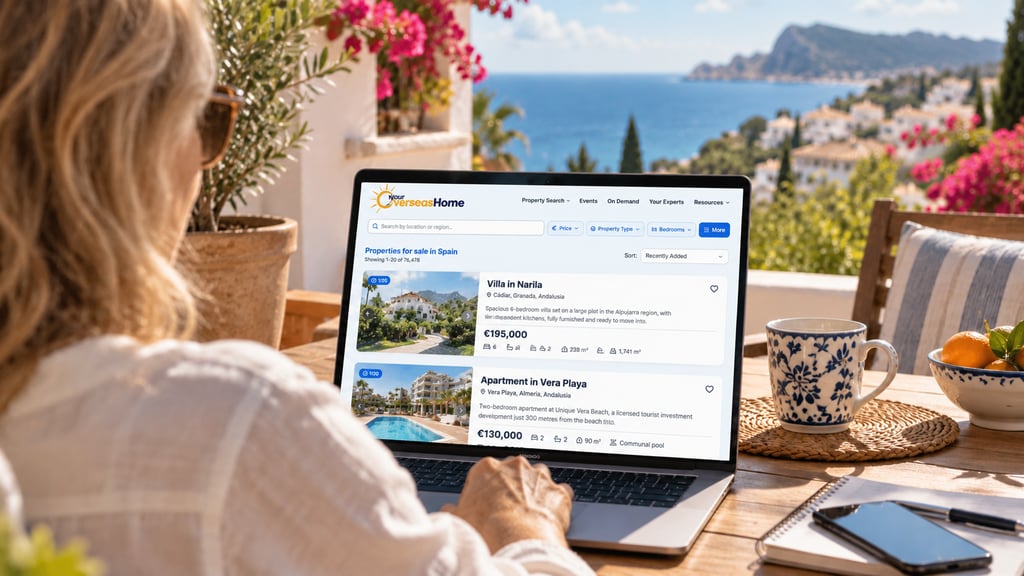
Take a question that sounds simple: Can I get Spanish residency by buying a property?
For years, Spain offered an investor residence route through qualifying investment, including property. That answer is now out of date. Spain’s investor residence provisions were removed with effect from 3 April 2025.
Our current guide to buying property in Spain reflects the position: buying a home no longer opens a residency route by itself.
First, ask for the current rule, not a general explanation. Include the country and your nationality. Add the date you need the information to be correct for.
Second, ask for the legal or government source and its effective date. Then open it. In this case, Spain’s official state gazette shows that the relevant investor residence articles in Law 14/2013 were left without content from 3 April 2025.
Third, separate the general rule from your own eligibility. Other Spanish visa routes remain. The right one depends on factors such as income, employment, nationality and intended length of stay. That is where a visa specialist or lawyer earns their fee.
The useful answer is not simply “yes” or “no”. It is an explanation you can audit.
How to make AI research more reliable
A few habits improve the quality of the output considerably.
Give it the material you trust
If you have an official government page, YOH buying guide, property particulars or notes from an adviser, give them to the tool and tell it to work from those materials. This narrows the room for invention.
Ask it to separate facts from assumptions
Weak parts of an answer become much easier to spot once the tool has to label them.
“List the facts supported by the sources, then list anything that is an estimate, inference or assumption.”
Put dates into the question
Rules change. Adding a date forces the tool to deal with that explicitly rather than treating an old answer as current.
“What’s the current transfer tax in this region as of September 2026?”
Ask for the source that governs the claim
A newspaper article summarising a tax change is not the tax authority. A relocation blog describing a visa is not the immigration authority. Ask for the primary source, then open it and check the claim yourself.
Primary source firstUse it to improve the human conversation
This is often where AI provides the most value. Ask it to turn a guide into ten questions for your viewing trip, identify missing information in a listing or help you prepare for a meeting with your lawyer, agent or adviser.
Use AI to arrive better prepared, not to remove the person responsible for the answer.
What AI cannot replace
A property purchase eventually stops being a research project and becomes a transaction. Somebody then needs to inspect title, planning history, ownership and the contract. Tax and visa advice may depend on your personal facts.
That gap came up unprompted in a July 2026 interview with Gary, one of YOH’s partner estate agents in Spain. He had seen a developer promoting the idea that buyers could complete a property purchase through AI. His reaction was immediate:
“There was one developer, I can’t remember the name, but they were trying to put on their website ‘you can buy this apartment with AI.’ It’s like, hold on a minute.”
For Gary, the missing part is the judgement and reassurance that build up through years of dealing with buyers and the local market:
“I mean, sometimes you can’t escape from the importance of experience that you guys have got, the experience that I’ve got in my work, because people want that, they need that reassurance.”
He also contrasted a relationship-led introduction with simply receiving a name and email. What helped, he said, was getting “a lot more information about what the clients are looking for”, so the relationship starts with context rather than from scratch.
AI cannot see the things that never make it onto a webpage either. A boundary may be wrong, building work may not match the paperwork or a local professional may know why an earlier sale collapsed.
Most importantly, AI carries no professional responsibility for the outcome. If you need advice that applies to your transaction, you can find an overseas property expert through Your Overseas Home.
What should I do next?
Still researching: use AI to organise the material rather than replace it. Start with current country guides, official sources and property listings, then ask the tool to compare what you have and identify gaps.
Planning a trip: download the overseas property viewing trip guide, then use AI to turn it into a checklist for your own locations, budget and priorities.
Close to making an offer: move from general research to named professionals. Confirm legal, visa and tax questions with the relevant specialist and use current figures when planning your currency transfer.
Find a webinar for your plans
Choose what you need help with and when you want to attend. We will take you straight to the most relevant upcoming events.
Summary
AI can save a great deal of time when you are researching property abroad.
It is particularly good at organising information, comparing material you provide, explaining unfamiliar terms and preparing better questions.
Current AI tools can also search the web and cite sources, which makes them more useful for up-to-date research. It does not remove the need to check those sources.
In YOH’s 2026 buyer survey, 13.7% of respondents selected AI as one of the best sources of information and help. Guides and trusted professionals were selected by roughly two-thirds.
The useful middle ground is clear: let AI help you understand the information and work out what to ask next. Let the official source or accountable professional provide the answer when money, legal rights or a property transaction turns on it.
Frequently asked questions
It can outline how a route generally works, which is useful background. It is not reliable on whether that route is still open, on the current income threshold, or on which rules apply to your nationality. Spain’s investor visa is the obvious trap, having closed to new applicants in April 2025. Check any visa question against the government page, then confirm with an immigration lawyer.
Only as a rough shape. Transfer tax, notary fees and registration costs vary by region and property type. Rates also change with each budget. A single national percentage is usually an average that will not match your purchase. Use AI for the list of costs you should expect, then get actual figures from your lawyer or from the tax authority’s own tables.
For gist, yes. Pasting a clause to understand roughly what it covers before your lawyer explains it is a reasonable use. Signing anything on the strength of a machine translation is not. Legal terms rarely map cleanly between languages, and a small mistranslation in a completion clause or a penalty term can be expensive. Your lawyer should translate and explain anything you sign.
Look for three things. Does it name the specific law or authority, give the date the rule took effect, and link to a source you can open? An answer missing all three is a guess. Two tools disagreeing on the same question is another useful warning that you need professional advice.
Sources
- Your Overseas Home Annual Buyer Survey 2026. Default analytical sample: 1,107 deduplicated, external, completed respondents. Fieldwork 16 June to 6 September 2026. Information-source question was multi-select. Legal-concern comparison uses prospective respondents who answered that question.
- National Institute of Standards and Technology, Artificial Intelligence Risk Management Framework: Generative Artificial Intelligence Profile – confabulation and misleading citations: https://nvlpubs.nist.gov/nistpubs/ai/NIST.AI.600-1.pdf
- OpenAI Help Center, Searching the web with ChatGPT – current web search, citations and source-checking guidance: https://help.openai.com/en/articles/9237897-chatgpt-search
- Anthropic Help Center, Enabling and Using Web Search – web search, citations and verification guidance: https://support.anthropic.com/en/articles/10684626-enabling-and-using-web-search
- Boletín Oficial del Estado, Law 14/2013 consolidated text – investor residence provisions left without content with effect from 3 April 2025: https://www.boe.es/buscar/act.php?id=BOE-A-2013-10074