



Buying a home in Spain starts with a picture in your head – the terrace, the view, the life you’ll build there. But before any of that becomes real, you’ll come across a run of unfamiliar Spanish property terms: NIE, notario, escritura, catastro. Each one sounds official and slightly alarming, and each one carries a cost or a consequence if you get it wrong.
The good news is that none of it is as complicated as it first looks. Once you know what each term means and when it turns up, the buying journey becomes far easier to follow.
In short: This guide explains the main legal, tax and administrative terms a foreign buyer encounters when purchasing property in Spain. It applies to residents and non-residents alike. Rates and fees vary by region and change over time, so treat every figure as illustrative. The key point: understand the term, then confirm the current detail with a professional before you sign.
Download the Spain Buying Guide
Contents
Your identity and your team
NIE (Número de Identidad de Extranjero)
The NIE is your foreigner identification number in Spain, and it’s the first thing you’ll need. It’s a personal, unique number the Spanish authorities assign to foreigners with economic, professional or social interests in the country, and it appears on every official document you’re issued.
You can’t buy property, pay purchase taxes, connect utilities or open most bank accounts without one. You apply using form EX-15 plus the associated fee slip, either in Spain through a Policía Nacional or Oficina de Extranjería office, or from abroad through a Spanish consulate. Many buyers ask a representative to handle it under power of attorney.
Notario (notary)
The notario is a public official who oversees the signing of your purchase and confirms it’s legal. In Spain the notary is impartial: they act for the transaction itself, not for the buyer or the seller.
They verify identities, check the property’s registry position, confirm whether there are outstanding debts and formally record the sale. You have the right to choose your own notary, and you can review the deed in the days before signing.
Gestor and gestoría
A gestoría is an administrative agency, and a gestor is the professional who runs your paperwork through Spain’s public offices. They’re not lawyers, but they handle the practical filing: tax forms, catastro changes, utility transfers and NIE applications.
Many buyers find a gestor smooths the process considerably, especially when documents need submitting to several offices at once. It’s worth speaking to a specialist lawyer too, for the legal checks a gestor doesn’t cover.
Speak to a Spain property expert
The documents that prove ownership
Escritura pública (public deed)
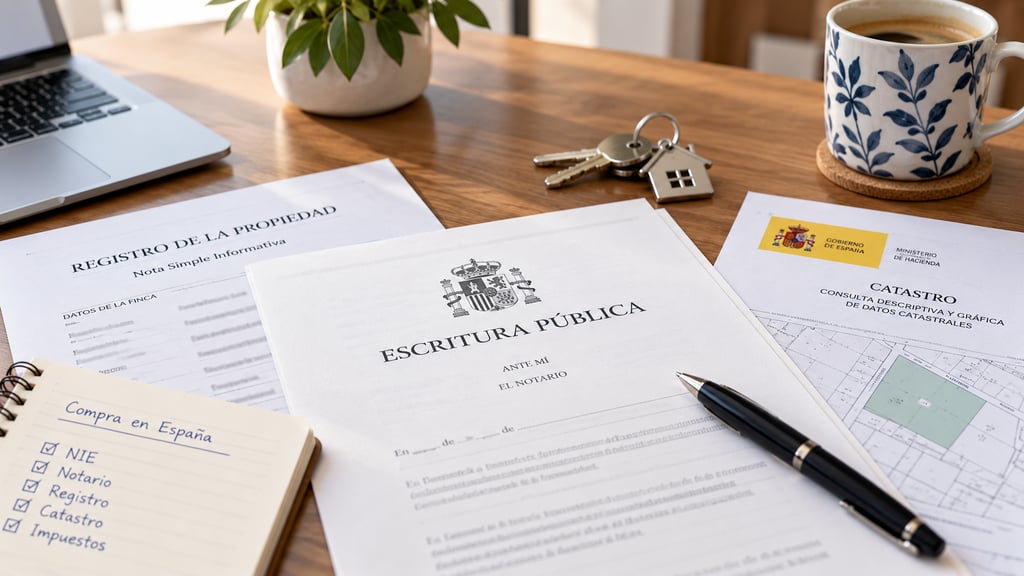
The escritura pública is the notarised deed that formalises the sale. It isn’t strictly obligatory to put a sale into a public deed, but the Consejo General del Notariado advises it strongly, because it gives you the strongest legal security available under Spanish law.
The notary keeps the original in their protocol and issues authorised copies. After signing, the notary sends an electronic copy to the property registry so ownership can be recorded.
Registro de la propiedad (Land Registry)
The registry is the official record of who owns each property and what charges sit against it. It’s overseen by the Ministry of Justice through Registradores de España, and it certifies ownership, mortgages and other rights.
Registering your purchase isn’t legally compulsory, but it protects you against third parties and is standard practice. Your notary typically lodges the deed for you after signing.
Nota simple
The nota simple is a short informative extract from the registry. It shows who owns the property, its description, and any charges such as mortgages, embargoes or easements.
It has informative value rather than the full legal force of a registry certification, but it’s the document buyers and lenders rely on before committing. Many buyers request one early, and it’s sensible to ask for a fresh copy shortly before signing.
Catastro (Cadastre)
The catastro is a separate administrative register run by the Ministry of Finance through the Dirección General del Catastro. It describes each property physically – its location, boundaries, surface area and use – and assigns a valor catastral (cadastral value) used to calculate taxes.
The distinction matters: the catastro deals with the physical and fiscal description of a property, while the registro deals with legal ownership. The two don’t always match, and reconciling any discrepancy is something to raise before you sign. You can look up basic catastro data free at the Sede Electrónica del Catastro.
The agreement before completion
Contrato de arras (deposit contract)
The arras contract is the private deposit agreement many buyers sign to reserve a property before completion. The most common form is arras penitenciales under article 1454 of the Código Civil.
Under this type, if the buyer pulls out they lose the deposit, and if the seller pulls out they must return double. The deposit is often around 10% of the price. It’s worth having the contract checked before you sign, because the exact wording decides what happens if either side walks away.
The taxes and fees you’ll pay
Spanish property taxes are split into two groups: the ones you pay when you buy, and the ones you pay every year as an owner. Almost all of them vary by autonomous region or municipality, and they change periodically, so the figures below are illustrative only.
ITP (Impuesto sobre Transmisiones Patrimoniales)
ITP is the transfer tax you pay when you buy a resale home. It’s a state tax ceded to the autonomous regions, so the rate depends on where the property is.
As a guide, general rates in 2026 run from 4% in the País Vasco to 10–11% in Cataluña and the Comunidad Valenciana, with Madrid at 6% and reduced rates for some buyers. Since 1 January 2022 the tax base is normally the higher of the price paid or the catastro’s valor de referencia. You usually have 30 business days from signing to file and pay.
IVA and AJD (VAT and stamp duty)
If you buy a new build directly from the developer, you pay IVA instead of ITP. The general rate is 10% of the price, with a reduced 4% for certain officially protected housing.
New builds also attract AJD, the stamp duty on notarised documents, which each region sets, typically between 0.5% and 1.5% – for example, Madrid’s general rate is 0.75%. IVA and ITP are mutually exclusive – one purchase never pays both.
IBI (Impuesto sobre Bienes Inmuebles)
IBI is the annual local property tax, charged by the municipality where the property sits. It’s calculated from the valor catastral and a rate set by the town hall.
The owner on 1 January is liable for that whole year’s bill. When you buy, it’s sensible to check the seller has no outstanding IBI, because unpaid amounts can attach to the property.
Plusvalía municipal
The plusvalía municipal – formally the Impuesto sobre el Incremento de Valor de los Terrenos de Naturaleza Urbana (IIVTNU) – is a local tax on the increase in the land’s value while the seller owned it. It’s charged by the town hall and applies to urban land only.
The seller normally pays it, and buyer and seller can privately agree to build this into the price. But there’s an important exception: if the seller is a non-resident in Spain, the law makes the buyer the substitute taxpayer, directly responsible for filing and paying the tax to the town hall, regardless of any private agreement between the parties. Since a 2021 reform the tax is only due where the land has actually risen in value, and there are two calculation methods, with the taxpayer able to choose the more favourable one.
IRNR (Impuesto sobre la Renta de no Residentes)
If you own a Spanish home but aren’t tax resident in Spain, you fall under non-resident income tax. Even if you never rent the property out, you must declare an imputed income each year simply for having it available.
The base is 1.1% of the valor catastral where that value has been revised under a general valuation within the last ten tax periods, or 2% otherwise. That base is then taxed at 19% for residents of the EU or EEA and 24% for everyone else – which, since Brexit, includes UK residents. It’s declared annually, and this is an area where a fiscal specialist earns their fee.
Summary of the main terms and when they apply
| Term | What it is | When it applies |
|---|---|---|
| NIE | Foreigner ID number | Before you buy anything |
| Notario | Impartial public official | At signing |
| Escritura pública | Notarised deed of sale | At signing |
| Nota simple | Registry extract of ownership and charges | During due diligence |
| Catastro | Physical and fiscal property register | For valuation and taxes |
| ITP | Transfer tax on resale homes | On buying a resale |
| IVA and AJD | VAT and stamp duty on new builds | On buying new from a developer |
| IBI | Annual local property tax | Every year as owner |
| Plusvalía municipal | Local land-value gain tax | On sale, usually paid by seller |
| IRNR | Non-resident income tax | Every year if you’re non-resident |
Two more terms worth knowing
Two documents round out the picture. The certificado de eficiencia energética (energy performance certificate) is required to sell or let a home, and the seller must provide it. And when the seller is a non-resident, the buyer must retain 3% of the price and pay it to the tax office within one month of the deed, as an advance on the seller’s tax.
What should I do next?
If you’re at the beginning of your buying journey, here are a few starting points: You can browse the latest Spanish property listings to get a feel for prices and areas. Many buyers find it helps to join our next Spain webinar and put their questions to experts and people who’ve been through the process themselves. And because the currency side affects your budget as much as the taxes do, it’s worth speaking to a currency specialist early – our guide Currency Transfer and Property Purchases Explained is a good place to start.
Summary
Buying in Spain means learning a handful of new terms, but each one has a clear job. The NIE gets you into the system, the notario and escritura make the sale official, and the nota simple, catastro and registro tell you what you’re actually buying. On the money side, ITP or IVA and AJD apply at purchase, while IBI and – for non-residents – IRNR return every year. The plusvalía usually falls to the seller. None of it needs to be daunting once you know when each term appears, and a good lawyer and gestor will carry most of the load. Do confirm the current rates for your region before you sign, because they change.
FAQs
The NIE is your foreigner identification number, and yes, you need one to buy. Without it you can’t pay purchase taxes, sign the deed at the notary or set up utilities. You can apply in Spain or through a Spanish consulate abroad.
The notario is an impartial public official who confirms the sale is legal, checks the property’s registry position and any debts, and formalises the deed. They act for the transaction, not for one side, and you can choose which notary to use.
The catastro describes the property physically and sets its cadastral value for tax. The registro records legal ownership and any charges. One is about the bricks, the other about who owns them, and the two don’t always agree.
You pay ITP on a resale home, and IVA plus AJD on a new build bought from a developer. The two are mutually exclusive. Rates vary by region and change periodically, so check the current figure before you budget.
The seller normally pays this local land-value tax, although the parties can agree otherwise in the contract. Since the 2021 reform it’s only due when the land has genuinely risen in value