
France is attracting everyone from retired couples seeking a healthier lifestyle to solo movers ready for a new adventure. The latest Your Overseas Home buyer survey reveals who is planning a life in France, where they want to settle and the worries they need to overcome.
What makes someone decide that the next chapter of their life should be in France? Is it the thought of a stone cottage surrounded by countryside, a village where you can walk to the bakery each morning or simply the chance to do something entirely different?
It’s all of that, and more, according to the Your Overseas Home Annual Buyer Survey 2026. But as well as those ‘pull factors’, there are plenty of things pushing us to France too, including politics, and finances.
See why so many of us are looking to buy in France and what we’re looking for. Are your own motivations and plans the same?
About our buyer survey
Since 2017 we have been surveying the international buying public in depth. Why? Because we know that buying your very own overseas home, either as a holiday home or for your main property, is about the most exciting thing you can do with your hard earned money. But it’s a big step, and not always easy.
So we want to help. And the first step in that is understanding where buyers need and want help.
Over the past decade we have had approaching 50,000 responses to our surveys, including well over 10,000 from our France readers. That gives us a unique insight into the needs of the overseas buying public.
In the 2026 survey France was the most popular first-choice destination. A quarter of our readers were choose Spain, slightly ahead of Spain.
So, what do those France-bound respondents actually want?
They’re dreaming of healthier lifestyles, gardens, village communities and countryside homes. Some are retiring, others intend to continue working and a surprisingly large proportion are planning to go it alone.
And while they’re enthusiastic about the prospect of a French life, many are understandably nervous about the paperwork involved in making it happen.
Why do people want to move to France?
For people planning to retire in France, the biggest attraction is the opportunity to live more healthily.
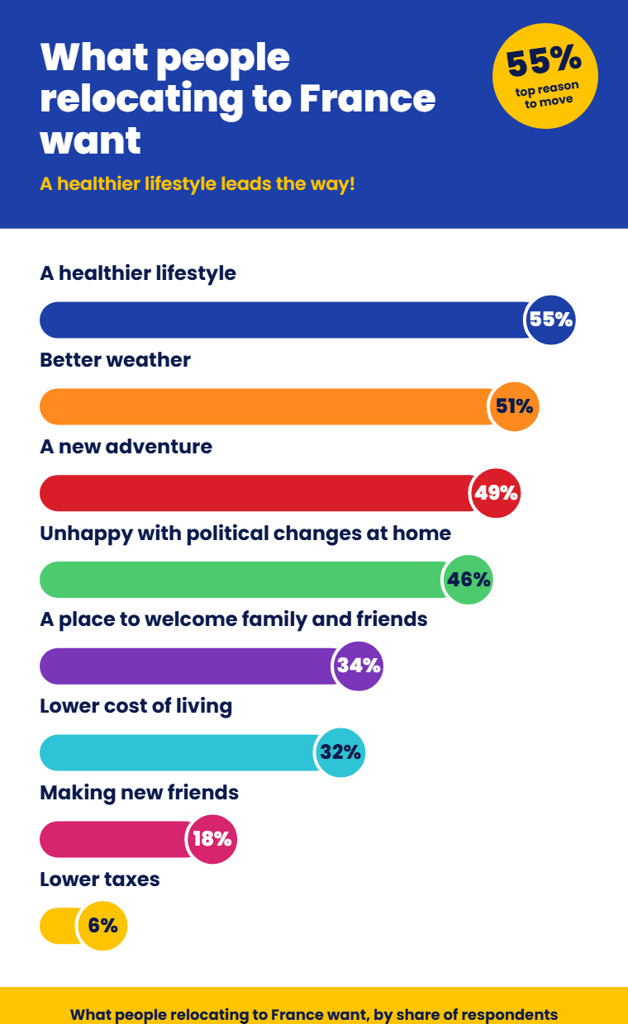
Among the France-bound retirement respondents, 55% selected a healthier lifestyle as a reason for their move.
Better weather came next, selected by 51% of respondents, while 49% were looking forward to a new adventure.
But it wasn’t just about the ‘dream’. Almost as many selected unhappiness with recent political changes in their home country. Of course, France has its own problems, but the results suggest that moving to France is as much about what people hope to gain as what they would like to leave behind.
Financial considerations are certainly part of the picture, but they aren’t necessarily the driving force.
A lower cost of living was selected by 32% of retirement respondents, but it’s probably just as well that we’re not going there for lower taxes – just 6% mentioned lower taxes.
For many, the attraction seems to be the opportunity to change how they spend their time, enjoy their surroundings and build a satisfying life in a new community.
It’s also worth remembering that this isn’t a new aspiration. France has long attracted people hoping to exchange their existing surroundings for a country home, village property or a base for exploring a different part of Europe.
What the 2026 findings reveal is how strongly health, personal fulfilment and the desire for change feature in those plans.
It’s not all about retirement
Retirees are the largest group among respondents actively planning to buy in France, but they’re far from the only ones.
Roughly half are planning to retire there, but almost a third want a holiday home and 18% intend to relocate without retiring. Very few are looking for a pure investment property.
That means a considerable number are looking for a French property while they still have working lives ahead of them.
And their motivations provide another interesting insight.
Among the non-retirement relocators, 71% want a healthier lifestyle, 60% a new adventure and 51% mentioned unhappiness with political changes at home. Better weather was a motivation for 43%. A few were moving with children, but more (20%) were moving on their own.
The rise of the solo expat in France
Indeed this one of the most interesting findings from the survey. It challenges the familiar image of a couple selling their family home and retiring together to the French countryside.
More than one in four (27.6%) retirement respondents choosing France planned to move alone. France had the highest proportion of solo retirement respondents among the six countries covered by the survey. Across all destinations, the equivalent figure was 65 of 313 respondents (20.8%).

That raises some interesting questions about what solo movers are looking for.
Without a partner to share the costs and responsibilities of a move, finding the right property, managing finances and establishing a social network may take on particular importance.
A village home with shops, cafés and neighbours nearby could offer a different experience from an isolated farmhouse several kilometres from the nearest town.
And for someone making a move alone, being able to get out, meet people and become part of the community may be every bit as important as the property itself.
These are potential considerations rather than reasons established by the survey, but they’re worth thinking about when deciding where to settle.
The French countryside still has enormous appeal
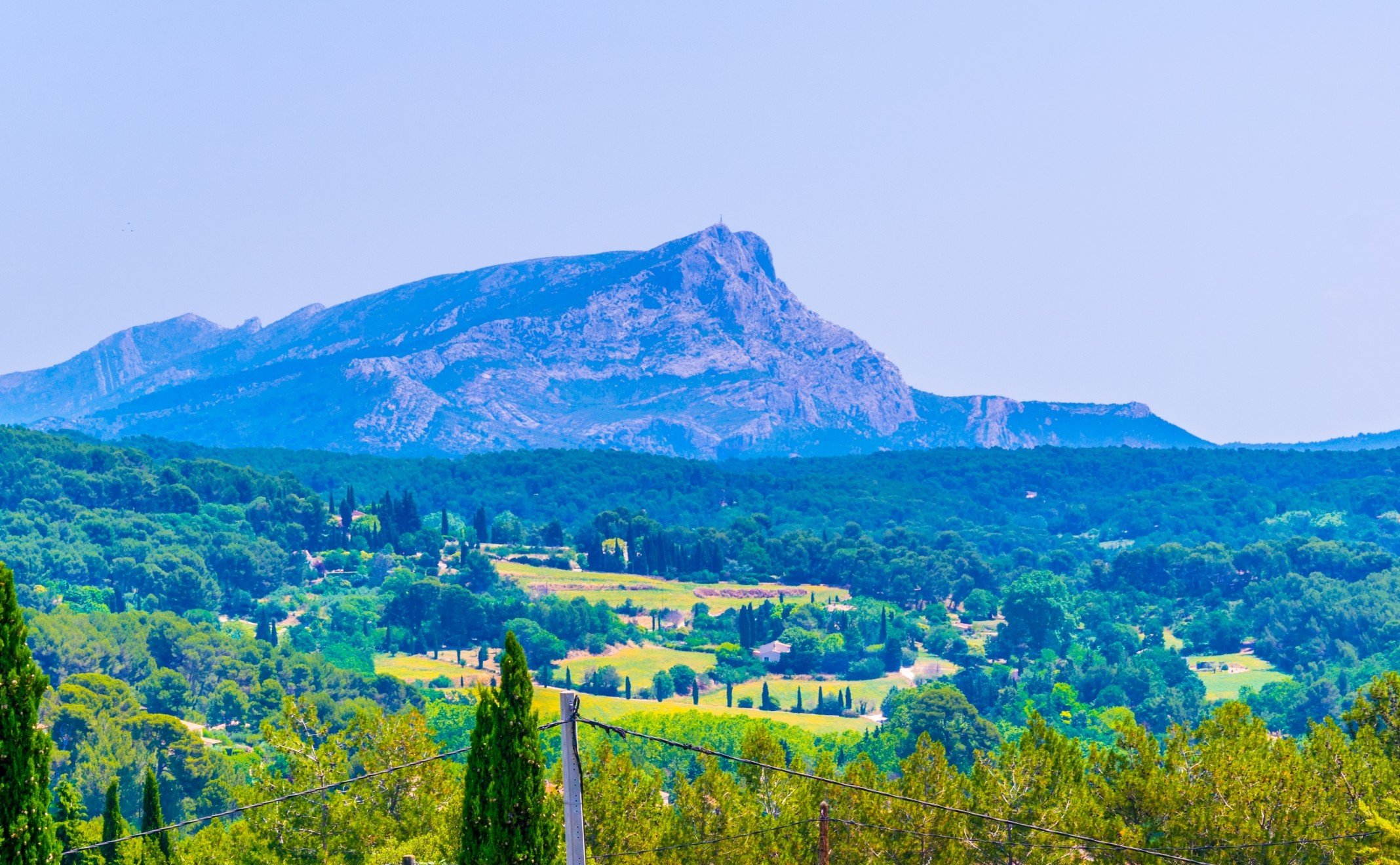
If the survey is anything to go by, the traditional dream of a home in the French countryside is alive and well.
Among 250 respondents who told us their dreams and priorities for a property in France:
- 165 (66%) will consider a home in the countryside
- 151 (60%) will consider a village home
- 78 (31%) will consider a seaside home
- 43 (17%) will consider renovating a building
- 40 (16%) will consider a city apartment.
Respondents could choose more than one type of property, so countryside homes and village properties weren’t necessarily competing choices.
A house on the edge of a village, with a garden and open views but shops within walking distance, could satisfy both preferences.
And this is one area where previous surveys provide a useful comparison.
In the 2025 France survey, 299 of 469 respondents (64%) selected a home in the countryside and 273 (58%) selected a village home.
The 2024 figures were similarly strong, with 644 of 944 (68%) selecting a country home or cottage and 533 (56%) a village property.
For anyone picturing retirement in a rural farmhouse or a working life based in a French village, that appeal clearly remains.
Gardens, views and a bakery within walking distance
What features make a property especially appealing to someone moving to France?
The 2026 survey provides some revealing answers.
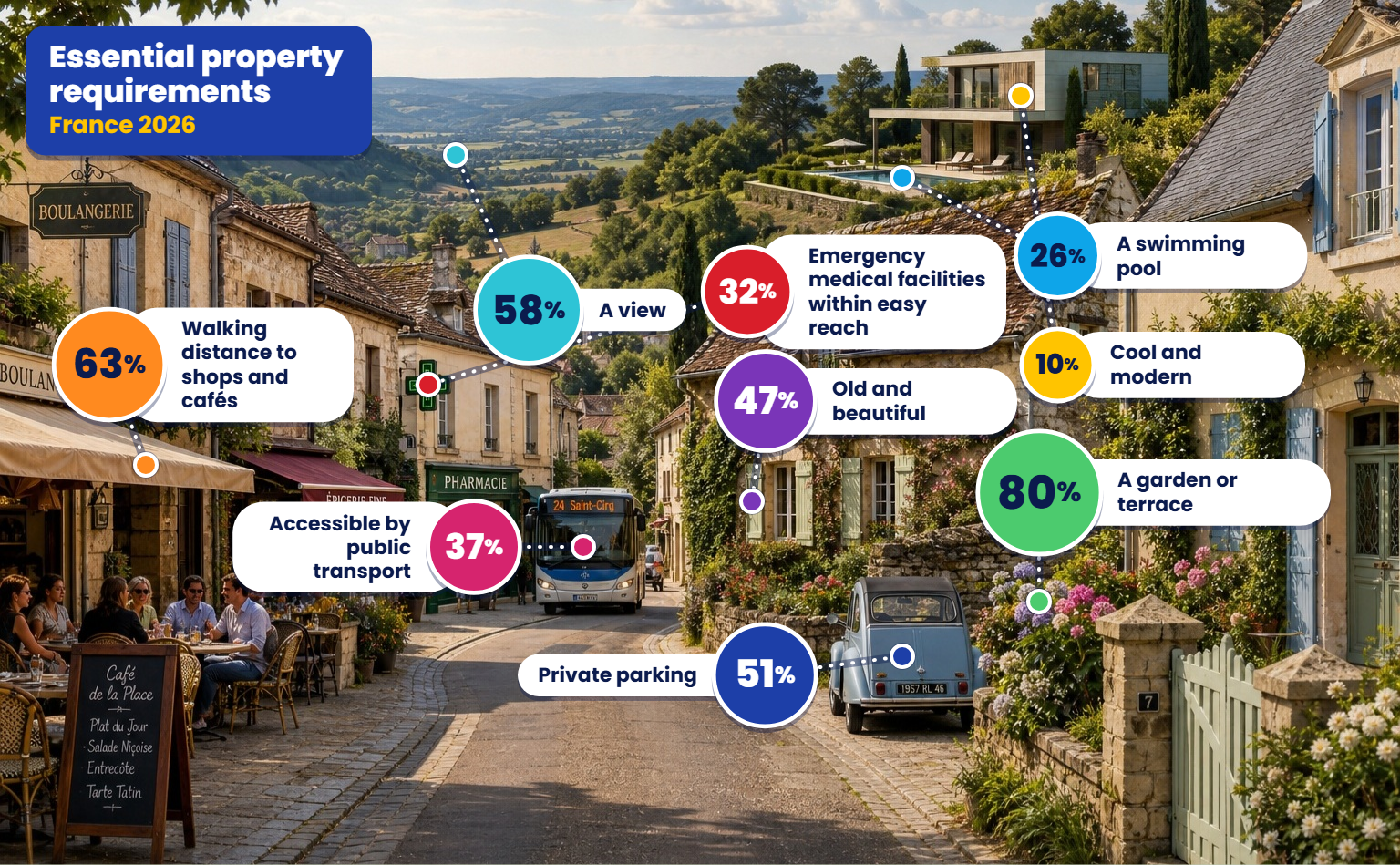
Among 250 prospective France respondents, 200 (80%) considered a garden or terrace essential.
But the second most popular requirement was more practical: 158 (63%) wanted to be within walking distance of shops and cafés. A view was selected by 145 (58%), but practicalities are important too, with private parking listed as essential by 127 (51%). Maybe the rise of electric charging vehicles makes that more important these days.
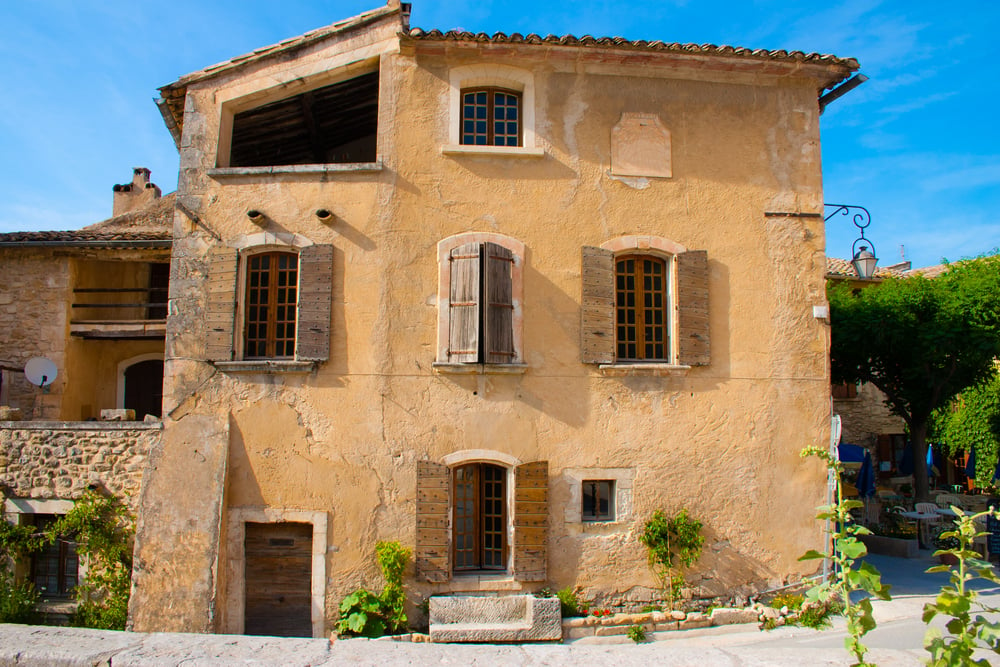
Almost half, 118 (47%), wanted a property they described as “old and beautiful” compared to fewer than 10% who wanted “cool and modern”. Interestingly, our buyers in Spain want the opposite (22% modern and 23% older).
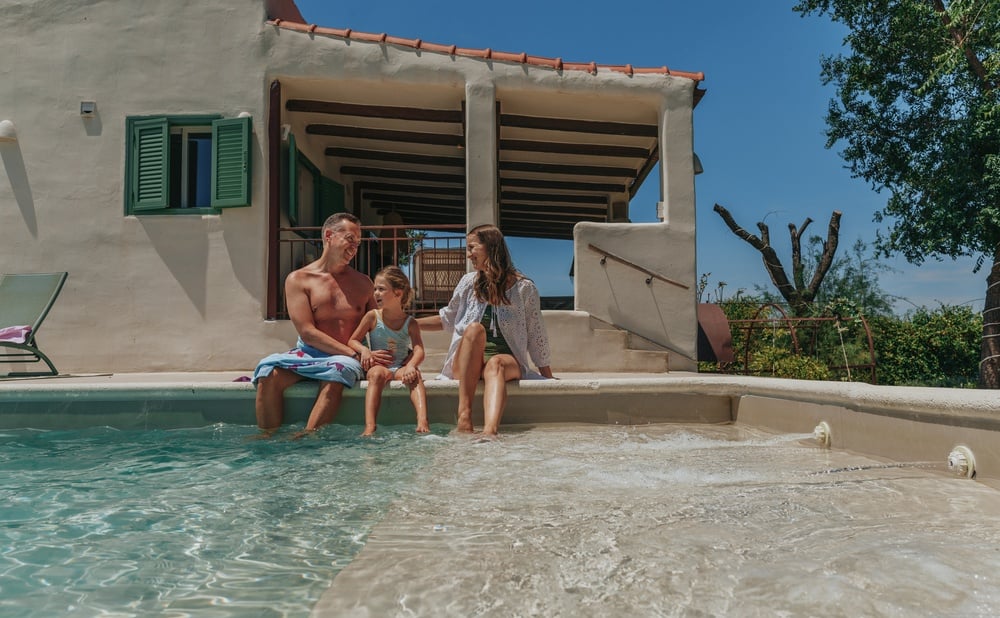
Meanwhile, only 26% considered a swimming pool essential. That might surprise anyone who assumes the typical overseas buyer is dreaming of a large villa with a pool.
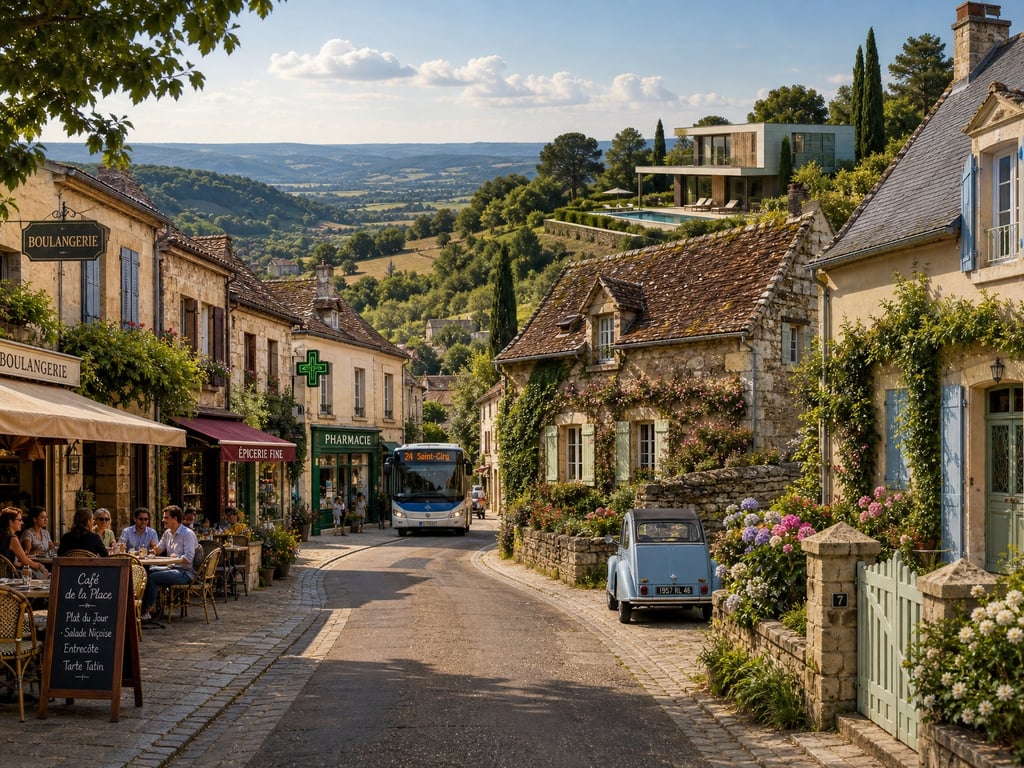
For France-bound respondents, everyday surroundings and practical convenience appear to carry considerable weight. Being able to walk to the boulangerie, shop locally or stop for a coffee without getting into the car may be part of the appeal.
Where in France do people want to live?
The south-west continues to attract considerable interest.
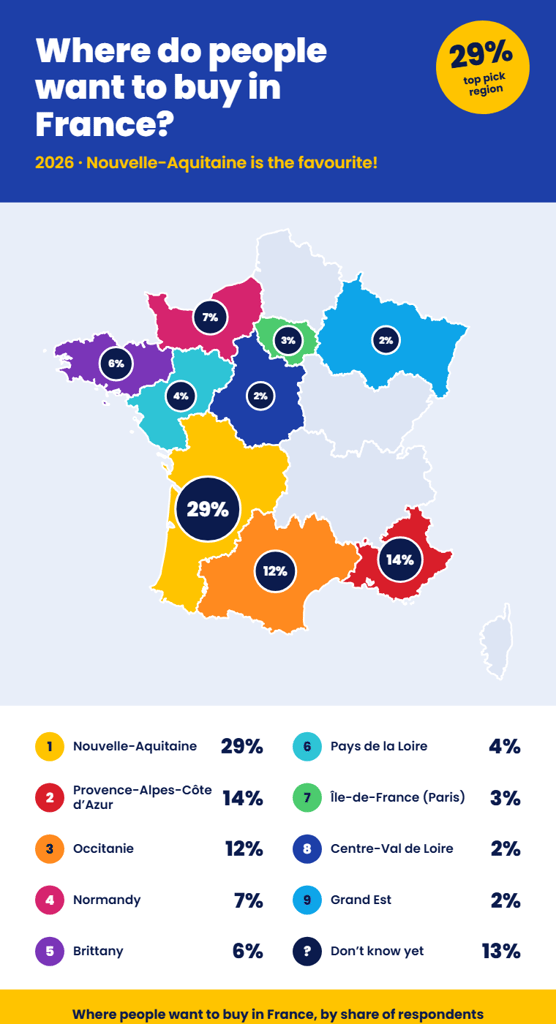
Of the 250 prospective France respondents who selected a preferred region in 2026, the most popular was Nouvelle-Aquitaine, chosen by 73 people (29%). The region includes the Dordogne, a longstanding favourite among British property buyers, as well as areas stretching towards the Atlantic coast.
Provence-Alpes-Côte d’Azur was next, selected by 14%, followed closely by Occitanie (12%). American buyers were far more likely to want to buy in Provence and the Riviera – so it’s good luck that they have bigger budgets too!
Normandy and Brittany were about like for like on about 8% each. Interestingly, 33 respondents (13%) said they didn’t yet know which region they preferred.
That suggests some buyers have decided on France before deciding on the particular place they would like to call home.
Previous surveys reinforce Nouvelle-Aquitaine’s appeal, which has generally been around 30%.
What can people afford when moving to France?
The dream of a French home doesn’t necessarily require a millionaire’s budget. Among 197 France-focused respondents buying a property in 2026, 137 (70%) selected a budget below €300,000.
That included 29 respondents (15%) budgeting under €100,000, 59 (30%) budgeting between €100,000 and €200,000 and 49 (25%) between €200,000 and €300,000.
At the other end of the market, 14 respondents (7%) had budgets of €500,000 or more.
Of course, what you can buy for those amounts varies enormously depending on the region, but the good news is the sensational properties you can still buy in France for less than €150,000.
Buying overseas: why the reality may be easier than you fear
Our biggest worries don’t relate to life in France, but about not being able to enjoy enough of it. Stresses over getting a visa and the 90-day rule being too limiting were in the top three, with concerns about the buying process splitting the two.
On the latter issue, the good news is that of those who had already bought, 87% said the process had been quite or very easy. So maybe we’re worrying too much.
Among 243 prospective respondents who provided an answer to the buying-concerns question:
- 45% were worried about getting a visa to live in France
- 37% were worried about the legal process of buying property
- 36% selected the 90-day rule limiting their time in France
- 30% were concerned about access to affordable healthcare
- 26% have not finalised where they want to buy.
For British citizens without EU residence rights, spending more than 90 days in France can involve different requirements depending on the circumstances and intended length of stay.
We started the survey in 2017, so we cannot know how people felt about moving before Brexit, but the numbers have been remarkably consistent since 2017. This is despite France being very easy to move to, especially as a retiree, with simple visa processes, low income requirements and a network of affordable professionals ready to help you.
So, who is moving to France in 2026 and 2027?
The survey paints a more varied picture than the familiar image of two retirees heading off to a French farmhouse.
Yes, retirement remains a major motivation. And many respondents still picture themselves in the countryside, perhaps in a traditional property with a garden and a view.
But France is also attracting people who want to move while they’re still working, people moving with children and a notable number taking on the adventure alone.
The age profile reflects the importance of retirement and later-life moves. Of all 281 respondents choosing France, 126 (45%) were aged 60–69 and another 66 (23%) were aged 50–59. Reflecting the fact that 70 is the new 60, more than one in five respondents were aged 70–80.
For these respondents, the aspiration is not simply to own a property overseas. It’s to enjoy life in a different setting, make the most of their retirement, have the opportunity to explore and find a home that supports the way they want to live.
And the property wish lists provide perhaps the clearest indication of what that means.
A garden, a view, somewhere attractive to live – but also shops nearby, access to services and the ability to become part of a community.
For those making plans to move in 2027, the message is encouraging: there’s no single way to build a life in France.
Whether you’re retiring with your partner, moving alone, relocating with children or planning a new working life abroad, the starting point is understanding what you want from the experience.
Then comes the practical work of finding the right place, making the finances add up and getting the paperwork in order.
The Your Overseas Home Annual Buyer Survey 2026 ran from 16 June to 6 September 2026 and included 1,107 unique, external, completed respondents. France was the first-choice destination for 281. Results are from a self-selected survey, not a representative poll of all overseas property buyers. Bases vary by question and journey, and respondents could select more than one answer to many questions. Historical comparisons are descriptive, with differences in survey design and recruitment taken into account.