
The other morning, I realised I’d become just a little bit French.
By half past seven (way before the time I usually roll out of bed!), I was hurrying round the house closing windows and pulling the shutters almost, but not quite, shut before the sun came up. It wasn’t something I’d consciously decided to do. In fact, when I first moved to the south of France I thought my neighbours were slightly mad. They seemed to spend every beautiful summer morning shutting themselves indoors just as the weather was becoming perfect.
Coming from England, where a sunny day is treated as an unexpected gift that should be enjoyed immediately because it might be raining again by teatime, it made no sense at all. Our instinct is to fling open every window, throw the doors wide, drag a chair into the sunshine and congratulate ourselves on living in a country where, for one glorious afternoon, we might not need a jumper.
It took me the best part of a summer to understand that my neighbours weren’t trying to cool their houses down. They were stopping them getting hot in the first place, and there’s an important difference.
Closing out the sun
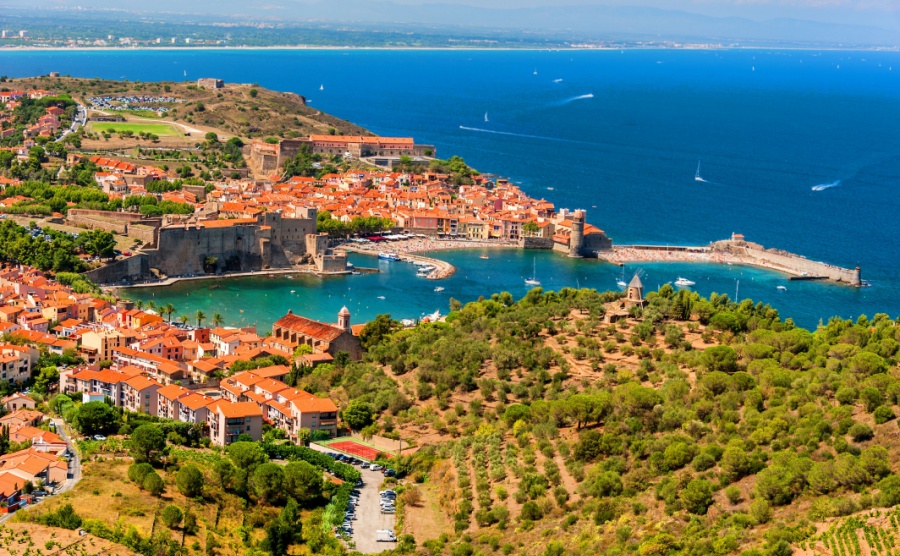
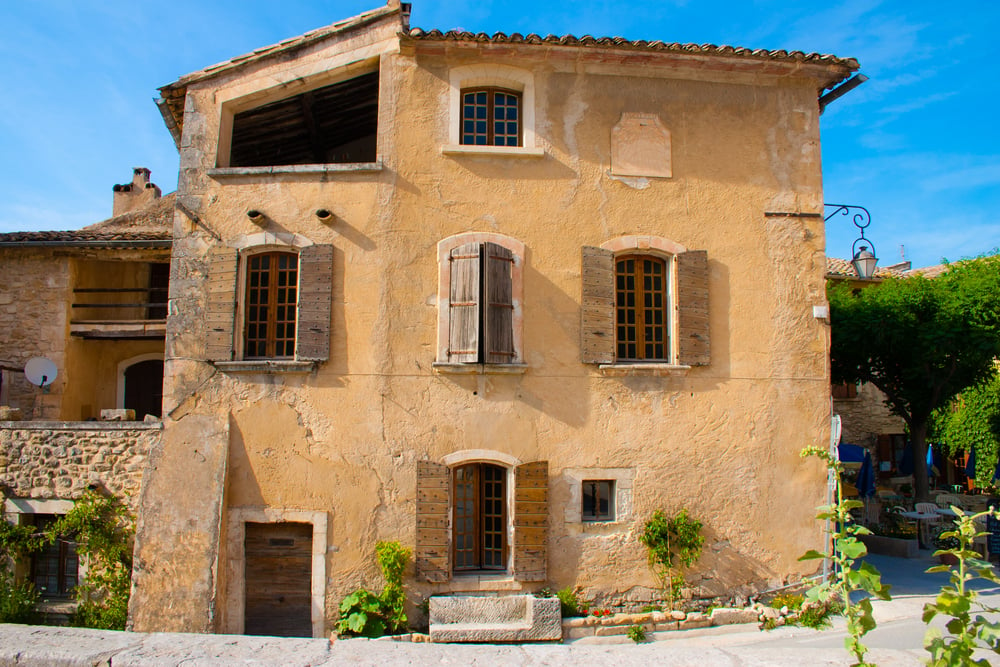
The house I bought in the Med was built in about 1870 by Italian stonemasons who came to the south of France looking for work. It sits above the bay with walls thick enough to make my wi-fi temperamental, and has windows set deep into the stone. I loved it from the first moment I saw it, although I doubt I fully appreciated just how intelligently it had been built. Long before anyone had heard the phrase “passive cooling”, people understood that if you shaded the windows, built with thick masonry and let the house breathe naturally, it would look after you remarkably well.
Most days it still does, and the sitting room remains comfortably around 20 degrees even when it’s 35 degrees outside.
Visitors often arrive expecting to walk into something resembling a pizza oven and are faintly surprised to find the inside pleasantly cool, even when the terrace is shimmering in the afternoon sun. They usually look around for the air-conditioning unit before realising there isn’t one.
The trick is almost embarrassingly simple. During the night, when the temperature finally drops, every window is opened to draw cool air through the house. Then, before the sun has much chance to warm the walls, everything is closed again. The shutters are left just far enough apart to allow a little soft light into the rooms, but not enough for the sun to turn the windows into greenhouse glass. Once I’d surrendered to this apparently illogical routine, I discovered that the house stayed comfortable for most of the day without any mechanical help whatsoever, even in rooms with single glazing.
It’s one of those pieces of common sense that somehow never occurred to me until I lived here. I’d always regarded shutters as decorative, rather picturesque additions to French houses that made photographs look attractive. Estate agents certainly encourage that impression. They speak about “authentic Provençal shutters” in the same reverential tone they reserve for exposed beams or original terracotta floor tiles. Now, if someone offered me the choice between shutters and air conditioning, I’d probably choose the shutters.
They consume no electricity, make no noise, never break down and probably save more energy over the course of a Mediterranean summer than most of us realise.
A question of air conditioning
Of course, even clever old houses have their limits. The summers I experienced when I first moved to France feel almost gentle compared with some of the recent ones. Heatwaves now seem to last longer, nights remain warmer and there comes a point when even those wonderfully thick stone walls begin to lose the argument.
Instead of cooling overnight, the house starts each morning a little warmer than the day before, and you find yourself opening windows at dawn with rather more urgency than enthusiasm, hoping to catch whatever cool air still remains before the sun begins climbing over the hills.
It is hardly surprising that France has found itself having an increasingly animated conversation about air conditioning.
For years there was something almost faintly disreputable about it. It was considered noisy, ugly and rather American, as though admitting defeat in the face of the climate. Traditional architecture had solved the problem centuries ago, people would argue, so why cover elegant old façades with humming white boxes? That confidence is beginning to waver.
A recent CNN article described the growing debate taking place across France as hotter summers become impossible to ignore. Sales of domestic air-conditioning units have risen sharply, yet so have concerns about the environmental consequences of relying on machines that consume electricity while pumping more heat back into already overheated streets. It’s an argument that seems peculiarly French, balancing practicality against aesthetics, environmental responsibility against personal comfort, and asking whether adapting old buildings is somehow preferable to adapting ourselves.
I’ve found my own views changing as well.
When I bought the house, I was determined not to install air conditioning. Partly because I didn’t want to spoil the building and partly, if I’m honest, because I rather liked the idea of living as previous generations had done. It appealed to my romantic side. I imagined that thick walls and shutters would always be enough because, for more than a century, they had been. I’m not quite so certain now.
Climate change has a habit of exposing the difference between nostalgia and reality. There are afternoons when I can understand perfectly why elderly neighbours have decided that discretion, in the form of a quietly humming air-conditioning unit tucked away where nobody notices it, is no longer a luxury but simple common sense.
I still think good design should come first, and I suspect France would be making a mistake if it abandoned centuries of intelligent architecture in favour of cooling everything mechanically, but I’m no longer convinced that installing air conditioning is somehow an admission of failure. Sometimes it’s simply another way of adapting.
Changing the timetable
Perhaps what has surprised me most is that adapting to the heat has very little to do with technology and almost everything to do with changing your habits. Builders start work early, gardeners seem to vanish by lunchtime and villages become noticeably quieter during the hottest part of the afternoon. The famous siesta is perhaps less dramatic than foreigners imagine.
Most people aren’t asleep. They’re simply doing things that don’t involve standing in full sun wrestling with a hedge or laying a patio. Paperwork, shopping, cooking, reading the newspaper, catching up with friends – anything that can be done indoors waits for the hottest hours, while physical jobs migrate to either end of the day.
Without really noticing, I’ve done exactly the same. Renovating an old house is wonderfully satisfying, but there are some jobs that become faintly ridiculous once the thermometer climbs into the mid thirties. Carrying roof tiles, mixing concrete, digging trenches or wrestling with old timber are all perfectly enjoyable at seven in the morning and thoroughly miserable at three in the afternoon.
These days I’m usually outside not long after first light, trying to accomplish everything that requires physical effort before the terrace becomes too hot to cross barefoot. By late morning I’m indoors writing, answering emails or working on whatever article happens to have a deadline attached to it. It isn’t laziness; it’s simply acknowledging that there are more intelligent ways to spend the middle of the day than trying to prove a point to the sun.
Summer on the table
The same quiet pragmatism extends to food. One of the pleasures of living in France is that the seasons still dictate what’s on your plate.
By the height of summer the markets are overflowing with peaches, apricots, nectarines, tomatoes, basil and melons so fragrant that the smell fills the car as you drive home. You don’t really feel like casseroles or roast dinners when it’s 36 degrees outside. Lunch becomes whatever is fresh, uncomplicated and requires as little cooking as possible. A tomato salad with good olive oil, a piece of grilled fish, perhaps some bread and cheese, followed by fruit that actually tastes as fruit should.
Dinner, of course, is another matter altogether. It drifts later and later as the summer progresses until nine o’clock feels entirely normal.
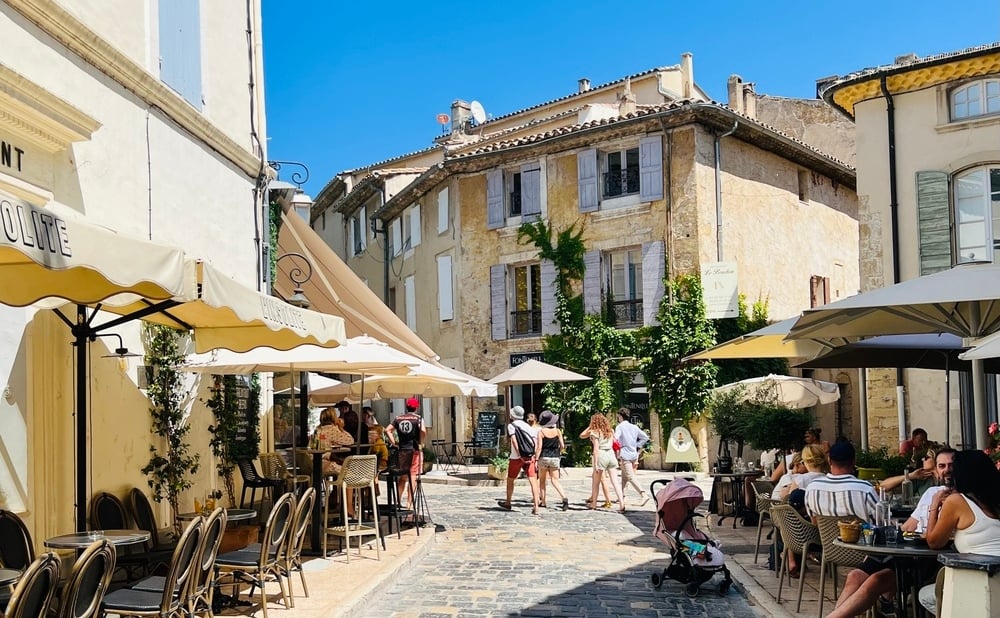
This puzzled me when I first arrived. Now I can’t imagine doing it any other way. By then the light has softened, the air has lost its edge and the whole village seems to emerge from behind its shutters. Children appear in the square, cafés begin to fill, neighbours wander out onto their terraces and conversations float through the evening air.
It feels less as though the day is ending than beginning again, and I often think that newcomers make the mistake of judging Mediterranean life at three in the afternoon, when in reality they should come back six hours later.
The dog’s new routine
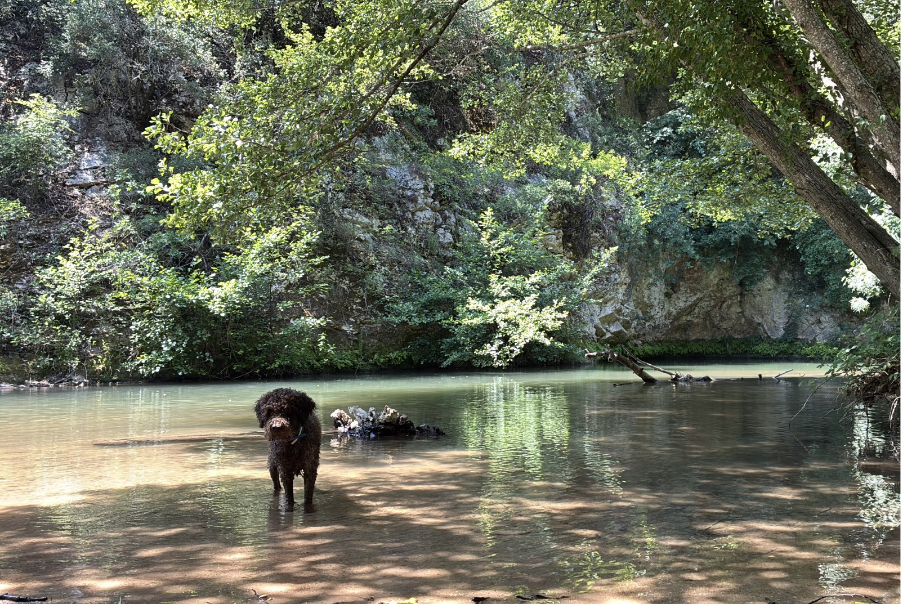
Then there is the dog. Poor Youna has many admirable qualities, but an ability to make sensible decisions in hot weather isn’t one of them. Like most lurchers, she possesses an almost touching optimism that every walk will involve a rabbit, a deer or something equally exciting. Left to her own devices, she’d probably chase wildlife until she collapsed.
That means it’s my responsibility to be the sensible one. During July and August our routine changes completely. Water becomes the objective rather than simply a pleasant discovery along the way. A stream where she can paddle for five minutes is worth more than any spectacular viewpoint, and I carry far more water than I imagine we’ll need because dogs, unlike people, are not especially good at recognising when enthusiasm should give way to self-preservation.
Gardening with the climate
Living here has also changed the way I look at gardens. Shade matters more than flowers. Trees matter more than lawns. Lavender, thyme, myrtle and olive trees aren’t simply beautiful; they’re survivors.
Increasingly, my own garden is moving in the same direction, not because I’ve suddenly developed impeccable Provençal taste but because I’ve realised that endlessly fighting nature is both expensive and exhausting.
What the French knew all along
That, perhaps, is the thread running through almost everything I’ve learned since moving here. The French aren’t necessarily any better at coping with hot weather than the rest of us. They seek shade, grumble about sleepless nights and discuss the forecast with exactly the same mixture of hope and resignation as everybody else.
The difference is that they don’t spend much energy pretending life can continue exactly as before. Houses are built differently. Gardens are planted differently. The day itself is organised differently. Even the current debate about air conditioning isn’t really about whether cooling is desirable but about how best to achieve it without abandoning the common sense that has served southern France remarkably well for centuries.