




Owning a home in France is a plan many UK buyers keep coming back to. But the French property buying process works differently from a purchase back home. That gap trips up buyers who assume it mirrors England and Wales.
The reassuring part is that the system is orderly and protective, once you know the order of play. This guide walks through each stage for 2026, from your first offer to the day you collect the keys. It also covers the costs and the one tax change worth knowing about this year.
In short: the French property buying process runs in two notarised stages. You sign a binding preliminary contract, the compromis de vente. The final deed, the acte de vente, follows about two to three months later. It applies to any buyer, resident or not. One caveat: budget for costs of roughly 7% to 8.5% on an older home. That figure nudged up in 2026.
Contents
The truth about buying a gîte and French residency
12 August at 5pm BST – 30 minutesThe French property buying process, step by step
Before the legal stages begin, most buyers do the groundwork. That means deciding on a region, setting a budget and lining up their team. Still weighing up locations? Our guide on where to buy property in France is a good place to start. You can also browse listings on our French property portal.
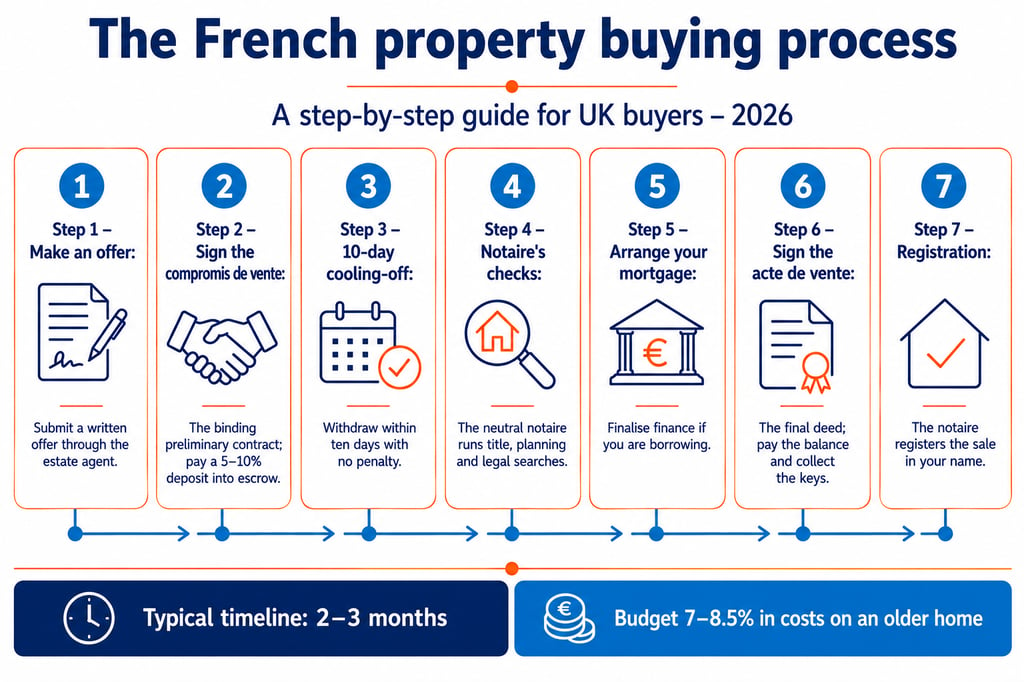
Once you have found the right home, the French property buying process follows a clear sequence:
- You make a written offer through the estate agent.
- You sign the preliminary contract, usually the compromis de vente, and pay a deposit into escrow.
- A ten-day cooling-off period runs, during which you can withdraw with no penalty.
- The notaire carries out title, planning and charges searches.
- You finalise your mortgage, if you are borrowing.
- You sign the final deed, the acte de vente, and pay the balance.
- The notaire registers the sale and you collect the keys.
For the wider view, see our overview guide on how to buy property in France. It runs from choosing an area to settling in. The sections below focus on the legal and financial stages in detail.
Making an offer (offre d’achat)
When you have found the right property, you make an offer through the estate agent. It is usually in writing, with any conditions you want attached, such as being subject to a mortgage. It is common to offer below the asking price. In a fast market, though, you may need to match or exceed it.
An important point of French law: no money should change hands at the offer stage. An offre d’achat can still become binding once accepted, so never sign one without your lawyer reading it first. If you would like an independent adviser in your corner, see our guide on finding a lawyer in France.
The compromis de vente and the ten-day cooling-off period

Once your offer is accepted, you sign a preliminary contract. For a resale home this is almost always a compromis de vente. This bilateral agreement commits both you and the seller, subject to any conditions written into it. In France, the saying goes that the promise to sell is as good as the sale.
A promesse de vente is the alternative. Here only the seller is committed. They reserve the property for you for a set period, and you hold an option to buy. You pay a holding sum, usually around 10%. You may forfeit it if you walk away for reasons outside the agreed conditions.
Either way, you get a statutory ten-day cooling-off period after signing. You can pull out during those ten days with no reason and no penalty. Any deposit is returned in full. The seller has no equivalent right, so once they sign they are committed. You can read the rule itself on service-public.fr and in the underlying law on Légifrance.
The notaire’s role, and your right to a second notaire
The notaire is a neutral public official, not your solicitor. They act for the transaction itself. That means drawing up the deed, running the legal searches and collecting the taxes for the state. One notaire commonly handles the whole sale while staying impartial between buyer and seller.
Here is a point many UK buyers miss: you can appoint your own second notaire at no extra cost. The two notaires share the same regulated fee. So instructing a second one to look after your interests does not increase your bill. For anything genuinely one-sided, you would still use a lawyer or specialist. Your own tax position or an independent survey are good examples. Notaire costs are the largest single line in your budget. For a full breakdown, see our guide to the costs of buying property in France.
Your deposit and the conditions suspensives
After the cooling-off period, you pay a deposit of typically 5% to 10% of the price. It goes into the notaire’s escrow account, not to the seller directly. It counts towards the purchase price at completion.
Your contract can include conditions suspensives, protective clauses that must be met for the sale to proceed. The most common is the mortgage clause. If your loan is genuinely refused, you withdraw and your deposit is refunded in full. Others cover planning searches and the local authority’s right of pre-emption. Never waive the mortgage clause if you are borrowing.
Both the deposit and the final balance are usually sent from a sterling account, so the exchange rate matters. Many buyers fix their rate at the compromis stage with a forward contract. This lets you lock today’s rate for a payment due months later. A currency specialist such as Smart Currency Exchange can set this up. They can also help your funds arrive on time for each deadline.
Buying costs in 2026, including the transfer-tax rise
Beyond the price, you should budget for purchase costs. The figures below are indicative bands, converted at roughly £1 to €1.17, the rate in mid-2026. Confirm the exact numbers with your notaire, as they vary by property and département.
| Cost | Older or resale home | New-build (Véfa) |
|---|---|---|
| Notaire fees (mostly tax) | Around 7% to 8.5% | Around 2% to 3% |
| Estate agency fees | 3% to 10%, often about 5%, usually shown in the asking price | Usually none for the buyer |
| Mortgage costs | Arrangement fee, valuation and compulsory loan insurance | As resale |
On an older home priced at €300,000 (£256,000), notaire fees work out at roughly €21,000 to €25,500. Despite the name, most of that is tax rather than the notaire’s own fee.
The change to note for 2026 is the transfer tax, the droits de mutation à titre onéreux. Under Article 116 of the 2025 Finance Law, most départements have raised their share by 0.5 of a point. That takes the total from about 5.81% to about 6.32% on older homes. The rise applies to deeds signed between 1 April 2025 and 31 March 2028. A relief exists for French first-time buyers of a main home. It does not apply to non-resident second-home buyers, so as a UK buyer you should assume the full rate. You can read the notaires’ own explainer on notaires.fr. There is more background in our guide to the increasing notaire fees in France. Official fee guidance sits on service-public.fr.
How long the process takes
From signing the compromis to signing the acte de vente, allow two to three months. That window covers the notaire’s searches, the pre-emption period and your mortgage approval.
Delays usually come from financing, missing copropriété documents, an expired diagnostic or, for overseas buyers, identity and document checks. A non-resident mortgage can add several weeks on its own. So start early rather than waiting until your offer is accepted.
Mortgages for foreign buyers
UK buyers can still borrow in France, though lenders are conservative. Most will lend up to about 70% to 80% of the value. Your total monthly debt, including any UK borrowing, should stay within roughly 35% of your gross income. As a non-resident you should expect to put down a larger deposit, commonly 20% to 30% or more.
French lenders ask for proof of identity and income, plus bank statements and tax returns. They also build in compulsory life insurance. Approval takes time, so a broker who knows the cross-border market is worth having. Our guide on how to find a mortgage broker in France explains what to look for.
Diagnostics and the DPE energy rating
The seller must supply a pack of technical reports, the dossier de diagnostic technique. They attach it to the compromis. Depending on the home’s age and location it can cover asbestos, lead, electrics, gas, termites and the energy rating. It is not a UK-style structural survey, so commission your own if you have concerns.
The energy rating, or DPE, matters more each year. A new calculation method from 1 January 2026 has improved the rating of many electrically heated homes. The government explains it on economie.gouv.fr. If you are buying an older home rated F or G, the seller must also provide an energy audit. You can still buy and live in a low-rated home. But letting one out is increasingly restricted, so factor renovation into your offer. If a renovation project appeals, see our guide on new build versus resale property in France.
Common mistakes to avoid
- Signing an offre d’achat or compromis without a lawyer reading it first.
- Waiving the mortgage clause to look like a stronger buyer, then losing your deposit if the loan falls through.
- Forgetting that notaire fees rose in 2026 and under-budgeting the transfer tax.
- Leaving the currency transfer to the last minute and being exposed to a rate swing on completion day.
- Overlooking French inheritance rules, which can decide who inherits your home. Our guide to French inheritance law explains why this matters for UK owners.
What should I do next?
If you are still choosing a region, browse listings on our French property portal. You can also download the free France Buying Guide. If you have found a property, line up your team before you make an offer. You will want an independent lawyer and, if you are borrowing, a mortgage broker. A currency specialist can then protect your budget between the compromis and completion. When you are ready, book a free consultation with one of our property experts. We will help you plan around your timeline.
Summary
The French property buying process is detailed but predictable. You make a written offer, sign a binding compromis de vente and pay a deposit into escrow. A ten-day cooling-off period protects you, and conditions suspensives let you withdraw if your mortgage is refused. The neutral notaire runs the searches, and you can appoint a second notaire at no extra cost. Completion follows about two to three months later at the acte de vente. Budget for costs of roughly 7% to 8.5% on an older home, and remember the 2026 transfer-tax rise. Fix your exchange rate early.
Frequently asked questions
Yes, there are no legal restrictions on foreigners buying property in France. However, it’s important to understand the legal and financial processes, especially around taxes and residency status.
The process typically takes between 2 and 3 months from offer acceptance to final signing (Acte de Vente). This may vary depending on whether a mortgage is involved or if the property is a new build.
Budget for roughly 7% to 8.5% on an older home, most of which is tax. Expect about 2% to 3% on a new-build. Estate agency fees are usually shown in the asking price. The 2026 transfer-tax rise means non-resident buyers should assume the higher end.
After signing the compromis de vente or promesse de vente, you get a statutory ten-day cooling-off period. You can withdraw during those ten days with no reason and no penalty, and any deposit is refunded in full.
Sources
- service-public.fr – promise to sell (compromis and promesse), verified April 2026.
- service-public.fr – notaire fees, updated September 2024.
- Notaires de France – transfer-tax (DMTO) increase, updated November 2025.
- economie.gouv.fr – new DPE from 1 January 2026.
- Légifrance – Article L271-1, ten-day cooling-off period.
- gov.uk – Living in France guidance for UK nationals, updated December 2025.