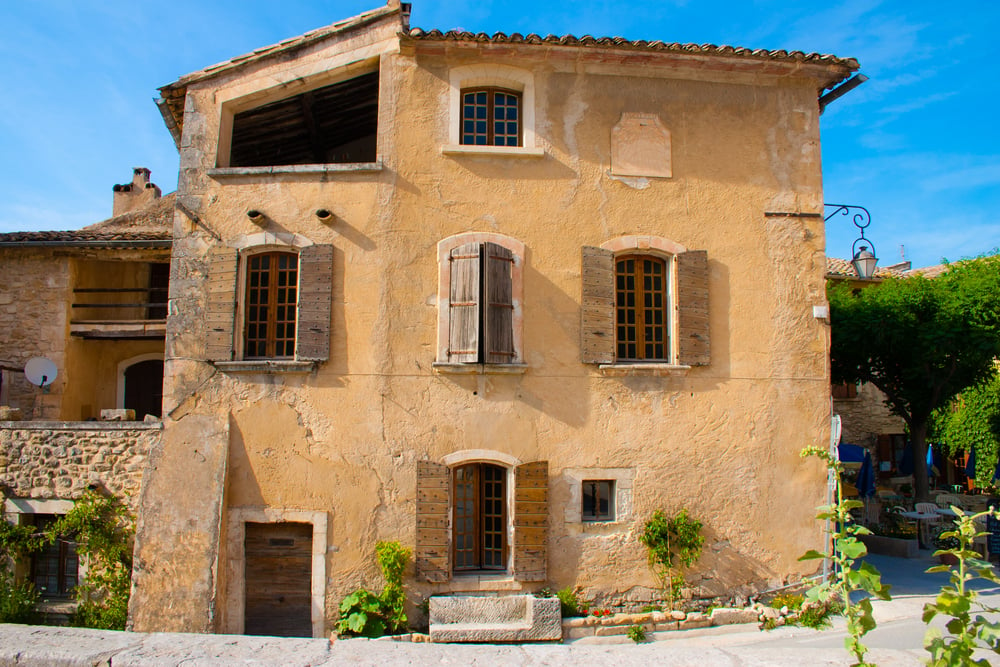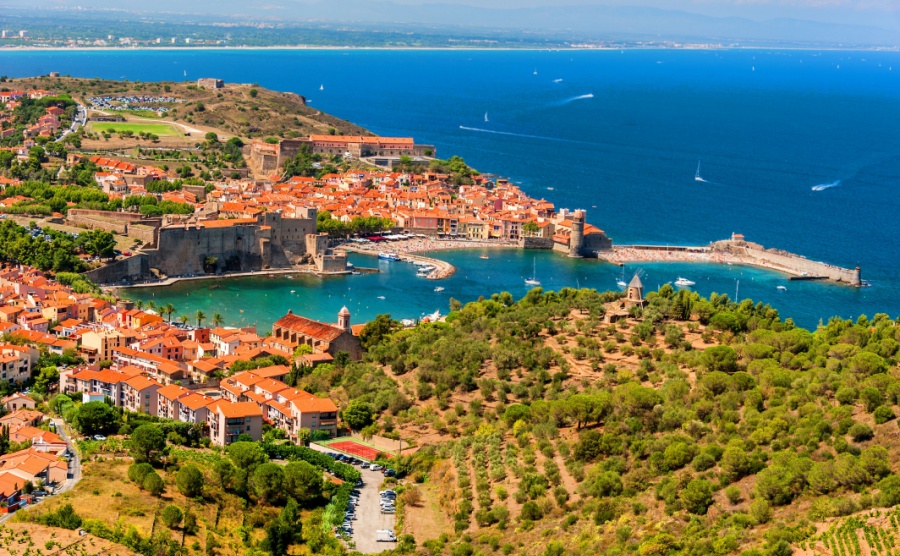




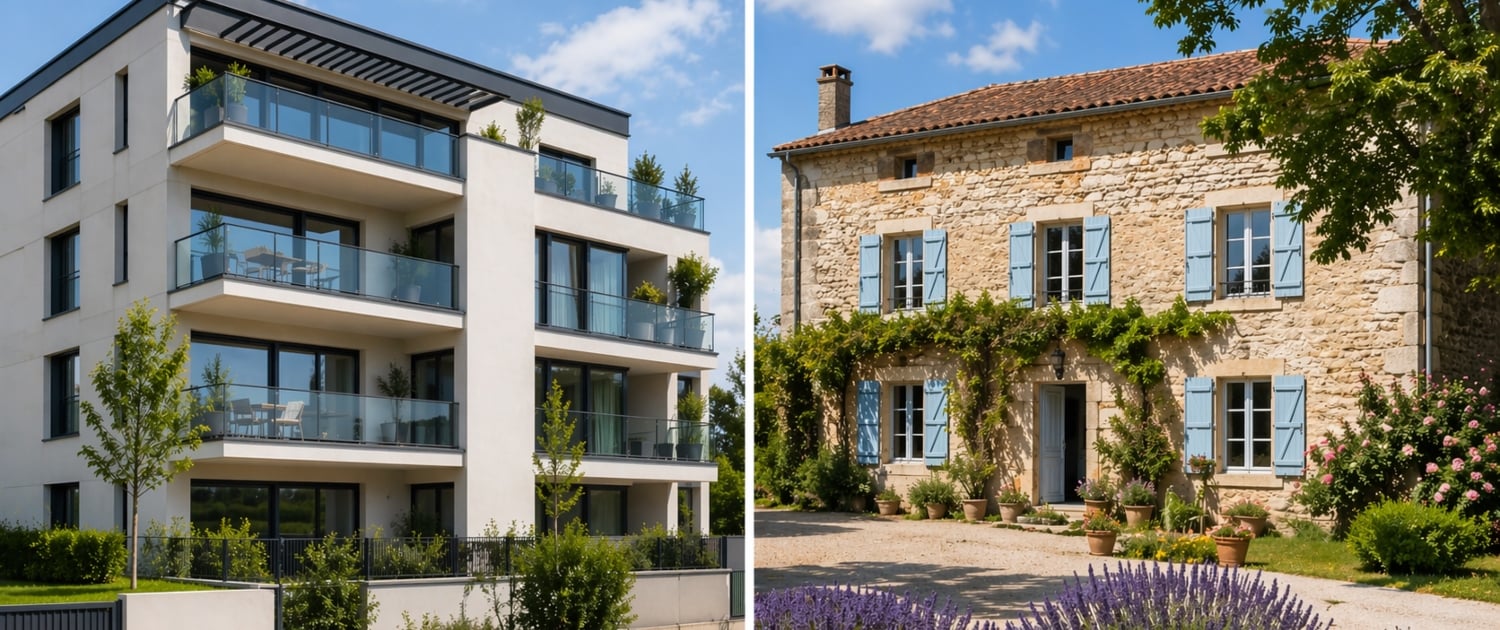
France draws buyers in with its stone farmhouses, market squares and centuries-old architecture. But the country’s new-build market is equally compelling – and in some regions it is the only realistic option. Whether you are searching for a ski apartment in the Alps or a rural retreat in the Dordogne, the choice between neuf (new build) and ancien (resale) shapes everything from what you pay at the notaire’s table to how the property is taxed, rented and one day resold.
The two paths are not equivalent alternatives. They follow different contracts, different timelines and different legal frameworks. A resale purchase in Normandy can complete within eight weeks. A new build in Val d’Isère may not be handed over for two years. Getting clear on the differences early will save you from a decision you didn’t fully understand.
Key points: Buying a new build in France typically costs around 2–3% in notaire fees compared with 7–8% for resale, a saving of roughly €15,000–€17,000 on a €300,000 purchase. New builds follow the VEFA contract and carry triple-warranty protection plus RE2020 energy compliance. Resale properties offer immediate occupation, character and significant negotiation room – but buyers must check the DPE energy rating carefully, as F and G-rated homes are now banned from new lettings. The right choice depends on your location, intended use and timeline.
Contents
- Two contracts, one notaire – two very different processes
- How the costs compare
- New build: VEFA stage payments and how they work
- Legal protections that come with buying off-plan
- The DPE energy factor – why it matters more than ever
- Where new build and resale supply is strongest
- Mortgages, currency exposure and the VEFA timing problem
- Which is right for you?
- What should I do next?
- Summary
- Frequently asked questions
- Sources
Two contracts, one notaire – two very different processes
Both purchases go through a French notaire, a state-appointed public officer who authenticates all property deeds. Foreign buyers can appoint any notaire in France – competence is national and many work bilingually. If you and the seller each appoint your own, fees do not double: under the 2016 décret governing notarial fees, the two notaires split their regulated émoluments and you pay the same total. For a UK buyer, having your own notaire on a resale is, in effect, a free independent legal check on the drafting.
A resale purchase follows a two-stage process. Once a written offer is accepted, both parties sign an avant-contrat – either a compromis de vente (a mutual commitment with a 5–10% deposit lodged with the notaire) or a promesse unilatérale de vente (the seller commits alone; the buyer pays around 10% as an option fee for two to three months). A 10-day statutory cooling-off period then applies – extended from seven to ten days by the loi Macron – during which the buyer can withdraw without penalty. Suspension conditions, most importantly the mortgage clause under the loi Scrivener, protect the buyer if financing falls through. Completion at the acte authentique typically follows two to three months later. You get the keys the same day.
A new build purchase runs under VEFA (Vente en l’État Futur d’Achèvement) – the only permitted contract form for off-plan residential property in France. The buyer signs a contrat de réservation with a capped reservation deposit: 5% if the final contract will be signed within one year, 2% if between one and two years and nothing beyond two years. The same 10-day cooling-off applies. Three to six months later, both parties sign the acte authentique de VEFA before a notaire – land ownership transfers immediately, ownership of works transfers as each stage is built. Handover (livraison) then follows 18–24 months later, with a procès-verbal listing any snagging issues (réserves). You do not get the keys until the building is finished.
For a practical walkthrough of the broader buying process, see our guide to how to buy property in France.
Looking at France?
Browse property listings on our portal or speak to an expert who knows the region.
How the costs compare
The most immediate difference between the two routes is the notaire’s bill. On a €300,000 (£255,000) purchase, the gap is substantial.
| Cost | New build (neuf) | Resale (ancien) |
|---|---|---|
| Transfer tax (DMTO / TPF) | ~0.715% (€2,145) | ~6.3–7.9% (€18,900–€23,700) |
| Notaire’s regulated fees | ~€3,400 | ~€3,400 |
| Contribution de sécurité immobilière | ~€300 | ~€300 |
| Disbursements | ~€1,200 | ~€1,000 |
| Total acquisition costs | ~€7,000 (2.3%) | ~€23,600 (7.9%) |
| Saving on neuf | ~€15,000–€17,000 | – |
The reason is straightforward: a new build is already subject to 20% TVA (already included in the displayed price), so stamp duty is replaced by a much lower taxe de publicité foncière of 0.715%. A resale triggers droits de mutation à titre onéreux (DMTO) – the standard transfer tax. Following the Loi de Finances 2025, around 70–80 of France’s 96 départements raised the departmental DMTO rate by 0.5 points between April 2025 and March 2028, pushing the total in most areas to around 6.3%. Buyers in Alpes-Maritimes, Isère or Morbihan still pay the historic 5.8%, and a handful of départements hold the statutory floor of 5.09%. You can check the current rate with Notaires de France before budgeting.
Two further cost differences are worth noting. New builds carry a two-year exemption from taxe foncière under Article 1383 of the Code Général des Impôts, usually worth €1,000–€3,000. On the other hand, VEFA mortgages typically require a more expensive hypothèque conventionnelle (around 1.5–2% of the loan amount), whereas resale buyers can often use a cheaper caution through Crédit Logement.
For a full breakdown of what you pay at each stage, see our guide to costs of buying property in France.
New build: VEFA stage payments and how they work
One of the distinctive features of buying off-plan in France is that you pay in stages as the building rises. French law caps each milestone under Article R261-14 of the Code de la Construction:
| Construction milestone | Maximum cumulative payment |
|---|---|
| Foundations complete | 35% |
| Weather-tight (roof on, hors d’eau) | 70% |
| Works complete (achèvement) | 95% |
| Keys handed over (livraison) | 100% |
Each call for funds (appel de fonds) requires an architect’s certificate confirming progress. Buyers can refuse payment if a developer requests funds prematurely. Critically, you are entitled to consign the final 5% with the notaire until all snagging items are resolved – the most effective tool for making sure defects are corrected quickly.
Note that unlike the CCMI regime for self-build contracts, VEFA carries no statutory penalty for late delivery. Delays are common – an independent consumer survey found roughly 30% of VEFA completions arrive late. Contractual penalty clauses exist but their enforceability depends on precise drafting, so it is worth having a specialist French property lawyer review the contrat de réservation before you sign.
Legal protections that come with buying off-plan

Despite the risks of delay, the French legal framework for new-build buyers is robust. Four protections are mandatory.
Garantie Financière d’Achèvement (GFA) – Since 2015, every VEFA contract must carry an extrinsèque completion guarantee from a bank or insurer (not the developer itself). A notaire will refuse to sign the acte without it. If the developer enters liquidation judiciaire, the guarantor steps in to finance completion via a substitute contractor. This is the primary protection against developer insolvency.
Garantie de parfait achèvement – The developer must fix any defects reported in writing within the first year after handover.
Garantie biennale – Covers all separable equipment – taps, shutters, radiators, ventilation units – for two years.
Garantie décennale – A ten-year structural warranty covering any defect that compromises the solidity of the building. It transfers automatically to successive owners. The developer must also hold assurance dommages-ouvrage, which pre-finances decennial repairs without waiting for a court ruling on liability.
Many UK buyers hire an independent expert en livraison VEFA to attend handover and document snagging items in the procès-verbal. It typically costs €300–€500 and is money well spent.
The DPE energy factor – why it matters more than ever
Energy performance has become one of the most consequential factors in choosing between new and resale in France. The Diagnostic de Performance Énergétique (DPE) is legally binding since 2021 and now affects resale values, rental rights and future marketability.
| DPE class | Primary energy (kWh/m²/year) | Rental status |
|---|---|---|
| A | ≤ 70 | Fully lettable |
| B | 71–110 | Fully lettable |
| C | 111–180 | Fully lettable |
| D | 181–250 | Fully lettable |
| E | 251–330 | Lettable until 2034 |
| F | 331–420 | Banned from new lettings since 2028 |
| G | > 420 | Banned from new lettings since January 2025 |
Rental bans now apply to all G-rated homes in France – new lettings have been prohibited since 1 January 2025. F-rated homes follow in 2028, E-rated in 2034. Rents on F and G properties have been frozen since August 2022 – no increases are permitted at renewal or re-letting.
If you are buying a resale property rated F or G to rent out, you are buying into a significant compliance problem. The loi Climat et Résilience also requires an audit énergétique réglementaire for all E, F and G-rated single-ownership homes being sold – this document must be provided to prospective buyers at the first viewing and includes renovation scenarios with costs. It can be a powerful negotiation tool: Notaires de France data show G-rated houses now sell on average 25% below equivalent D-rated homes, and each DPE class costs roughly 8% of a house’s value.
For buyers who simply want to use the property themselves – without any intention to let – there is no legal obligation to renovate. An E or F-rated stone farmhouse remains entirely liveable as a holiday home. But resale values increasingly reflect DPE status, and a buyer with a long horizon should weigh the likely trajectory.
Every new build delivered since 2022 must comply with RE2020, France’s current thermal and carbon regulation. A 2025/2026 compliant new build routinely achieves DPE A or B and faces no meaningful regulatory risk until at least the late 2030s – making it the lower-risk choice for investors who want to let.
If you are considering a resale property that needs improvement, our guide to buying a renovation property in France covers planning rules, permitted development and finding reliable trades.
Where new build and resale supply is strongest
Supply is the practical constraint that often drives the decision more than preference.
| Region / market | Dominant stock | Notes |
|---|---|---|
| French Alps (Les Arcs, Val d’Isère, Tignes, Méribel, Courchevel) | New build | Leaseback and freehold; limited resale at ski-in/ski-out locations |
| Côte d’Azur (Nice, Cannes, Antibes) | Both | New-build pipeline active; strong resale in established streets |
| Dordogne, Lot, Gers, Charentes | Resale | Rural character stock; minimal new build development |
| Normandy, interior Brittany | Resale | Traditional stone and colombage; occasional new build near towns |
| Loire Valley | Resale | Historic châteaux, farmhouses and townhouses dominate |
| Atlantic coast (Biarritz, Arcachon, La Baule) | Both | Active new-build pipeline alongside established resale |
| Greater Paris corridor | New build | Grand Paris Express developments in Saint-Denis, Noisy-Champs, Bagneux |
| Languedoc (Hérault, Aude, Gard) | Both | Good resale supply; new build concentrated near Montpellier |
France’s new-build industry is under strain. Q3 2025 recorded just 9,962 units placed on the market – the first time the quarterly figure has fallen below 10,000 according to the Fédération des Promoteurs Immobiliers. Resale transactions, by contrast, recovered to around 945,000 in 2025. If you are set on a ski leaseback or coastal new-build, the pipeline is thinner than it was before 2023 and completed inventory sells quickly.
For details on buying a ski property in France – including service charges and leaseback mechanics – our dedicated guide covers the numbers in full.
Mortgages, currency exposure and the VEFA timing problem
French banks lend to UK non-resident buyers, though terms tightened post-Brexit. Expect rates of 3.5–4.25% over 20–25 years, with LTV of 70–80% for UK nationals (versus 80–85% for EU nationals). Many buyers work with specialist brokers to navigate the French mortgage market, and our guide to finding a mortgage broker in France covers the main options.
The more underappreciated issue with new build is currency exposure. A resale buyer faces a concentrated conversion window: 10% at the compromis, 90% at the acte two to three months later. A single forward contract typically covers both. A VEFA buyer faces staged payments across 18–36 months, at dates that shift whenever construction slips.
On a €500,000 new build, a 10% adverse GBP/EUR move over the build period costs around £40,000 – quietly erasing the notaire-fee saving that made new build look attractive. The most common mitigation is a series of forward contracts, each matched to an expected appel de fonds. A euro-denominated mortgage eliminates this problem for the financed portion, leaving only deposit and fees exposed.
A currency specialist who understands VEFA timelines is worth engaging early. Smart Currency Exchange works with buyers throughout the French buying process and can structure a hedging programme that fits the staged-payment schedule.
Which is right for you?
| Buyer type | Better fit | Key reason |
|---|---|---|
| Ski or coastal investor, wants to let | New build (VEFA) | RE2020 compliance, TVA recovery on leaseback, lower entry costs |
| Rural retreat buyer (Dordogne, Lot, Normandy) | Resale | New build supply does not exist here; character stock only |
| Holiday home buyer, DPE not a priority | Resale | Bigger choice, immediate occupation, negotiable price |
| Paris investor, long-term hold | New build (Grand Paris) | Cleanest legal and energy position; Airbnb rules limit short-let on resale |
| Buyer on a short timeline | Resale | New build adds 18–36 months before keys |
| Buyer with renovation appetite | Resale | Character properties with renovation potential command growing discounts |
Neither route is inherently superior. Many buyers who arrive certain they want a Provençal farmhouse end up reconsidering once they see the DPE on their shortlisted properties. Equally, buyers drawn to new-build ski apartments sometimes step back when they understand the leaseback exit mechanics. Take both options seriously before narrowing your search.
If you are weighing France against other markets, our property investment in France guide sets the rental yields and capital growth picture in broader context.
What should I do next?
If you are comparing new build and resale options in France, the best starting point is to clarify your intended use and timeline before you view anything. A property consultant who works exclusively in France can help you map supply in your preferred region against your budget.
- Browse French property listings on Your Overseas Home to see what resale and new-build stock is available in your target area
- Join a France property webinar – our upcoming sessions cover the buying process, costs and regional markets in depth
- Speak to a currency specialist about a forward contract or VEFA payment plan – Smart Currency Exchange works with buyers at every stage of the French buying process
- Get a lawyer in place early – particularly for VEFA contracts, where the contrat de réservation should be reviewed before you sign
Summary
New build and resale property in France follow different legal frameworks, cost structures and timelines. New builds (neuf) carry notaire fees of around 2–3% compared with 7–8% for resale, and come with triple-warranty protection and RE2020 energy compliance that insulates buyers from DPE rental bans. Resale (ancien) offers immediate occupation, character stock and negotiation room – but buyers must factor in energy ratings carefully, with G-rated homes now banned from new lettings and F to follow in 2028. VEFA buyers face staged euro payments across 18–36 months, creating currency exposure that can quietly offset the lower transaction costs if left unhedged. The optimal choice depends on location, intended use and holding period.
Frequently asked questions
New builds often carry a higher price per square metre than comparable resale – national averages ran around €5,068/m² for new build versus €3,000–€3,500/m² for resale across France in 2025. However, lower notaire fees (2–3% versus 7–8%) and the taxe foncière exemption partially offset this. On a like-for-like basis in many ski resorts or coastal areas, the total acquisition cost including fees is often comparable, and the RE2020 energy standard adds long-term value.
Yes. French banks lend to UK non-resident buyers for VEFA purchases, though minimum loan sizes typically start at €150,000. During construction, you pay interest only on the drawn amount (intérêts intercalaires). Full capital repayment begins at handover. LTV is typically 70–80% for UK nationals. Working with a specialist French mortgage broker is recommended, as product availability varies between lenders.
Since 2015, all VEFA contracts must carry an extrinsèque Garantie Financière d’Achèvement (GFA) from a bank or insurer – the notaire is legally required to verify this before signing the deed. If the developer enters liquidation, the guarantor is obliged to fund completion of the project, either directly or by appointing a substitute contractor. Buyers do not lose their staged payments. Always ask to see the GFA document before signing the contrat de réservation.
No legal obligation to renovate applies to buyer-occupiers. The rental bans and rent freezes only apply if you want to let the property. However, DPE ratings are increasingly reflected in resale prices – G-rated houses now sell on average 25% below equivalent D-rated homes according to Notaires de France data. A low rating does not prevent purchase or occupation, but it will affect your future sale price and rental options.
Between signing the contrat de réservation and taking possession, expect 22–30 months on average. The acte authentique de VEFA is typically signed three to six months after reservation; construction then runs 18–24 months. Delays are common – approximately 30% of VEFA deliveries are late. Your contract should include a delivery date, suspension conditions and – ideally – a contractual penalty clause for late handover.
Sources
- Notaires de France – French property contracts: sales agreement
- Service-public.fr – Audit énergétique obligatoire en cas de vente d’un bien passoire thermique
- Service-public.fr – Hausse des droits de mutation dans certains départements 2025
- Legifrance.gouv.fr – Article 1383 CGI – Exonération taxe foncière deux ans
- Vie-publique.fr – Passoires thermiques: interdictions de location assouplies
- Fédération des Promoteurs Immobiliers – new-build sales data Q3 2025
- Immobilier.notaires.fr – Valeur verte: DPE impact on resale prices