





Portugal has drawn British buyers for years, and the appeal hasn’t faded: the light, the coast, the slower pace and a cost of living that still compares well with home. But the reality of the purchase is more technical than the daydream, and 2026 has added a tax change that catches non-residents out.
The good news is that the costly mistakes are avoidable with a little preparation. Most go wrong at the same handful of points: tax, legal cover, due diligence, budgeting and what happens after completion. Getting these right is what separates a smooth purchase from an expensive one.
Here are the five mistakes we see most often when buying property in Portugal, and how to sidestep each one.
Key takeaway: The biggest 2026 mistake is a tax one. Non-residents now pay a flat 7.5% property transfer tax (IMT) from the first euro, often double what a resident pays. The other four are avoidable too: no independent lawyer, weak due diligence, under-budgeting and leaving currency to chance, and misreading the tax and short-let rules after you buy.
Contents
- Mistake 1: assuming you pay a resident’s buying costs
- Mistake 2: relying on the seller’s lawyer or the notary
- Mistake 3: skipping due diligence
- Mistake 4: under-budgeting and ignoring currency risk
- Mistake 5: getting the after-purchase rules wrong
- The Portuguese market in 2026
- What should I do next?
- Summary
- Frequently asked questions
- Sources
Looking at a move to Portugal?
Browse property listings on our portal or speak to an expert who knows the country.
Mistake 1: assuming you pay a resident’s buying costs
The largest tax when you buy is IMT, the property transfer tax, paid before completion. For residents buying a main home it runs on a sliding scale that starts at 0%. That is the figure most buyers see quoted online, and it is where the trouble starts.
Since 2026, non-residents buying a home in Portugal pay a flat 7.5% IMT from the first euro, with no 0% band and no reductions. The rule came in under a new decree-law and applies to residential property bought by people who are not Portuguese tax resident. On a €300,000 (around £256,000) home, a non-resident now pays €22,500 (around £19,200) in IMT, roughly double what a resident second-home buyer would pay.
There are ways out. You avoid the flat rate if you are already tax resident, if you become tax resident within two years of buying, or if you let the property long-term at a moderate rent. In those cases you usually pay the 7.5% up front and reclaim the difference. The rates are set out in the 2026 decree-law on the IMT Code and confirmed on the tax authority’s own site, Portal das Finanças.
The fix is to model IMT on your actual residency plans before you offer, not on the headline resident rate. Our full breakdown of what IMT buyers pay in Portugal in 2026 walks through the bands, and the wider costs of buying property in Portugal guide covers everything else you add on top.
Mistake 2: relying on the seller’s lawyer or the notary

Many British buyers assume the Portuguese notary does the job a UK conveyancing solicitor would. It doesn’t work that way. The notary is a neutral public official who confirms identities, authenticates the deed and collects the taxes. They do not check the property for you, and they are not on your side.
Using the seller’s or a developer’s lawyer is the same trap from the other direction. That lawyer acts for the seller, so any conflict is resolved in the seller’s favour, not yours.
Appoint your own independent lawyer, registered with the Portuguese Bar, before you sign anything or send any money. The UK government’s Living in Portugal guidance makes the same point, and you can check a lawyer’s registration through the Ordem dos Advogados. If you can’t attend in person, a power of attorney lets your lawyer sign for you. Our guide to finding a property lawyer in Portugal explains what to look for.
Mistake 3: skipping due diligence
In Portugal, debts follow the property, not the seller. Unpaid council tax, condominium arrears and an undischarged mortgage can all become your problem the day you complete. Buyers also inherit planning problems: an extension built without consent, or a rural plot that can’t legally be built on or lived in.
This is why the paperwork matters more than the viewing. Before you commit, your lawyer should pull and check the land registry certificate (certidão permanente), the tax record (caderneta predial), the habitation licence (licença de utilização), the energy certificate and the condominium accounts.
For older or rural homes, commission an independent survey from a licensed engineer. Portugal has no survey culture, so no one arranges this unless you do. It’s the step that most often saves a buyer from a bad purchase, and it feeds naturally into the step-by-step process of buying in Portugal.
Mistake 4: under-budgeting and ignoring currency risk
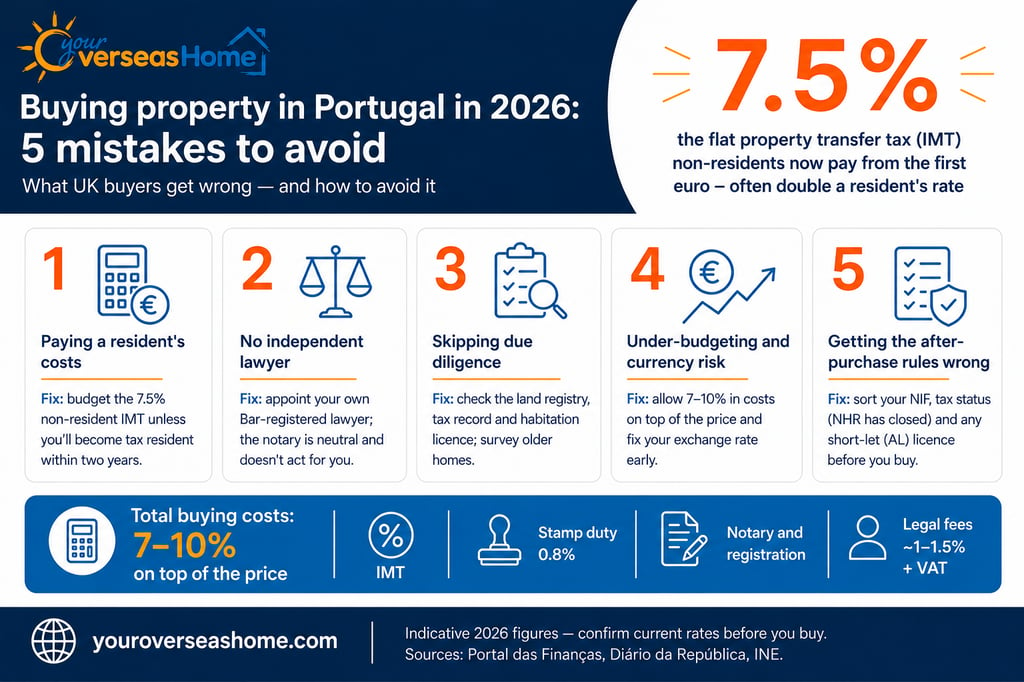
Two money mistakes tend to arrive together. The first is budgeting for the asking price and forgetting the extras. As a rule, total buying costs run to 7–10% on top of the price once you add IMT, stamp duty at 0.8%, notary and registration fees, and legal fees of around 1–1.5% plus VAT. If you take a Portuguese mortgage, there are further costs again, as our guide to getting a mortgage in Portugal as an international buyer sets out.
The second is currency. You agree a price in euros but pay the balance weeks or months later, and the pound can move a long way in between. On a €300,000 purchase, a swing in the exchange rate can change your sterling cost by thousands, in either direction.
This is where the promissory contract (contrato promessa de compra e venda, or CPCV) comes in. You sign it once terms are agreed and pay a deposit, usually around 10%. If you pull out without cause you lose it; if the seller pulls out they owe you double. Because you are now committed to a euro figure, it’s worth speaking to a currency specialist about fixing your rate with a forward contract, so your sterling cost can’t drift. Smart Currency Exchange, part of the same group as Your Overseas Home, can help you plan the transfer. Our guide to making an offer on a property in Portugal covers the CPCV in more detail.
Mistake 5: getting the after-purchase rules wrong
The mistakes don’t stop at completion. Three in particular catch UK buyers.
First, you can’t complete without a Portuguese tax number (NIF), and as a non-EU resident you’ll usually need a fiscal representative to get one. Sort this early or it holds everything up. Second, don’t assume the old Non-Habitual Resident (NHR) tax regime is still open: it closed to new arrivals and its replacement is far narrower, so take Portuguese tax advice before you register as resident. Our guide to the UK–Portugal double tax treaty is a sensible starting point.
Third, if letting the property is part of your plan, check the short-let rules before you buy, not after. Short lets need an Alojamento Local (AL) registration, and control now sits with each municipality, with restrictions in the busiest parts of Lisbon. The official position is set out on the government’s Alojamento Local page. An existing, transferable AL registration attached to a property can be worth more than the apartment itself.
The Portuguese market in 2026
For context, Portugal’s market is still rising but cooling. National statistics office INE recorded house prices up 17.8% year on year in the first quarter of 2026, but sales volumes fell and price growth eased for the first time in over a year. Lisbon, Cascais and the Algarve remain the most expensive areas. For UK buyers that means a little more breathing room to do the checks above, without expecting bargains. If you’re weighing regions, our Algarve versus Silver Coast comparison is a good place to start, or you can browse property for sale in Portugal directly.
What should I do next?
If you’re still choosing a region, read our guide to why buy a property in Portugal and browse listings to get a feel for prices. For a wider view of what can go wrong, our companion guide on the potential pitfalls of buying in Portugal goes further on the legal traps.
When you’re closer to buying, two conversations pay for themselves: an independent Portuguese lawyer for the legal side, and a currency specialist for the money. Speaking to a currency specialist early means you can fix your exchange rate as soon as your offer is accepted, so a moving pound doesn’t add thousands to your purchase.
Summary
Buying in Portugal is straightforward when you prepare for it. Budget for the new 7.5% non-resident IMT unless you’ll become tax resident. Appoint your own independent lawyer, and never rely on the notary or the seller’s. Insist on full due diligence, including a survey on older homes. Budget 7–10% in costs on top of the price, and fix your currency early. Finally, get your NIF, tax position and any short-let plans sorted before you commit, not after.
Frequently asked questions
The most expensive mistake is budgeting for a resident’s buying costs. Since 2026, non-residents pay a flat 7.5% IMT on a home purchase from the first euro, often double what a resident pays. On a €300,000 home that’s €22,500. You can avoid it if you become Portuguese tax resident within two years, so plan your tax position before you offer.
It isn’t legally required, but going without your own lawyer is a real risk. The notary is neutral and does not check the property or protect your interests, and the seller’s lawyer acts for the seller. An independent lawyer registered with the Portuguese Bar handles the searches, contracts and completion, and can act for you by power of attorney if you can’t be there.
Budget 7–10% of the purchase price on top of the price itself. The largest item is IMT (higher for non-residents in 2026), followed by stamp duty at 0.8%, notary and registration fees, and legal fees of roughly 1–1.5% plus VAT. A mortgage adds further costs. Currency movements between offer and completion can add or save thousands.
Not as a new arrival. The Non-Habitual Resident regime closed to new entrants and its replacement is much narrower, aimed mainly at certain skilled and research roles rather than retirees or passive-income earners. Take Portuguese tax advice before you register as resident, and check how the UK–Portugal double tax treaty affects your pension and other income.
Often yes, but you need an Alojamento Local (AL) registration and the rules now vary by municipality. Some areas, including parts of Lisbon, restrict new registrations. Check the position for the specific property and parish before you buy, because an existing, transferable AL licence adds real value, while a restricted area can undo a rental-income plan.
Sources
- Diário da República — Decreto-Lei on the IMT Code (2026 changes, including the non-resident rate): diariodarepublica.pt
- Autoridade Tributária / Portal das Finanças (Portuguese tax authority): portaldasfinancas.gov.pt
- gov.uk — Living in Portugal (legal advice and buying guidance): gov.uk/guidance/living-in-portugal
- Ordem dos Advogados (Portuguese Bar Association — check a lawyer’s registration): portal.oa.pt
- Government of Portugal — Alojamento Local (short-let registration): gov.pt — Alojamento Local
- INE (Statistics Portugal) — House Price Index, Q1 2026: ine.pt