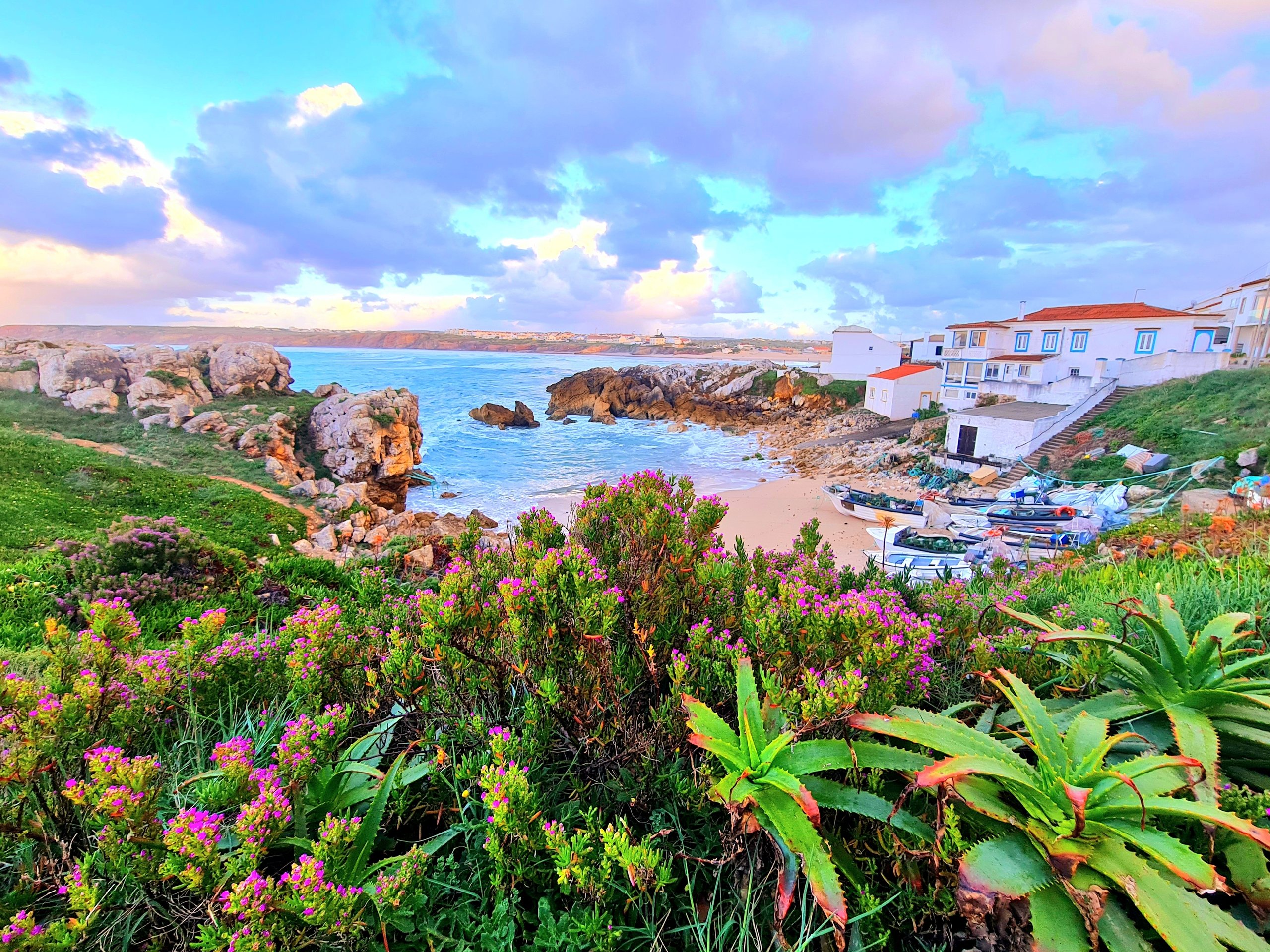
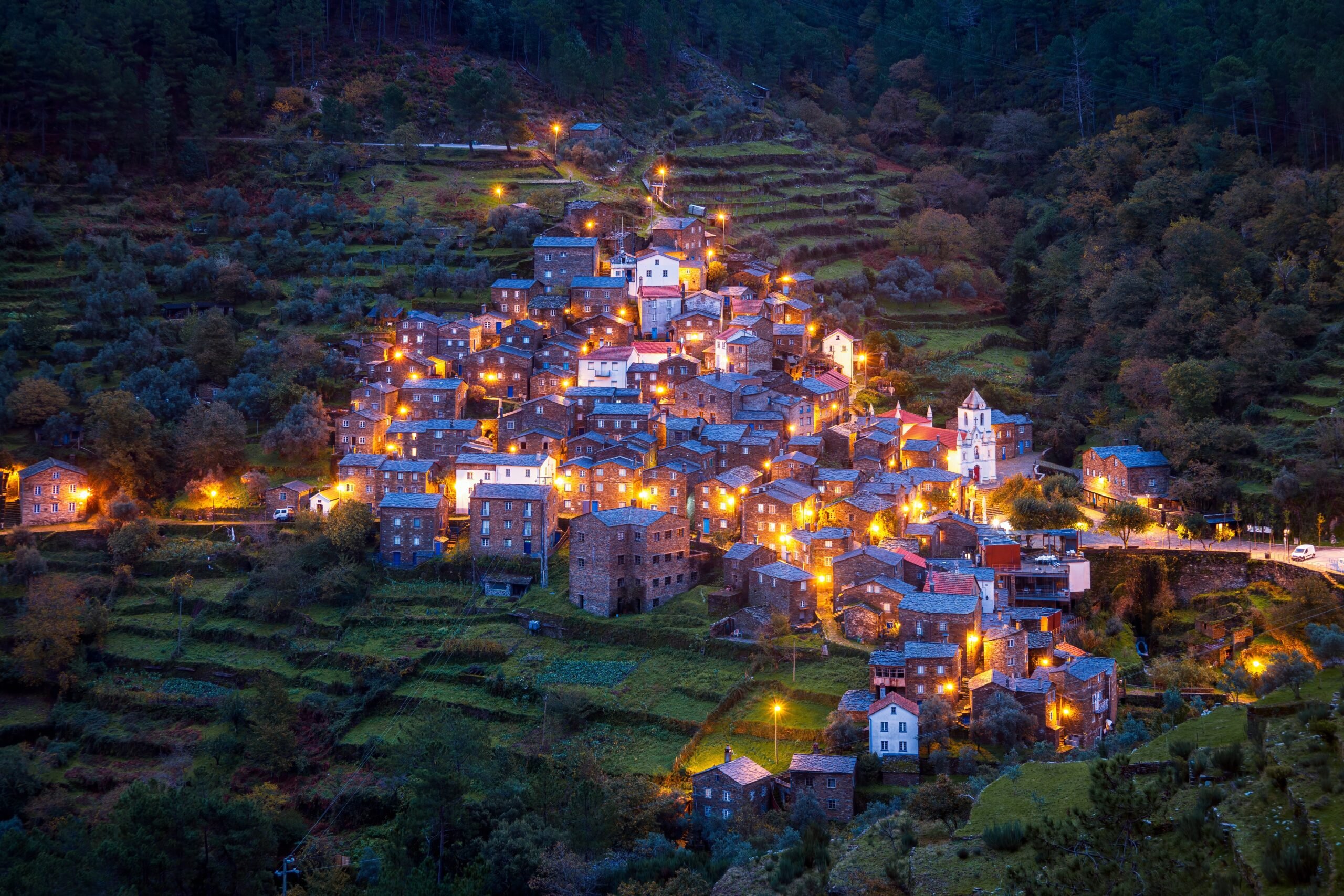

Portugal’s coast has drawn British buyers for decades, and it’s easy to see why. Year-round mild weather, direct flights from most UK airports and property prices that still compare favourably with southern Spain or the South of France make it one of the most practical retirement destinations in Europe. But with hundreds of kilometres of coastline to choose from, the real question isn’t whether to retire by the sea in Portugal – it’s where.
The answer depends on what matters most to you: proximity to an international airport, the size of the local British community, access to English-speaking healthcare or simply how much your pension stretches. Some coastal towns are well-established retirement hubs with all the infrastructure you’d expect; others are quieter, more affordable and suit buyers who prefer to live among the local Portuguese community.
We’ve profiled eight beach towns across three price tiers – from the polished Lisbon riviera to the undiscovered eastern Algarve – to help you narrow your shortlist.
In short: Portugal offers coastal retirement options at every budget, from around €2,900/sqm in the eastern Algarve to over €7,000/sqm on the Lisbon riviera. Most Algarve towns are within 30 minutes of Faro Airport, which has direct flights from more than a dozen UK airports year-round. All legal residents can register with Portugal’s public health service (SNS), though many British retirees also take out private cover for faster specialist access.
Contents
What to consider before choosing a town
Before you fall for the first sea view you find on a property portal, it’s worth thinking about the practical side of coastal living in Portugal. A town that’s perfect for a two-week holiday doesn’t always work as a permanent base.
Healthcare access is usually the biggest concern for retirees. Once you’re a legal resident, you can register with the SNS (Serviço Nacional de Saúde) through your local health centre. This gives you access to subsidised GP appointments, hospital care and prescriptions. In practice, many British retirees combine public registration with private health insurance – typically costing €100–€200 per month for over-60s – because waiting times for specialists can be long. Our full guide to accessing healthcare in Portugal covers the registration process step by step. The Algarve has a good spread of medical facilities, including the private Hospital Particular do Algarve with sites in Faro, Alvor and Gambelas.
Flight connections matter more than you might think. Being close to an airport with year-round UK routes makes it far easier for family to visit – and for you to get home when you need to. Faro Airport has direct flights from London (Gatwick, Stansted, Luton, Southend), Manchester, Birmingham, Bristol, Edinburgh, Leeds, East Midlands and several other UK airports, operated by Ryanair, easyJet, Jet2 and British Airways. Lisbon Airport serves an even wider network. Our guide to transport in Portugal covers getting around once you arrive.
Seasonal population swings are another factor. Some Algarve towns triple in population over summer. If you want a community that functions year-round – with open restaurants, social activities and a critical mass of residents – check what happens between November and March.
Download the Portugal Buying Guide
Premium tier: Cascais and Carvoeiro
Cascais
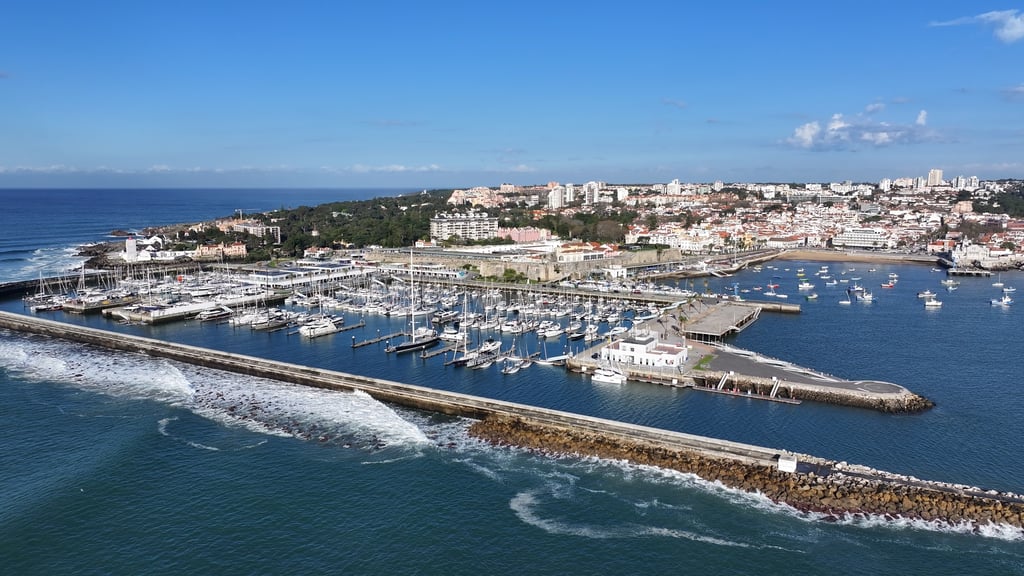
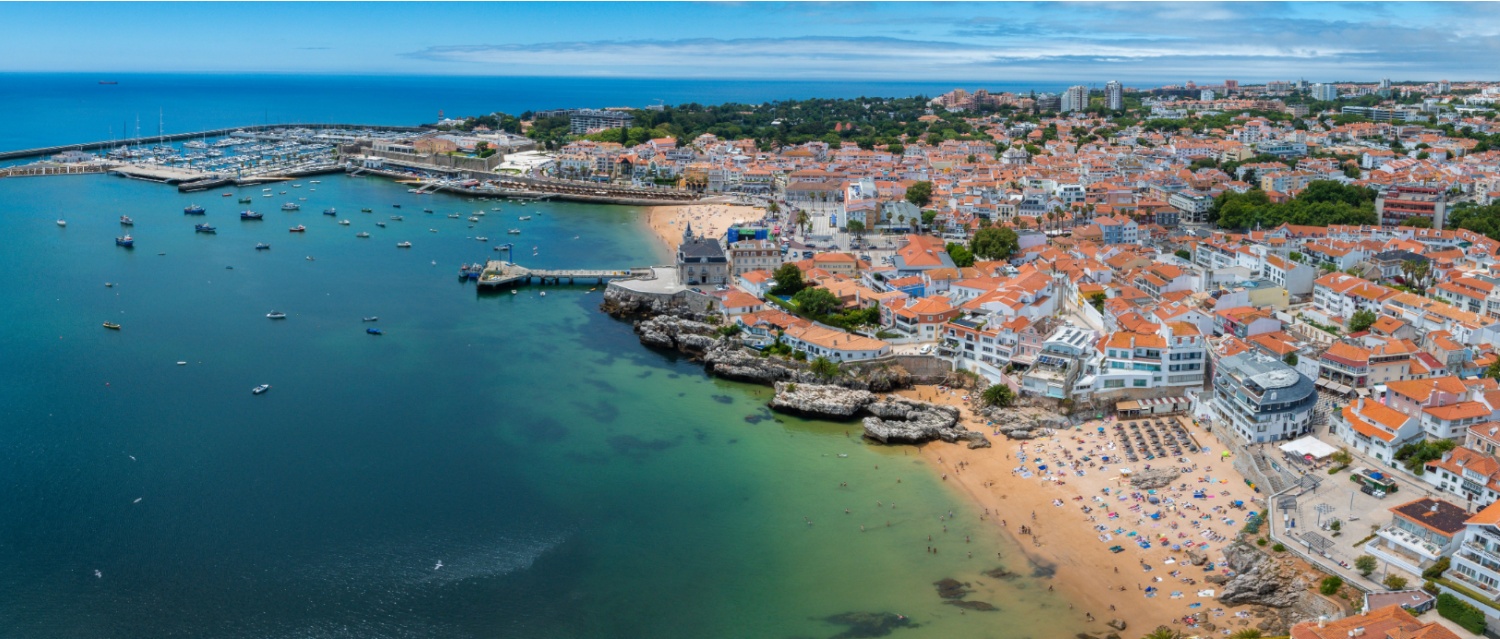
The seaside town of Cascais sits on the Lisbon riviera, 25 minutes by train from the capital. It has the feel of an upmarket region rather than a tourist resort: a compact old town with restaurants and independent shops, a marina, coastal cycle paths running towards Estoril and the green hills of Sintra-Cascais Natural Park on the doorstep.
For retirees, the main draw is having everything within easy reach. Lisbon’s international hospitals, cultural life and airport are a short commute away, yet day-to-day life revolves around the seafront promenade and the small sandy coves along the coast. There’s a well-established international community and English is widely spoken.
The trade-off is price. Average property prices in Cascais sit at around €7,260/sqm (£6,100/sqm), making it one of Portugal’s most expensive markets outside central Lisbon. A two-bedroom apartment near the centre typically starts from around €450,000 (£378,000). Our guide to buying property in Cascais covers the local market in more detail. This is a town for buyers with a larger budget who want the best of both worlds: coast and city.
Nearest airport: Lisbon (25 minutes by car) Year-round community: Strong – Cascais has a large permanent resident population
Carvoeiro
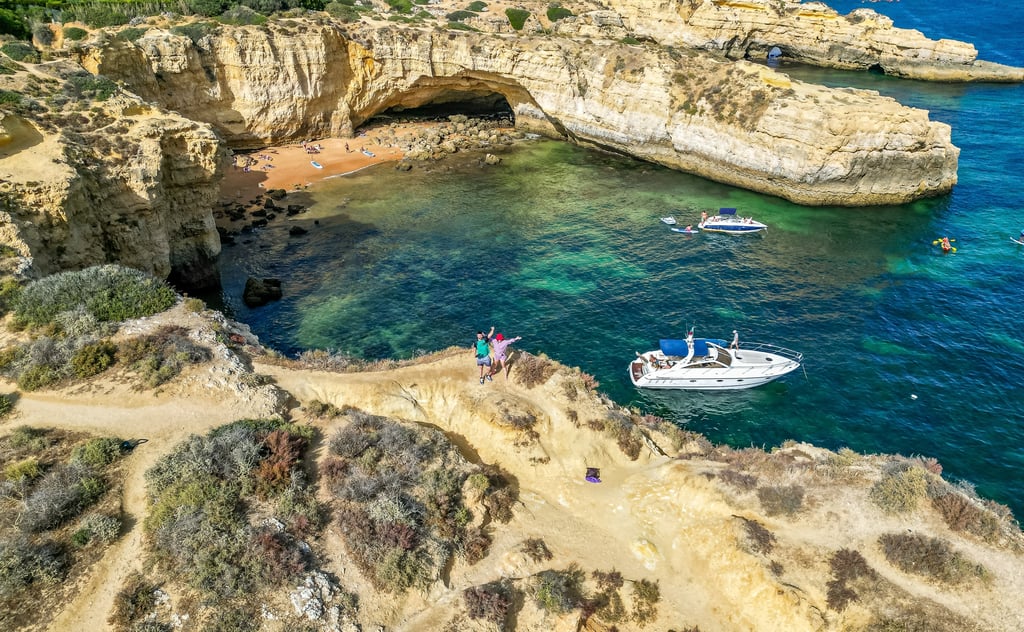
On the central Algarve coast between Portimão and Albufeira, Carvoeiro is a former fishing village built around a small, cliff-framed beach. With fewer than 3,000 year-round residents and a significant international community, it offers a more intimate feel than the larger resort towns.
The location is convenient. Portimão is 15 minutes west with its marina and annual food festivals. The town of Silves, the former Moorish capital of the Algarve, is 20 minutes inland. Lagos and its famous cove beaches are 40 minutes along the coast. Faro Airport is roughly 45 minutes east.
Property prices reflect Carvoeiro’s popularity with foreign buyers. Expect to pay around €4,000–€5,000/sqm (£3,360–£4,200/sqm) for a well-maintained property, with villas commanding higher premiums. It’s more affordable than Cascais but still firmly in the upper end of the Algarve market.
Nearest airport: Faro (45 minutes) Year-round community: Moderate – quieter in winter but retains a core resident population
Mid-range tier: Lagos, Tavira and Nazaré
Lagos
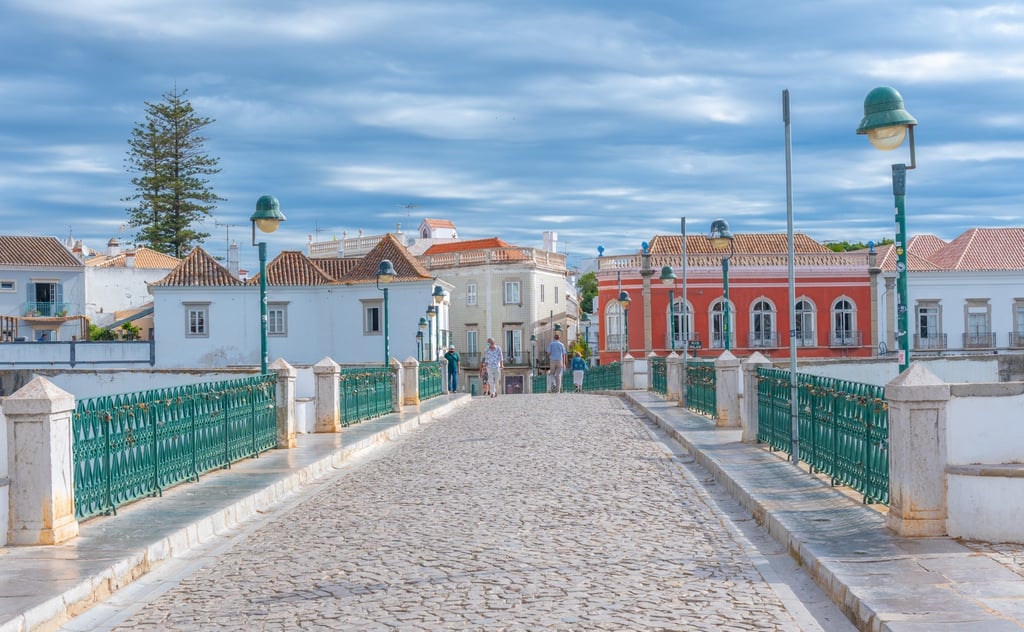
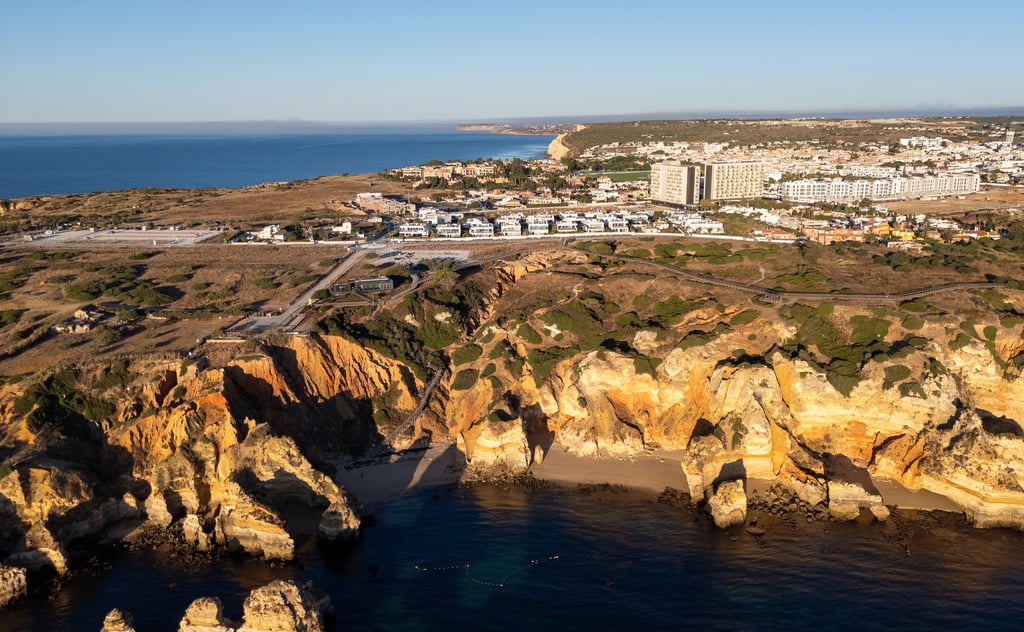
Lagos is one of the Algarve’s most popular towns with British buyers, and for good reason. It combines a walled historic centre with around a dozen beaches – including Praia Dona Ana, one of the most photographed in Portugal – plus a modern marina and strong infrastructure including international medical services.
At around €5,000/sqm (£4,200/sqm), Lagos sits at the upper end of mid-range. A two-bedroom apartment in the old town or near the marina typically costs €350,000–€450,000 (£295,000–£378,000). For buyers who want a lively, year-round town with strong British community networks, Lagos is hard to beat. Faro Airport is an hour east along the A22 motorway.
Nearest airport: Faro (1 hour) Year-round community: Strong – one of the largest British communities in the Algarve
Tavira
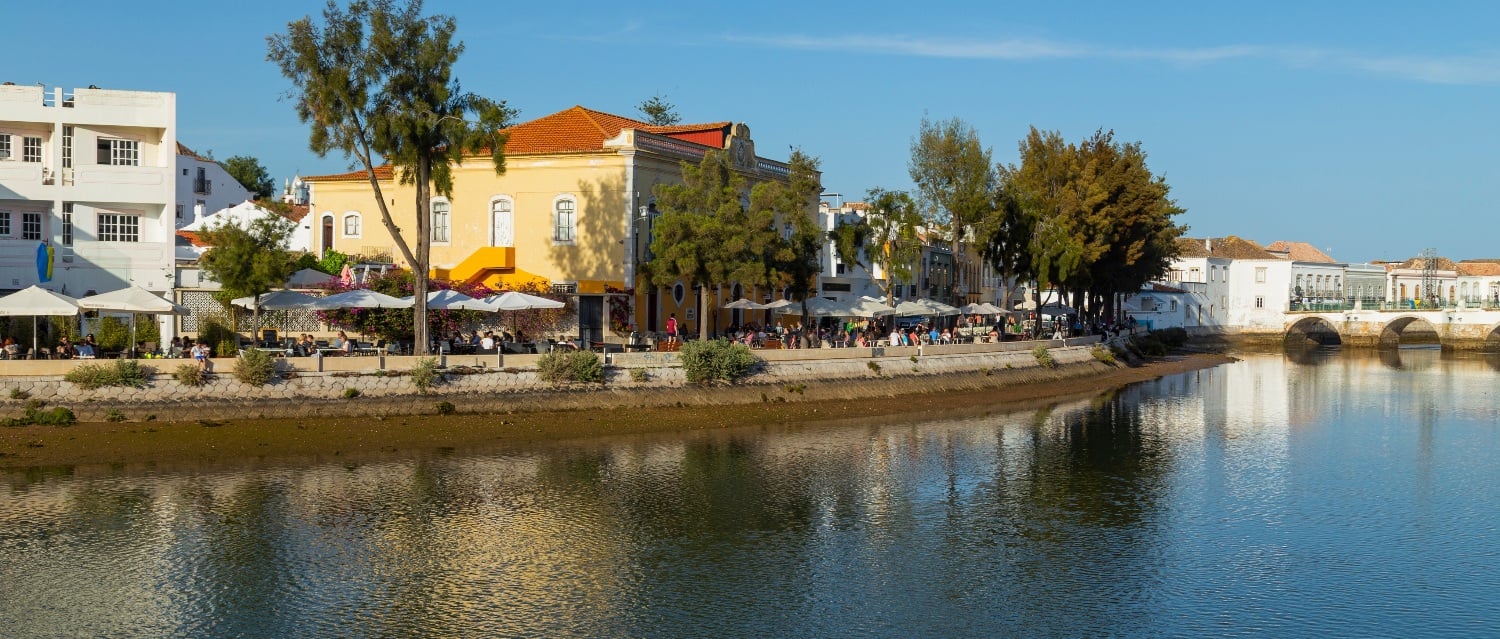
If Lagos is the sociable choice, Tavira is the contemplative one. This historic town on the eastern Algarve coast is known for its Moorish architecture, peaceful riverfront and nearby island beaches accessed by short ferry rides across the Ria Formosa lagoon.
Tavira attracts retirees who want an authentic Portuguese environment rather than a resort atmosphere. English is spoken in most businesses but you’ll hear far more Portuguese here than in the western Algarve. The town has good healthcare facilities, regular local markets and a walkable centre that’s flat enough for comfortable daily use.
Property prices are more accessible at around €3,660/sqm (£3,075/sqm), making Tavira one of the better-value options in the Algarve. A renovated two-bedroom apartment in or near the centre can be found from around €250,000–€350,000 (£210,000–£295,000). Faro Airport is just 30 minutes away – the closest of any town on this list.
Nearest airport: Faro (30 minutes) Year-round community: Good – Tavira has a growing international retirement community, particularly Dutch, German and British
Nazaré
Nazaré sits on the Silver Coast, roughly halfway between Lisbon and Porto, and is famous worldwide for its enormous Atlantic waves. Away from the surf season, though, it’s a working fishing town of around 10,000 residents with a traditional Portuguese character that’s largely untouched by mass tourism.
Retirement here suits buyers who prefer cooler summers, Atlantic beaches and a more local way of life. The town is built on three levels – the beach (Praia), the clifftop (Sítio, reached by funicular) and the harbour area – each with its own character. Fresh seafood is central to daily life, and prices for eating out remain well below Algarve levels.
The Silver Coast generally offers lower property prices than the Algarve, with averages around €2,000–€2,800/sqm (£1,680–£2,350/sqm). The compromise is distance from an airport: Lisbon is roughly two and a half hours south, and there’s no local international airport. The British community is much smaller here – this is a choice for buyers who are comfortable integrating into Portuguese daily life.
Nearest airport: Lisbon (2.5 hours) Year-round community: Small international presence – predominantly Portuguese
Affordable tier: Olhão, Fuseta and Sesimbra
Olhão

Olhão is one of the Algarve’s best-kept secrets for budget-conscious retirees. This working fishing town, 15 minutes from Faro Airport, fronts the Ria Formosa Natural Park and is known for its covered markets selling some of the freshest seafood in southern Portugal.
The town has a strong local identity. Its cubist-inspired architecture, influenced by trade links with North Africa, gives it a distinctive look. While the international community is growing, Olhão still feels firmly Portuguese – and property prices reflect that. At around €2,900/sqm (£2,440/sqm), it’s one of the most affordable coastal municipalities in the Algarve. Two-bedroom apartments in good condition can be found from €180,000–€250,000 (£151,000–£210,000).
Healthcare access is practical: Faro’s main hospital is 15 minutes away, and the town has its own health centre for day-to-day needs.
Nearest airport: Faro (15 minutes) Year-round community: Growing international presence, still predominantly Portuguese
Fuseta
Just east of Olhão, Fuseta is a small fishing village that sits on the edge of the Ria Formosa lagoon. It’s significantly quieter than anywhere else on this list – the kind of place where the morning meeting point is the bakery and the afternoon is spent on the lagoon beach.
Fuseta appeals to retirees looking for simplicity and value. New-build villas and apartments are being developed, but the village core retains its traditional character. Property prices are similar to Olhão’s, and in some cases lower for older properties requiring renovation.
The compromise is infrastructure: Fuseta has basic amenities (cafés, small supermarket, pharmacy) but for anything more substantial you’ll drive to Olhão (10 minutes) or Tavira (15 minutes). Faro Airport is around 25 minutes by car.
Nearest airport: Faro (25 minutes) Year-round community: Small but growing – a handful of international retirees
Sesimbra
South of Lisbon on the Arrábida coast, Sesimbra offers something different: a fishing village atmosphere within day-trip distance of the capital. The town curves around a sheltered sandy bay overlooked by a Moorish castle, and the surrounding Serra da Arrábida offers some of the best coastal walking in Portugal.
Sesimbra is less known among British buyers than the Algarve towns, but it’s well-established with Portuguese retirees and has a year-round local community. Lisbon is about 40 minutes north by car, giving access to hospitals, the airport and city life when needed. Property prices are moderate at around €3,000–€3,500/sqm (£2,520–£2,940/sqm), though supply can be limited in the centre.
Nearest airport: Lisbon (45 minutes) Year-round community: Strong Portuguese community, small but emerging international presence
At a glance: eight towns compared
| Town | Region | Avg. price/sqm | Airport (drive time) | Year-round community | Best for |
|---|---|---|---|---|---|
| Cascais | Lisbon riviera | €7,260 (£6,100) | Lisbon (25 min) | Strong | City access + coast |
| Carvoeiro | Central Algarve | €4,500 (£3,780) | Faro (45 min) | Moderate | Cliffs, golf, quiet luxury |
| Lagos | Western Algarve | €5,000 (£4,200) | Faro (1 hr) | Strong | Social, beaches, walkable |
| Tavira | Eastern Algarve | €3,660 (£3,075) | Faro (30 min) | Good | History, authenticity, value |
| Nazaré | Silver Coast | €2,400 (£2,015) | Lisbon (2.5 hrs) | Small | Atlantic life, low cost |
| Olhão | Eastern Algarve | €2,900 (£2,440) | Faro (15 min) | Growing | Seafood, markets, value |
| Fuseta | Eastern Algarve | €2,800 (£2,350) | Faro (25 min) | Small | Simplicity, lagoon beaches |
| Sesimbra | Arrábida coast | €3,250 (£2,730) | Lisbon (45 min) | Strong | Lisbon access, walking |
Prices are indicative averages for 2025/2026 based on published market data. Actual prices vary significantly by property type, condition and micro-location. GBP conversions are approximate at €1 = £0.84.
What should I do next?
If you’re beginning to narrow your shortlist, a good next step is to attend one of our free Portugal property webinars, where our experts cover the buying process, costs and visa requirements in detail. You can also browse properties for sale across Portugal on our portal – filtering by region, price and property type to get a feel for what your budget will buy.
If you’re further along and ready to talk specifics, our expert matching service can connect you with vetted English-speaking lawyers, tax advisers and property agents in your chosen area. And if you’re thinking about how to move money to Portugal for a purchase, speaking to a currency specialist early can help you plan transfers and protect your budget from exchange rate movements.
Summary
Portugal’s coastline offers retirement options at every price point and lifestyle preference. The eastern Algarve – particularly Tavira, Olhão and Fuseta – delivers the best value for retirees on a moderate budget, with Faro Airport on the doorstep.
Lagos and Carvoeiro suit buyers who want established international communities and strong infrastructure at mid-range to premium prices. Cascais is the choice for those who want coastal living within reach of a European capital. And for buyers willing to look beyond the Algarve, the Silver Coast and the Arrábida coast south of Lisbon offer lower prices and a more authentically Portuguese way of life.
Whichever town you choose, visiting outside of peak summer is the best way to judge how it feels as a permanent home – our guide to how to retire to Portugal covers the full process from planning to move-in day.
Properties for sale in Portugal
Frequently asked questions
Yes. British citizens can apply for a D7 visa (also known as the passive income visa), which is the most common route for retirees. You’ll need to demonstrate a regular income – typically a pension of at least €870 per month for a single applicant – and arrange private health insurance as part of the application. The D7 leads to a residence permit and, after five years, eligibility for permanent residency.
In the main Algarve towns – particularly Lagos, Tavira, Albufeira and Carvoeiro – English is widely spoken in shops, restaurants and medical facilities. Many estate agents, lawyers and financial advisers operate in English. That said, learning even basic Portuguese will improve your daily life significantly and is appreciated by the local community, especially in quieter towns like Olhão and Fuseta.
A retired couple can live comfortably in a smaller Algarve town on around €1,800–€2,200 per month, covering rent or mortgage payments, utilities, groceries, dining out and private health insurance. Lisbon-area towns like Cascais are more expensive, with monthly costs typically 20–30% higher. These figures exclude property purchase costs.
Yes. The UK state pension is payable worldwide and increases annually in Portugal under the triple lock, just as it does in the UK. It’s paid directly into a Portuguese or UK bank account. Many retirees use a currency specialist to manage the GBP-to-EUR conversion and reduce exchange rate risk.
Portugal taxes residents on their worldwide income, which includes UK pensions. The standard income tax rates are progressive, ranging from 14.5% to 48%. However, Portugal’s IFICI scheme (which replaced the NHR programme) may offer reduced rates for new residents in certain circumstances. It’s worth speaking to a tax adviser who specialises in UK-Portugal cross-border planning before making the move.