
Italy’s greatest treasures are not all kept behind glass or frescoed onto a Renaissance church wall. Some are kneaded by hand, sung from a stage, carried through village streets or passed down quietly from one generation to the next.
UNESCO calls this “intangible cultural heritage” – the customs, skills and traditions that help define a place. In Italy, that includes everything from Neapolitan pizza-making and opera singing to truffle hunting, religious festivals and centuries-old crafts.
These are not relics from the past. They are still part of everyday life, giving visitors and residents a chance to taste, hear and take part in traditions that remain deeply rooted in their communities. Here are some of the Italian customs UNESCO believes the world should protect.
Italy is the world leader in the number of UNESCO World Heritage sites. There are currently 61, of which 55 are cultural sites and six are natural wonders. But, did you know that Italy also has 20 on the UNESCO list of Intangible Cultural Heritage?
What is “Intangible Cultural Heritage”?
It involves living actions rather than a monument. This includes skills and traditions which are passed down the generations. Good examples are songs, stories, dance, festivals, farming skills, crafts, and cooking methods.
Italy has 20 elements on the UNESCO list of Intangible Cultural Heritage. Each one still exists thanks to the Italian passion for preserving that which is special and treasuring it. They fully understand that these aren’t treasures to be kept secret, and lost over time. Instead, they are passed down from generation to generation and celebrated.
Much of Italy’s cultural heritage involves music and food, often enjoyed both together. So, lets look at those you can listen to and taste that have made it onto the UNESCO list and where you might witness them.
1. Sardinian Tenor Singers
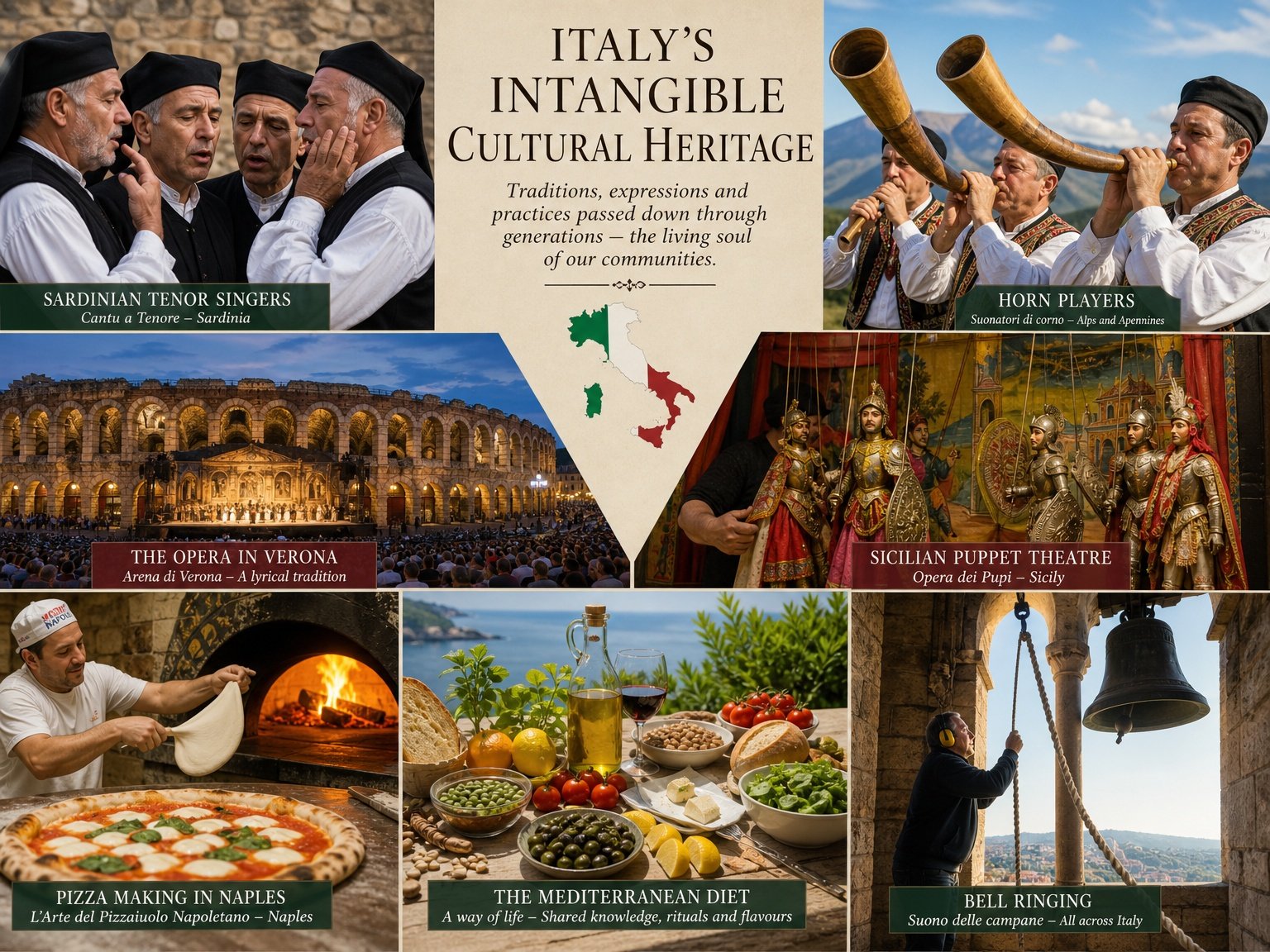
“Canto a tenore” (singing tenors) are an integral part of the Sardinian identity. You could be in a bar, and quite spontaneously four men might face each other and begin to sing in a polyphonic way. One singer chants an ancient or contemporary poem while the others sing in harmony. You may also hear them at special occasions and festivals.
Where can you hear the “Canto a tenore”?
You will hear them across Sardinia, but especially in the region of Barbagia and other central areas of the island, where it is a part of everyday life.
The village of Bitti, in the mountains, is the most famous place for this type of music. The Museum of Rural and Pastoral Civilization in Bitti, has a wing totally dedicated to “Canto a tenore”.
There are some amazing properties for sale on Sardinia.
2. Horn Players
Horns in Italy are curled hunting horns. The brass or copper tube is about four and a half metres long. It is curled round into a large circle and then flares out at the end.
Playing the horn involves skills and techniques that require good breath control and an ability to sing a melody. Although these musicians come from different backgrounds, they all dress very smartly, often in historical royal garments. The main group are called “Equipaggio della Regia Venaria”.
Where can you see Italian horn players?
The region of Piedmont has the most hunting horn players. Historically they were part of cultural performances connected to the royal residences of the House of Savoy. You can see them perform today at various open-air events and at:
- Palazzina di Caccia di Stupinigi
- Reggia di Venaria Reale
- Castello di Casotto
- Castello di Racconigi
The Piedmont region has many large countryside properties for sale, that might be used for holiday accommodation, farming or equestrian.
3. Opera Singing
Opera was created in Florence in the late 1500s, and by 1637 the first public opera house opened in Venice. Italian opera singing is “a physiologically controlled way of singing that enhances the carrying power of the voice in acoustic spaces, such as auditoriums, amphitheatres, arenas and churches.” The knowledge and skills are taught to singers by a maestro. As well as the particular singing technique, performers also learn facial expressions, gestures, and acting.
Where are the best places to see an opera in Italy?
- Teatro alla Scala (Milan) known as “La Skala”, opened in 1778 and is world famous.
- Teatro La Fenice (Venice) with it’s gold decoration and velvet seats.
- Teatro di San Carlo (Naples) built in 1737, it is considered the oldest continuously used opera house in the world.
- Arena di Verona (Verona) A large Roman amphitheatre with huge stage sets.
4. Sicilian Puppet Theatre
The puppet theatre in Sicily (Opera dei Pupi) began in the early nineteenth century. The string puppets are carved and painted by craftspeople and the performances are often done by a family.
The puppets are very detailed and wear elaborate costumes and armour, as they perform stories of chivalry. The shows are usually accompanied by musicians, like the sound track to a film. The music adds to the drama especially during the popular battle scenes.
The two main puppet schools are in Palermo and Catania. While the Catania puppets are large and heavy with rigid legs, the Palermo ones are smaller, lighter and have articulated legs. They sometimes appear on antiques markets across Italy, and I’ve seen a couple hanging from book cases in Italian homes.
Where can you see Sicilian puppet theatre?
A dedicated group of families still carry on the tradition of making the puppets and performing, and it’s possible to visit their workshops. You can see performances at:
- Teatro dei Pupi in Syracuse, do traditional sword fighting performances.
- Museo Internazionale delle Marionette Antonio Pasqualino, Palermo.
They also go on tour to other regions, with performances sometimes taking place in Rome, Milan, and Naples. The Marionettistica Fratelli Napoli go on tour, and they represent five generations of puppet masters.
A two bedroom house in the Palermo province starts at around €35,000, and in Catania a two bedroom town house costs from €100,000.
5. Bell ringing
In Italy, a bell ringer is called a “Campanari”. The knowledge, skills and techniques involved, can have distinct local styles. The shape of the bells, belfries and bell towers also plays it’s part in the sound produced.
The bells are used as a form of communication in the community to tell the time, and indicate when traditional festivals and celebrations are taking place. They are part of a community’s history, and shared identity.
Where can you hear bell ringers in Italy?
They can be heard across the country. But, ones of note can be found at:
- Gubbio and Arrone in Umbria.
- The Duomo in Sansepolcro (Tuscany).
- Cattedrale di San Pietro, Bologna.
- Tower of San Giorgio in Bràida or the Duomo in Verona.
- Rovereto (Trentino) – These bells are cast from melted bronze cannons used in World War I. They ring 100 times every evening at dusk to honour fallen soldiers of all wars.
6. Italian cooking
Italian cooking is so much more than making a spaghetti bolognese from a jar. It is part of the Italian cultural heritage that families and friends gather around the table for meals. Lunch times particularly are a family time, when recipes, cooking techniques, and knowledge of the raw ingredients are passed down.
Community events, ceremonies, and festivals also centre around the cuisine, whether it’s street food, a seven-course wedding dinner, or lunch at Nonna’s (grandma’s) the food is recognisably Italian and creates a sense of belonging. You can read more about Italian Cuisine’s UNESCO status here.
7. Neapolitan pizza makers
A Neapolitan pizza maker is called a ‘Pizzaiuolo’. This traditional craft involves four phases including the preparation of the dough and its baking in a wood-fired oven. The skills needed are learnt in the ‘bottega’, where young apprentices observe masters at work, learning all the key phases.
What makes them special is the way they twirl and toss the dough in the air to oxygenate it, and then stretch it out. It’s quite common for them to sing or tell stories while doing this. Then the pizza is cooked in a wood-fired oven.
Where can you find Neapolitan pizza makers?
As it originates in Naples, the capital of the Campania Region, this is where you’ll find the most authentic Neapolitan pizza makers. In Naples there are around 3,000 Pizzaiuoli.
Every year, the Association of Neapolitan Pizzaiuoli organizes courses focused on the history and techniques to ensure it continues. There are also specific academies.
8. The Mediterranean Diet
The Mediterranean diet is an important part of healthy eating in Italy. It includes eating fresh vegetables, fruit, cereals and legumes. Fish is regularly seen on the dinner table, and meat consumption is fairly low.
Olive oil is used more often than fats, and many homes have olive and fruit trees. The cultural practices that get this food to the table include growing, harvesting, conserving, and cooking. Generation after generation are taught how to preserve the goodness and flavour of fresh ingredients.
Where in Italy is best suited to a Mediterranean diet?
Italy’s southern regions are where you can experience the most authentic Mediterranean diet.
- Campania: Known as the birthplace of the Mediterranean diet, the inhabitants of coastal areas south of Salerno eat plenty of healthy greens and tomatoes.
- Puglia: At weekly markets you can buy local seasonal vegetables and fruit. Fish are caught around the coast, and inland you will find citrus, almond, cherry and olive trees. Over a third of Italy’s olive oil is produced here and 35% of its durum wheat.
- Sicily: Being an island, fish is big part of the diet here. Also, eggplants, tomatoes, and citrus.
- Calabria: Fish and vegetables are popular in Calabria, especially egg plants, hot peppers, and onions.
What’s the benefit of being on the UNESCO list?
Being officially recognised brings in extra tourism, funding and advice to ensure traditional practices like music and cuisine are protected. Living near a UNESCO site or a place where cultural heritage is preserved creates pride in a community and a sense of belonging. To have your local cultural heritage recognised around the world is something special, and the extra visitors are good for the local economy too.