
How do you identify a town with a thriving and authentic Italian lifestyle? Where the community works together all year and where people still look after each other?
Do you ever look around your local town in the UK or USA with dismay? Useful shops like butchers and bakers boarded up or replaced with vape shops, town centres deserted, local events unsupported while everyone seems to sit at home staring at screens?
Of course, that may not be your local town, but the death of the high street and the decline of community involvement – and subsequent loneliness – are clearly identified problems in many countries. Moreover, some Italian communities have problems too; it’s why the one-euro homes campaigns were launched.
But the good news is that, in my experience, Italian towns still tend to work as communities. Weekly markets where local farmers sell their produce; family businesses such as fishmongers, cobblers and newspaper sellers where you can have a chat with the same proprietor year-in, year-out; traditional events organised by community groups where the whole town gets involved.
These towns are thriving without relying on tourists alone and have everything you need to enjoy an authentic Italian lifestyle. But how can you know that the Italian town or village where you’re planning to settle has an authentic and thriving culture, even when the summer tourists have gone home?
How do I know my local town in Italy will be a lively, authentic community I can settle into? While the ‘death of the high street’ and lack of community engagement is an increasing problem in many countries, Italian towns and communities are keeping it real. Before committing, check out our five tests for whether the Italian location where you’re buying is full of life.
Contents
Keeping it real
In Italy the people and local governments have woken up to the threats that come from the modern age and are being proactive in saving an authentic, traditional Italian lifestyle. In an age of internet shopping, theme parks and fake images, many Italian towns are still keeping it real.
Event organisers, cultural associations, farmers, shop owners and accommodation providers understand that it’s the authentic Italian lifestyle that visitors and residents really want. Not a ghost town or a city packed with souvenir shops and tourists taking selfies.
On the other hand, lack of job opportunities from tourism can cause young people to leave to find work elsewhere, leading to the same problem. It’s a balancing act.
Here are five ways to know that ‘your’ town has got the balance right, between traditional Italian authenticity and getting the best from the modern world.
Planning to buy property in Italy?
Download our free Italy Buying Guide for practical advice on finding a property, navigating the buying process and preparing for your move.
Get your free guide1. Online location research
Okay, this may seem ironic given what I was just saying about the need to be there and in the moment. However, yes you can do initial research online.
Even if you want to buy a property in the countryside or a small village, you will need the facilities of a town at some point. Don’t rule out a village if it appears deserted in the photos, go on Google Earth and explore the area. You might find that a quiet hill top village has a newer town in the valley below, with plenty of shops and restaurants.
First look up the population, then by using Street View take a virtual stroll around the streets. Look out for shops and businesses. Also, if you do a Google search for “restaurants in …” You will generally get a map come up with a list of businesses.
2. Look for local events
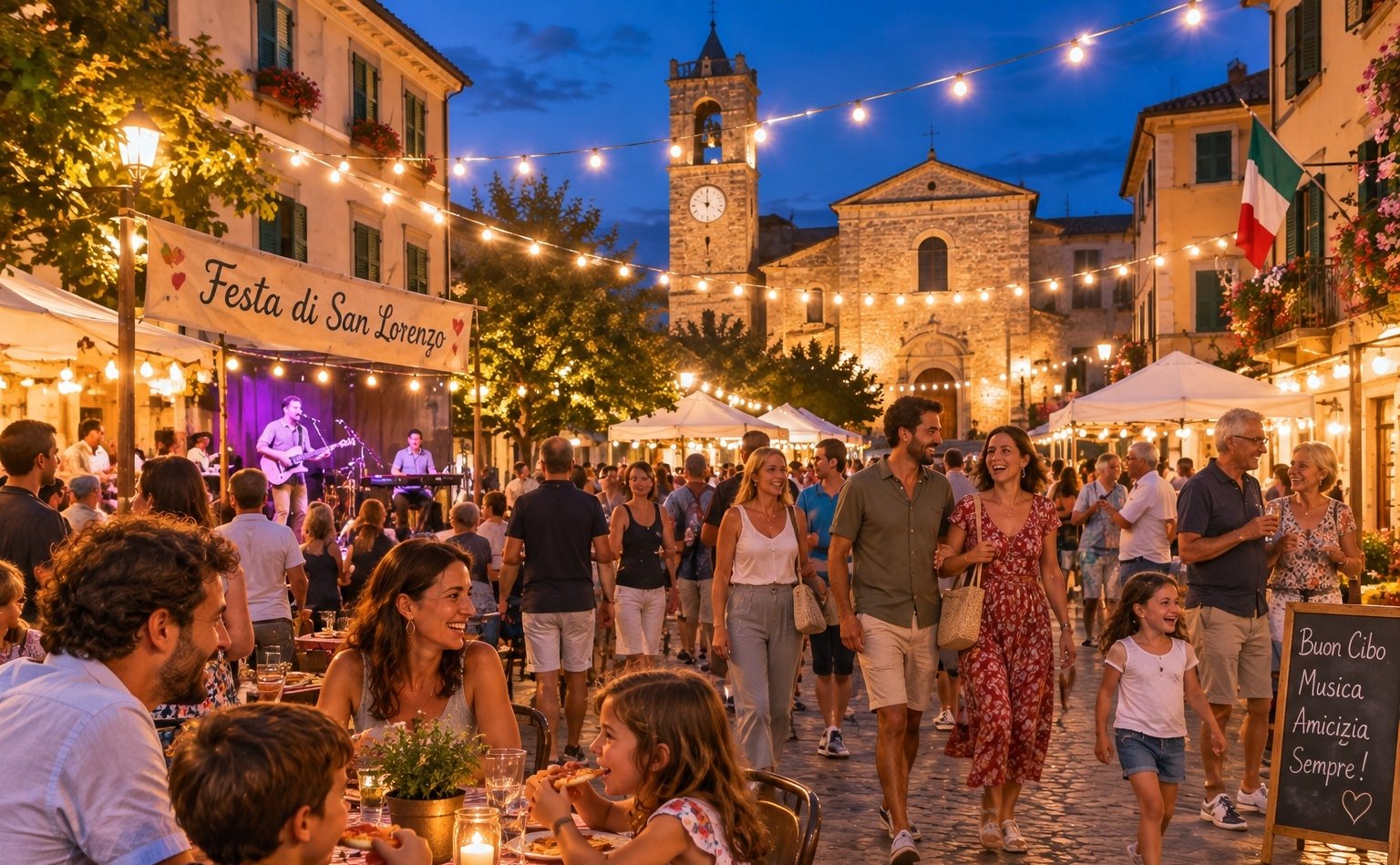
A town or village that organises several events over the year is a good indication that there are community groups with a real pride in their hometown. These events are often held annually to celebrate a patron saint’s day or a new harvest. In some towns residents will spend the winter months making costumes and floats for the carnival in February.
When Italians come together it is always a celebration, often featuring good food and live music in the piazza. These events are NOT put on to attract tourists; they are part of the town’s heritage. But everyone is welcome.
Some villages and small towns hold events that have become so famous they attract thousands of visitors over one weekend. For example:
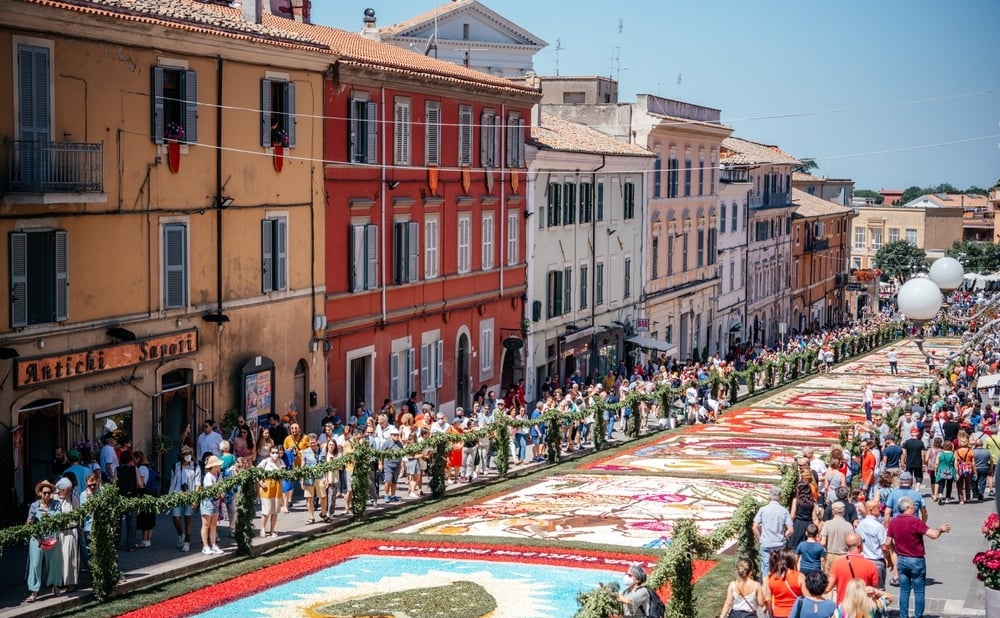
- Spello, Umbria – Population 8,200 – Corpus Domini in June – They create pictures made of flower petals along the medieval streets. They report as many as 100,000 visitors.
- Portovenere, Liguria – Population 3,155 – Festa on 17 August – the village is lit with just candles, tealights and handmade roman torches and there is a torchlight procession. Around 10,000 visitors follow the procession or watch from boats.
- Oria, Puglia – Population 14,300 – Torneo dei Rioni in August – Thousands watch the medieval procession on the day before the tournament. Featuring period costumes and knights on horseback.
Visit during a Festa
When planning a viewing trip to one particular town, try and go when the Festa is on. It’s a time when every local person will be gathered in town and you’ll see who the key people are, such as the mayor (Sindaco), Festa Committee President and representatives of the church. They usually walk behind the statue of the patron saint as it is carried around the town with the marching band.
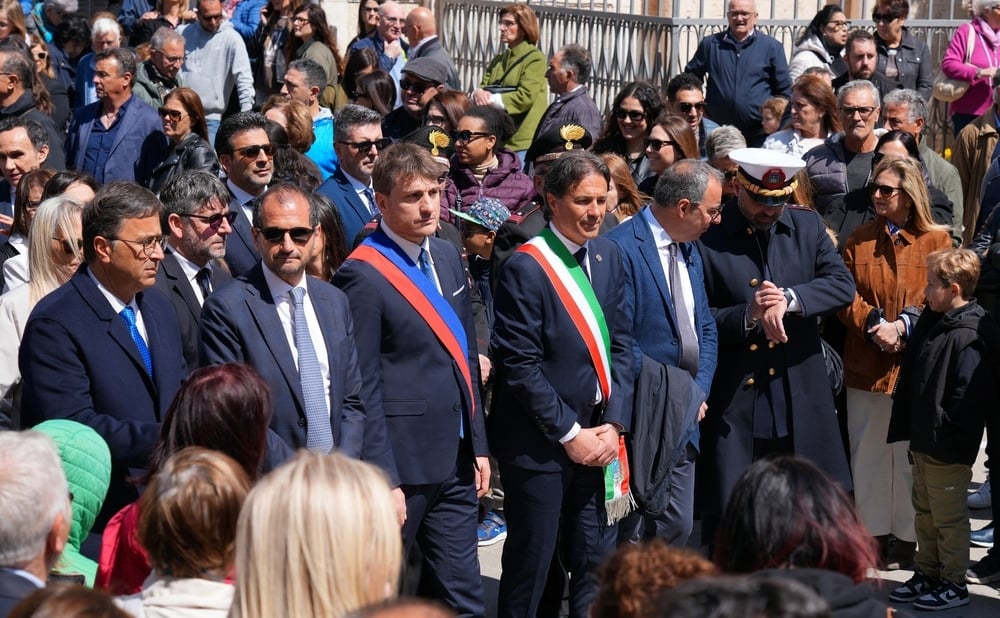
Our local town just held its annual Festa. Due to contributions made by local businesses, the council and donations from the sale of merchandise and raffle tickets, all events were free. The organising committee were all volunteers, and they did a great job planning festivities for all ages and spread over five evenings. The evening which drew the largest number of people was for the procession of the Patron Saint.
Highlights of our local town Festa
Street Illuminations (Luminarie)
White wooden frames were built in a unique lace like pattern and covered in hundreds of lights. They surrounded the piazza with a bandstand at one end. There were also arches of lights along the main street.
Live outdoor concerts
Each night was a different type of music to appeal to a mix of age groups. From 80s pop, to a brass band. My favourite night was the traditional pizzica music of Salento, because it was lovely to see the local people dancing in the crowd.
Traditional games
Traditional games were made of wood by a community group in Ceglie Messapica. They were laid out all along a pedestrianised street, so that children, parents and grandparents could all play together. There were table top skittles, bean bag throwing, connect four, and various games of dexterity.
Street entertainers
On various evenings there were entertainers dotted around the streets. A magician pulling a dove from a box, a clown, a balancing act, people on stilts, puppets, even some of the children’s favourite cartoon character were there for memorable selfies. This year spiderman and a transformer were particularly popular. The candyfloss and balloon seller also added to the family atmosphere.
Fireworks
On one night, at the very end of the evening a large group paraded with the Festa organisers to the outskirts of town, singing as they walked. Some also came in cars or watched from their terraces. My house is in the countryside, but I was able to watch the stunning fireworks display from my roof.
Art exhibitions
Our town has many artists, both amateur and professional, who display their work. This also includes sculptures and other crafts. For example, there is the man who makes the statues that are carried in processions. He is called a “Cartapestaio”, which means he makes the statues from papier-mache, but with artistically sculpted clay heads and hands.
Other events in authentic Italian towns
Other events you might see in authentic Italian towns include: Urban runs, bike rides, medieval processions and tournaments, antiques markets, Open courtyards, human chess, free museum days, music events with musicians dotted around the streets, Christmas markets, and local dance schools performing outside, so that everyone can come and watch. When produce is harvested they might also hold a food festival called a “Sagre”.
3. Look out for community groups
As well as small community groups that share interests, such as art, the Red Cross, vintage cars, dogs or a sport, there are some that come under a national banner. Here are two to look out for:
Pro Loco
The name Pro Loco comes from Latin, and translates to “for the place”. The Pro Loco groups are made up of volunteers who give their time to promote local culture and food, and organise events that will attract tourists. There are over 6,000 local groups across 20 regions, mostly in villages and small towns. When you see a “sagre” or walking tour it’s usually them that have organised it. On concert nights they might also pop up a marquee and make a pasta dish to sell to hungry concert goers.
Examples of towns with active Pro Loco groups are Martina Franca in Puglia, Cartoceto in the Marches region and Marciana Marina in Tuscany. These towns help promote local produce, wines, music, urban and countryside walks, and events based on the history of the town.
A Facebook search for “Pro Loco” and the name of the town should bring up information about their activities in the area you’re are interested in, or see more information on Pro Loco here.
Auser
There are around 1,650 Auser groups across Italy, that help older adults to stay active and included in their local community. Thousands of people volunteer to man helplines, transport people to hospital appointments, and offer support to frail individuals.
Our local group is very active. They dance every Sunday and put videos of themselves on their Facebook page. They go on holidays and day trips together, and do courses in English, making clothes and using a computer. You can find out if the town you are interested in has an active group, by using a simple search map on the Auser website. Or look for their Facebook page, to see what they are doing.
4. Family life, family values
We consider ourselves to be very fortunate to live in a town that still has a good mixture of ages, with young people wanting to carry on in the family businesses. This means there are still shops, restaurants and other businesses that offer a family welcome and a friendly service. They have experience and knowledge that has been passed down the generations, and a real passion for what they do.
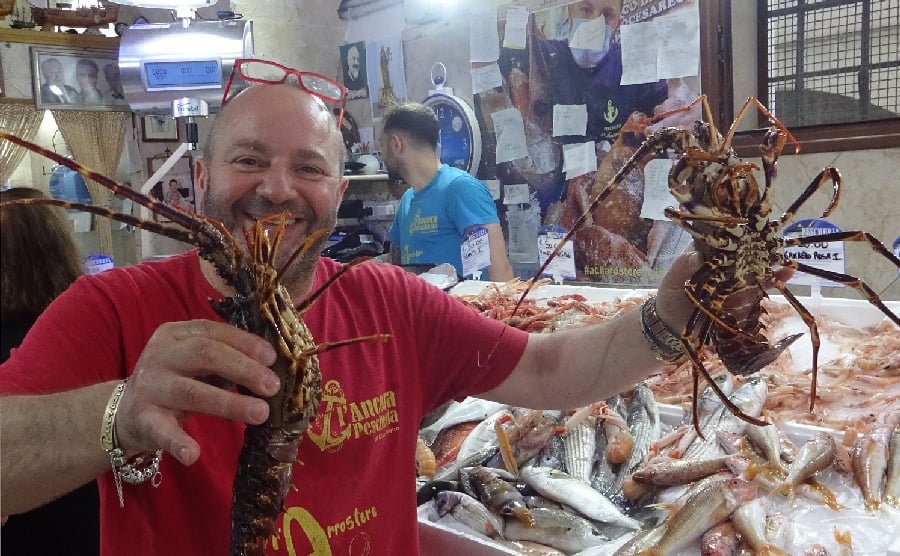
For example, eight generations of Dino’s family have sold fish in our local town and his son is set to carry on the business. Despite the supermarkets having fish sections, Dino and son have kept their customers because they have built a reputation for quality and an impressive selection of the seafood. Plus, Dino is a real character that people can have a laugh with. He has expanded the business from the fish stall his grandfather ran to now having a shop and a van. Delivering an incredible selection of seafood to hotels and for special occasions.
In the south, people are less trusting of buying online and cash is used a lot more than in the northern cities. To some extent people also have a greater loyalty to supporting local businesses when they can. But, with supermarkets like Eurospin and Chinese shops offering cheaper prices customers are being tempted away.
5. Can you find the shops you need?
When you go shopping, do you want to serve yourself and beep your card on a machine or be served by a real person? Someone who remembers your name, asks after your family and can answer your questions. It’s also nice to know your purchase will directly help support their family. The only place I have seen self-serve tills in Puglia is at a large shopping centre supermarket.
Hidden stores
Italian towns don’t always have an obvious high street where all the shops are situated. Old buildings can also make it difficult to have a big shop window or modern signage. I am still finding businesses I hadn’t noticed before, as they are hidden in back streets and along residential roads. But, they are there to be found, you just have to ask a local. Some shops will also have stalls at the weekly market.
Family run shops
There are greengrocers, butchers, bakers, farm shops, newspaper kiosks, shoe repairers, haberdashers, fabric shops, pharmacists, jewellers and shops where you can buy a gift and the assistant will wrap it beautifully with tissue paper, in a gift bag with a bow. Even when you buy a selection of cakes to take to a friend’s house, it is carefully wrapped either in a box or on a gold tray with wrapping and ribbon.
We should also mention the small farmers that pulls up on a street corner to sell whatever they have picked that morning. And the old man selling snails from a bucket on the back of his little three wheeled Piaggio.
An authentic lifestyle in a real town
In conclusion, It is a combination of these real characters, local businesses, a good town council (Comune) and the volunteers that organise the community events, that ensure Italian culture and local traditions continue. Find them and you’ll find an authentic Italian town where real life work commitments tick along quite happily next to a relaxed Italian lifestyle with friends and family.
In addition, it is the younger generation who bring life to a town by sharing their talents in dance, sport, art, music and getting involved in festivals and family businesses. I would recommend looking at towns (municipalities) with a population between 25,000 and 40,000, if you want a good selection of facilities, without the busy city vibe. Official population data can be found on istat. Which is also useful if you are looking for a small town with a population under 30,000, that could qualify for a fixed 7% tax on your retirement income.
Find a webinar for your plans
Choose what you need help with and when you want to attend. We will take you straight to the most relevant upcoming events.