


Whether you’re dreaming of a classic white cube house overlooking the Aegean, a modern city apartment or a peaceful sustainable villa, there’s a property type in Greece to suit every lifestyle. Here’s your guide to finding the Greek home that’s perfect for you.
The type of property you buy in Greece shapes almost everything else: your budget, your running costs, your rental potential and how much time you spend on upkeep. A cube house in Santorini and a village house in the Peloponnese can sit at opposite ends of the price scale, but both come with their own practical realities. This guide breaks down what each property type actually means for buyers in 2026 – including what you can expect to pay, where you’ll find them and what to watch out for.
Types of property in Greece
Greece offers seven main property types: white cube houses, city apartments, Venetian-style homes, village houses, beach resort properties, countryside villas and sustainable homes. The right choice depends on your budget, how much maintenance you want to take on and whether you plan to rent it out, live in it year-round or use it seasonally. Entry-level buyers tend to find the best value in village houses and city apartments; island villas and Venetian mansions sit at the higher end. Always check planning permissions and title deeds before committing to any property.
Contents
Types of Greek property
| Property type | Best for | Common locations | Entry price (approx.) | Upkeep level |
|---|---|---|---|---|
| White cube house | Holiday lets, island lifestyle | Cyclades, Dodecanese | €290,000 | Low–medium |
| City apartment | Year-round living, rentals | Athens, Thessaloniki | €80,000 | Low |
| Venetian-style home | B&Bs, character buyers | Corfu, Crete, Peloponnese | €400,000 | High |
| Village house | Community living, renovation | Crete, Rhodes, Corfu | €70,000 | Medium–high |
| Beach resort property | Low-maintenance holidays | Crete, Rhodes, Peloponnese | €125,000 | Low |
| Countryside villa | Privacy, lifestyle buyers | Mykonos, Corfu, Kefalonia | €300,000 | Medium–high |
| Sustainable home | Energy-conscious buyers | Nationwide | Varies | Low (long-term) |
Note: entry prices are approximate guide figures based on listed asking prices as of 2025–2026 and will vary by condition, location and proximity to the coast.
A white cube house
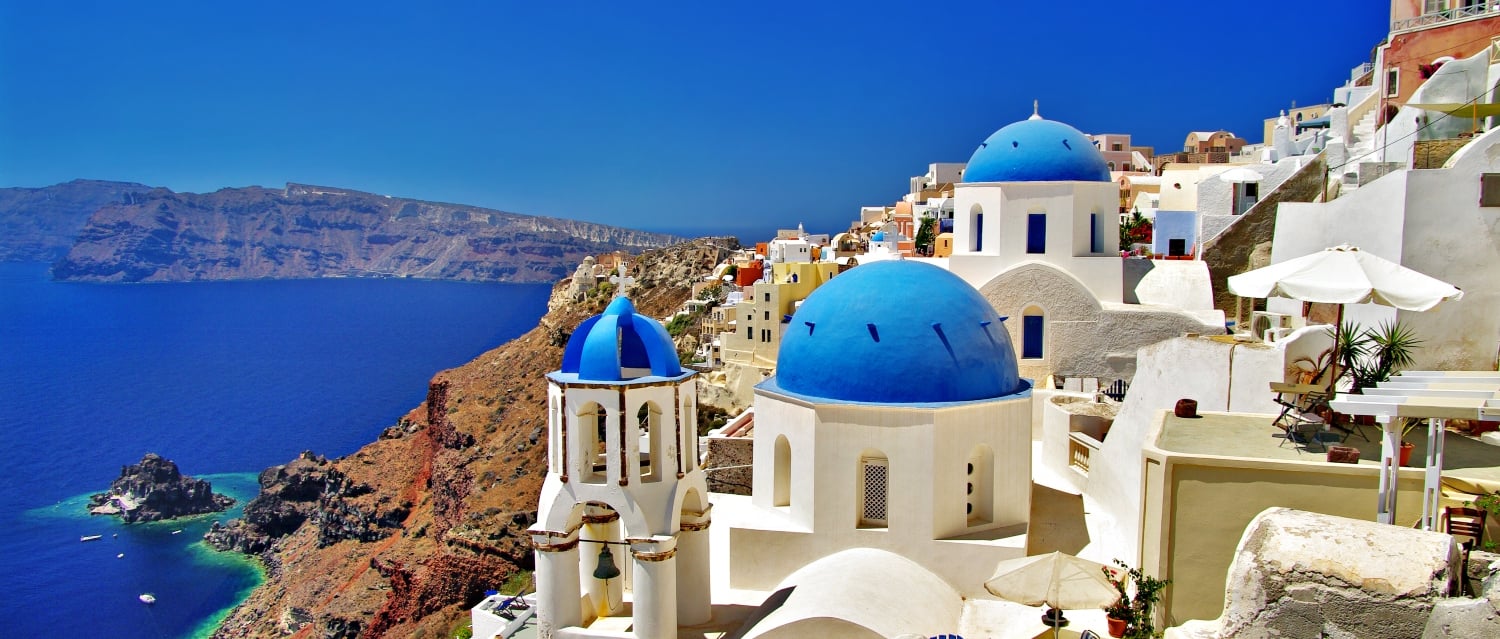
We’ve all seen photos of gleaming white houses, perched on a hillside overlooking the sea. Blue doors, windows and church domes beautifully picking out the blue of the sky. Built at a time when donkeys were the only transport, the charming streets of these villages are narrow and paved in stone. Often, the houses have small terraces with stunning views across flat roof tops to the sea. Inside these homes, the smooth white curves blend harmoniously into arches, steps and seating, creating the feeling of being in an ice cave. Which is just what you need on a hot summer’s day.
Why buy a cube house?
This type of Greek property has become what many people picture as the quintessential Greek holiday home. Therefore, you should have no trouble renting it out to tourists, when you aren’t using it yourself. Cube houses are usually located in holiday resorts that cater well to visitors, providing restaurants, bars, gift shops and stunning sunsets.
Where can I find a cube house?
You’ll mostly find these sugar cube houses in the Cyclades and Dodecanese islands. The ones we see in photos of Greece tend to be in Santorini. However, as the look is loved so much, you will find new villas in this style across Greece.
How much do they cost?
The price of a two-bedroom apartment in Santorini costs from €290,000. A two-bedroom villa can range from €330,000 to over a million. It’s all about location and views.
What does owning one actually involve?
Cycladic cube houses are generally low-maintenance in terms of exterior upkeep – the white render is traditional and widely serviced locally. However, properties on steep hillside sites can be tricky to access for deliveries or larger works. The narrow streets that give these villages their character also mean no parking at the door. If you plan to rent it out, short-term lets on the Cyclades perform well in summer but drop sharply outside July and August – worth factoring into any yield calculation.
A city apartment
City apartments in Greece range from studios to large homes with many bedrooms. They may be in new modern blocks or part of a historic building. Some have balconies or roof terraces with city views, while those on the coast may even have sea views. There are some really ultra-modern apartments being built with all the mod cons.
Why buy a city apartment?
Many city apartments are conveniently located for transport links, restaurants and shops. Plus, you will have all the city attractions and nightlife on your doorstep. Services such as high-speed internet, public transport and medical care will also be better in the city.
Where can I find a city apartment?
Areas of Athens that are popular with expats include Glyfada, Koukaki, Exarcheia and Kolonaki. However, Athens isn’t the only city in Greece. You may also consider one of Greece’s other cities, such as Thessaloniki, Ioannina and Larissa, which are towards the north of mainland Greece. Patras in the Peloponnese and Heraklion or Chania on Crete are also great options.
How much is a city apartment?
In Athens you can find two-bedroom apartments from €80,000. However, to get one in good condition in a nice area expect to pay anything from €360,000 to over a million. The average asking price for a two-bedroom apartment in the Athen’s historic centre in April 2025 was 3,613 €/m² (less in the suburbs), whereas in Thessaloniki it was 1.958 €/m², in Patras 1,194€/m², Larissa 1,145€/m², Heraklion 1.524€/m², Ioannina 1,618€/m² and Chania €3,635/m².
What does owning one actually involve?
City apartments are among the lower-maintenance options in Greece. Most are in managed blocks with communal costs (koinochristos) covering stairwells, lifts and shared areas – typically €50–€150 per month depending on the building. Athens in particular has seen strong rental demand since 2022, making central apartments attractive to investors as well as full-time residents.
A Venetian-style home
Venetian-style buildings are mostly seen on the waterfront of Greek ports. There are also some amazing Venetian style mansions, once owned by noble families and merchants. Venetian-style houses are often fairly tall, with windows and shutters neatly stacked above one another. Their terracotta-tiled roofs and colourful facades in pink, peach or yellow add warmth to the waterfront. Many also feature a central balcony with arches and metal railings.
Why buy a Venetian-style home?
Due to their size and great locations, they have become a popular type of property among expats wanting to run a small hotel or B&B. Those that are on historic waterfronts benefit from being close to seafront cafes and restaurants, as well as having sea views.
Where can I find one?
From 697AD to 1797, the republic of Venice expanded into parts of present-day Greece. Particularly, the Ionian islands, Cycladic Islands, the Peloponnese and Crete. They built a series of fortresses to secure important sea trade routes, such as Palamidi Fortress in Nafplio in the Peloponnese and Fortezza in Rethymno on Crete. These wealthy seafarers influenced the architecture in these port towns. Good examples are the Venetian style houses found in Corfu, Assos on Kefalonia, and Chania and Rethymnon on Crete.
How much do they cost?
Venetian houses usually cost from €400,000, but the more luxurious Mansions around Corfu tend to be around €1.5m.
What does owning one actually involve?
Venetian-style homes are among the most characterful properties in Greece – and among the most demanding to maintain. Older buildings may need significant work on the roof, windows, damp-proofing and wiring before they’re habitable to a modern standard. If you’re considering one as a commercial venture – running a small hotel or B&B – you’ll need to factor in licensing requirements under Greek short-let regulations, which have tightened since 2024. Many buyers work with a local architect from the outset to get a realistic renovation budget before making an offer.
A village house
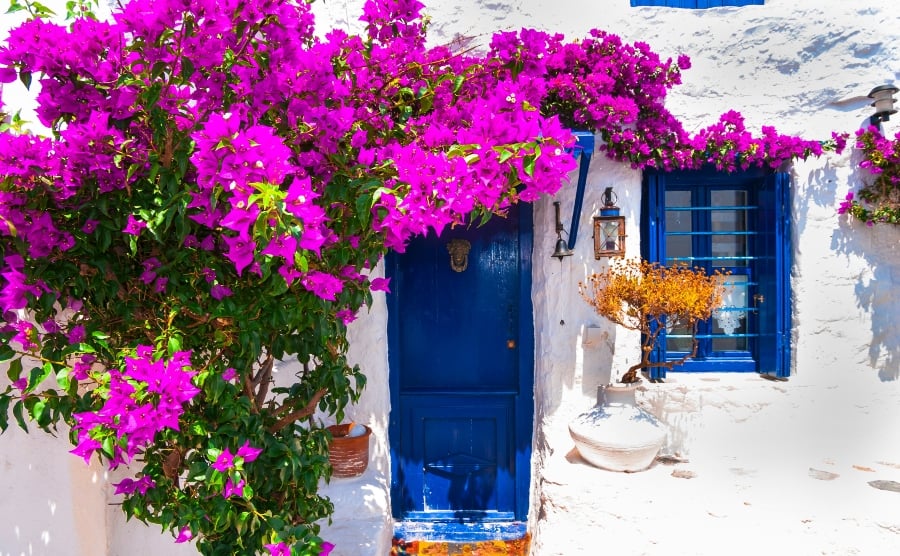 Traditional village house
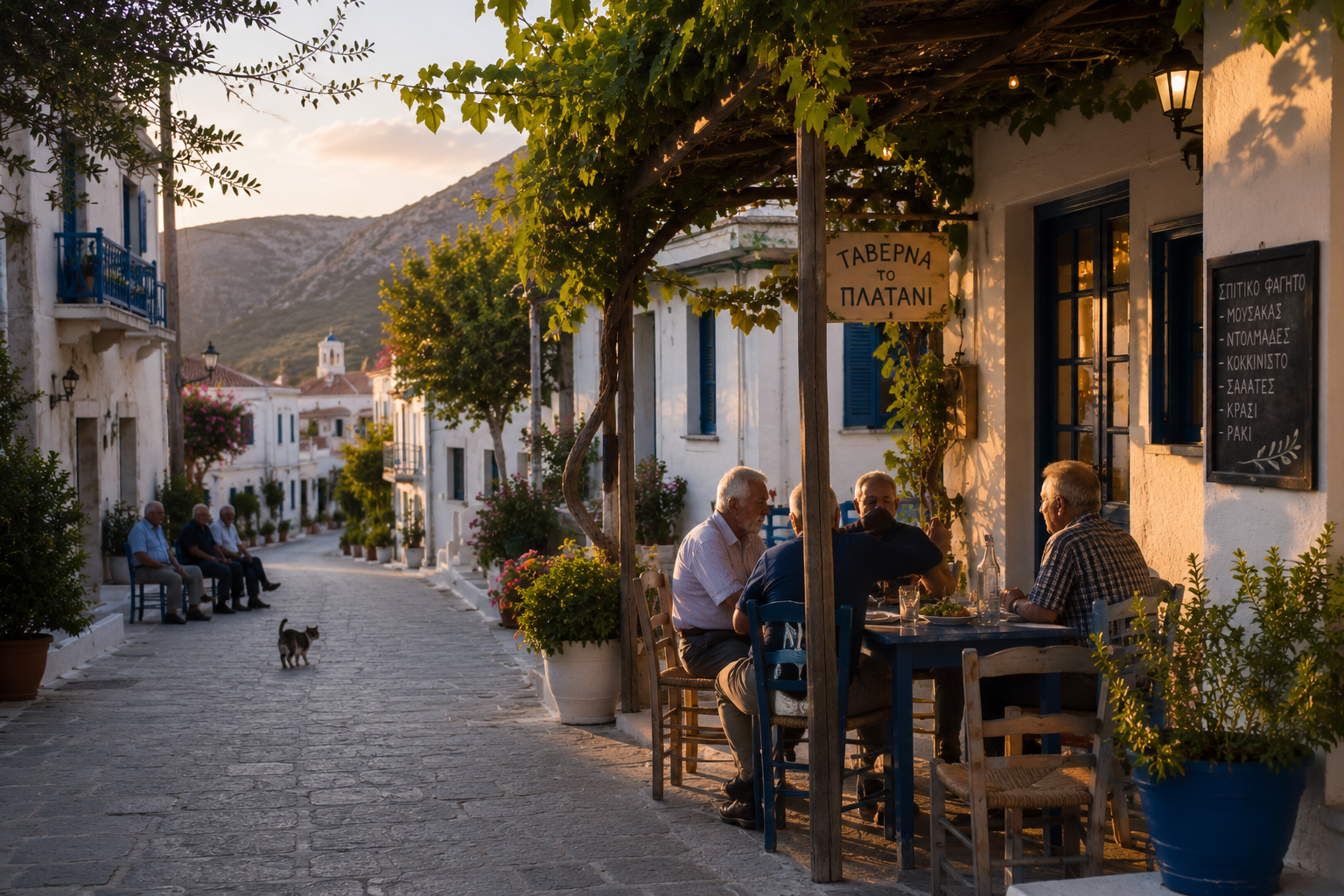
A typical village house in Greece has thick stone walls, a red tiled roof and blue windows and doors. With louvered shutters on the outside and windows that open inward, it allows the sun to be kept out, while still allowing some air to circulate.
Greek village houses often have a shady courtyard, where families can dine outside. Incredibly, some old village houses still have outdoor paving done in a mosaic pattern using large black and white pebbles. You may also notice that where the house is painted white, the bottom of the wall curves out at the bottom, creating a white border to the road. At Easter, it’s traditional to give this white edging a fresh coat of whitewash along the procession route.
If the village is in an elevated location, the house might also have a balcony to make the most of the amazing views. This tends to be constructed of wood with metal railings and made all the more beautiful with a pink bougainvillea climbing up to it. Ceilings are generally high with wooden floorboards on the first floor. However, the ground floor is generally stone or tiled.
Why buy a village house?
If you want to feel part of a Greek community, where everyone looks out for their neighbour, a village house is an excellent choice. They are usually within walking distance of a village shop, café, bakery and weekly market. Village houses in the mountains and by the sea may also have amazing panoramic views.
Where can I find one?
You can find charming villages all across Greece. Some of the most popular villages are on Crete, Mykonos, Rhodes, Corfu and Halkidiki. But there are many still waiting to be discovered by foreign house buyers.
How much is a village house?
The price of village houses can vary greatly, depending on location, condition and popularity with tourists. But as a guide, prices start from around €70,000. If a property in your dream location is above your budget, simply spread your search to other villages nearby. By heading inland, the prices become much more affordable. It is in the more remote villages that you will find cheap houses to renovate.
What does owning one actually involve?
Older village houses often need modernising – new wiring, plumbing and kitchen or bathroom upgrades are common. That’s reflected in the price, and many buyers deliberately seek out renovation projects. Costs vary considerably by island and region: labour is typically cheaper on the mainland than on the more popular islands. Before buying any rural or village property, have a lawyer check the title deeds carefully – boundary disputes and unregistered extensions are not uncommon in older village stock.
A beach resort property
Types of properties in modern beach resorts tend to follow the blue and white colour palette loved by tourists, with the addition of bigger windows and covered verandas. Whether you choose a villa or an apartment, you will find modern shower rooms and a basic kitchen for preparing summer meals. A bonus feature is a terrace or balcony with a view of the sea.
In a modern resort complex, there may also be communal facilities such as a swimming pool, gardens, spa etc. with services available to take care of the property in your absence. There are also five-star resorts that have a golf course, world-class dining, sport facilities, a wellness centre and access to a private beach.
Why buy a property in a resort?
A beach resort villa or apartment is ideal if you want to use it just for summer holidays. If you dream of long days on the beach and then strolling back home for a shower before heading out to a bar or restaurant, this is the place for you. The properties can be quite modern and low maintenance, with property management services available nearby. They can also achieve good holiday rental rates in the summer months.
Where can I find one?
The bigger islands, such as Crete, Rhodes, Mykonos and Paros have smart beach resorts, as do the coast southwest of Athens and in the Peloponnese.
How much is a resort property?
Two-bedroom villas and apartments in a complex with pool and gardens can start from as little as €125,000. But for large luxury villas, the prices run into the millions.
What does owning one actually involve?
Resort properties are the most hands-off option for buyers who won’t be in Greece full-time. Many complexes offer on-site management services that handle cleaning, maintenance and holiday lets in your absence. Service charges vary – typically €1,500–€3,500 per year for a two-bedroom apartment in a well-managed complex, though larger villa plots cost more. Rental income from Greek island resorts can be strong in peak season (June to September), but occupancy outside that window is limited.
A countryside villa
Countryside villas can vary in style, but generally have enough outside space for a large, covered veranda and pool. Facades are usually stone or painted white to reflect the sun, with big windows and tiled or flat roofs, plus a solar panel for hot water. Whether it’s an old or new property, the best villa designs are those using local materials in their construction that blend in with the surrounding landscape. The scent of wild herbs and the beautiful colours of geraniums and climbing bougainvillea add that touch of Greek charm to the most modern villa.
For something a bit different, take a look at the Mani tower houses in the south of the Peloponnese. These towers were constructed between the 17th and 19th centuries as fortified residences to protect families of great influence. Today some tower houses have been renovated and extended. In addition, new homes are also being built with towers.
Why buy a countryside villa?
A countryside villa can offer privacy and tranquillity in natural surroundings. They also have the space to park a car and have a garden, pool and outdoor seating area. This means you can totally relax in your own space, without having to fight for a sun lounger. Some villas also have stunning panoramic views of the mountains or the sea.
Where can I find one?
Mykonos, Santorini and Paros are among the top Greek islands to buy a luxury villa. However, there are beautiful villas dotted around the countryside all across Greece. Corfu, Kefalonia and Crete have some very stylish villas.
How much do they cost?
A two-bedroom villa with a pool can cost from around €300,000 and run into the millions.
What does owning one actually involve?
Villas with pools and gardens take the most ongoing maintenance of any property type here. Pool maintenance alone typically runs to €1,500–€2,500 per year if you’re using a local service. Gardens in the Greek climate need irrigation systems and regular attention. That said, many villa owners offset costs by renting out during peak months – Mykonos, Santorini and Corfu villas can command strong weekly rates in July and August.
A sustainable home
Sustainable homes with low energy costs have become increasingly popular with house buyers in Greece. Greece’s push towards greener housing is reflected in national energy efficiency standards and renewable energy initiatives, overseen by the Greek Ministry of Environment and Energy. With over 3,000 hours of sunshine per year, Greece is perfectly situated to harness the power of the sun. Solar panels for hot water are a top priority, and photovoltaics for electricity can greatly lower energy bills. Other features to look out for are windows with shutters, blinds or a covered veranda to help keep the heat out. The building should also be properly insulated and have windows on either side to get a through breeze at cooler times of the day.
Old stone houses are one type of property in Greece that already has many sustainable features, such as walls built from local stone. Some can be as much as a metre thick, which stops the heat radiating all the way through. High ceilings and the position of doors, windows and bedrooms can help maximise the use of the wind and sun to heat and cool the home. A real bonus is a house with a cool room located partly underground.
Why buy a sustainable home?
Eco-friendly houses both respect the environment and save you money on energy bills. A win-win for both the house buyer and the planet.
Where can I find one?
If you want a house that is built sustainably and is eco-friendly, it helps if the authorities and community around it think the same way. Many of the islands have recognised the need to reduce waste, cut down on the use of plastics and produce greener energy.
Tilos island was the first island in the Mediterranean to be entirely self-sufficient in energy and recycles 90 percent of its rubbish. The island of Astypalaia has replaced 1,500 engine vehicles with 1,000 electric vehicles. Even in the small town of Arkalochori, on Crete, a group of people have founded the Minoan Energy Community. Here, energy is produced by two photovoltaic parks, supplying around 300 members of the community with free electricity.
Building with stone is a tradition that’s still very much alive in Greece, particularly in the north, Pelion, Crete and the Peloponnese. Even on the small Island of Tinos, a team of people have built stone “Ecolodges”, with the aim of becoming self-sustaining. In fact, greener homes are being built across the country, including ultra-modern apartment blocks in Attica and Crete.
What does owning one actually involve?
Energy performance certificates (EPCs) are legally required for all property sales in Greece. When viewing any property, ask to see the energy certificate – properties rated A or B will be significantly cheaper to run than older stock. Solar panels for hot water are near-universal in newer builds and add genuine long-term value. If you’re buying an older property with the intention of improving its energy rating, grants and low-interest loans are available through the Greek government’s Exoikonomo programme, which has run in various forms since 2020. Check current eligibility at ypen.gov.gr before budgeting.
Final thoughts
Whichever type of property in Greece you choose, it’s worth investing in one that is built to last – just as the Parthenon in Athens has stood for 2,500 years.
What should I do next?
If you’re still deciding which type of Greek property suits you, the most useful next step is usually a viewing trip – seeing the same budget in a cube house, a village house and a resort apartment in person is the quickest way to narrow things down.
If you’re a non-EU buyer considering property as a route to Greek residency, the golden visa programme has specific investment thresholds that vary by location – our guide to Greece golden visa property rules in 2026 covers what’s changed and what it means for buyers.
When you’re ready to move forward, it’s worth getting a currency plan in place early. Exchange rate movements between the pound and euro can affect your budget by thousands of pounds – speak to a currency specialist to protect your buying power.
Speak to a Greece property expert
Frequently asked questions about houses in Greece
You’ll find a wide variety of property styles across Greece. Classic white cube houses are common in the Cyclades, while Venetian-style homes line the waterfronts of islands like Corfu and Crete. Village houses with stone walls and tiled roofs are dotted throughout the mainland, and modern city apartments are available in Athens and Thessaloniki. In addition, there are countryside villas, beach resort properties and increasingly popular eco-friendly sustainable homes.
The biggest risks come from unclear ownership rights, incomplete building permits and properties built without proper authorisation. Some rural homes may also have access or boundary disputes. Without legal checks, buyers can be caught out by hidden debts or inheritance claims tied to the property. The safest route is to appoint an independent Greek lawyer who specialises in property law to conduct due diligence before you sign anything.
Greek property prices are often lower than in other parts of Europe because the market was hit hard by the financial crisis of the late 2000s. While prices are recovering, they still remain attractive compared with Spain, Italy or France. Cheaper homes are usually found in inland villages or less touristy regions, where demand from overseas buyers is lower. Renovation projects also tend to be priced affordably, reflecting the investment needed to modernise them.
Beach resort apartments and island villas produce the strongest short-term yields in peak season, particularly on Mykonos, Santorini, Crete and Rhodes. Athens city apartments have performed well for year-round lettings since 2022. Any rental property must be registered with the Greek tax authority (AADE) and declared on your annual tax return.
Yes, in most cases. EU citizens can buy without restriction. Non-EU buyers – including British nationals – can also buy freely in most of Greece, but properties in certain border areas and some islands require additional approval from the Greek Ministry of Defence. Your lawyer can confirm whether a specific property falls in a restricted zone.
Village houses in inland or less-visited areas offer the lowest entry prices – sometimes under €50,000 for a renovation project. City apartments in Thessaloniki, Patras and Larissa are also significantly cheaper than Athens or island equivalents.
You might also like: