

The Peloponnese gives you sea, mountains, history and genuine village life – on a mainland that most Greece buyers overlook.
Most people searching for a home in Greece head straight for the islands. But if you’ve ever spent time on the mainland, you’ll know the Peloponnese is worth a much closer look. It has everything: a long coastline, medieval towns built into cliffsides, mountain villages, olive groves… And because it tends to sit outside the usual island shortlist, property prices here are still relatively affordable – for now.
The region is technically a peninsula, connected to the rest of Greece by a narrow strip of land at Corinth. But since the Corinth Canal was cut through that isthmus back in 1893, it functions as an island in all practical terms. Cross the bridge from Athens and within an hour you’re in a different world – stone tower houses rising above olive trees, fishing boats coming into harbour, Byzantine ruins set against the backdrop of the Taygetus mountains. If you haven’t visited, do so before you rule it out.
Contents
Where to buy in the Peloponnese
The region divides broadly into a handful of distinct areas, each with its own character and price level. Below is a guide to the ones that attract most interest from overseas buyers.
The Mani
The Mani peninsula is the long finger of land that points south into the Mediterranean between the gulfs of Messinia and Lakonia. It’s dramatic country – bare rock, ancient olive trees, fortified villages and a coastline that swings between shingle coves and open sea. Writer Patrick Leigh Fermor settled here in the 1960s, building a house above the sea at Kalamitsi with his wife Joan. The house is now run by the Benaki Museum and open for tours; it’s become a draw for visitors in its own right.
Kardamyli, the village just up the coast, is the most well-known part of the western Mani and gets busy in summer. If you want somewhere quieter, the Lakonian (eastern) Mani – Areopoli, Gytheio, the deep south villages of Vathia and Gerolimenas – still has that sense of being on the edge of somewhere. The landscape is harsher, the villages smaller and the prices noticeably lower.
The Mani’s stone tower houses are what draw many buyers here. These tall, square structures were originally built for defence, and some date back centuries. A renovation project in the Lakonian Mani – a roofless or partially derelict tower – will typically ask €120,000-€250,000 (approximately £102,000-£212,000). Restored examples in good condition start at around €300,000, and the top end of the market for a fully renovated tower with sea views can reach well over €1 million.
Traditional stone village houses offer more choice at more accessible prices. Liveable properties in the Lakonian Mani often ask €85,000-€120,000 (£72,000-£102,000); in the western Mani villages, which attract more international interest, expect to pay €120,000-€350,000 for comparable quality. Newly built stone maisonettes – a popular option for buyers who want the Mani look without the renovation project – range widely, with prices in the western Mani running €350,000 upwards and going considerably higher for premium sea-view developments.
One practical note: much of the Mani falls within designated traditional settlements, which means renovation permits can take six to 12 months and come with strict rules on materials and finishes. If you’re looking at anything that needs significant work, factor that into your planning from the start.
Gytheio
Gytheio is a working coastal town rather than a holiday resort, and it’s a better place to live for it. The harbour is active, the promenade has good tavernas and the town has enough going on that you won’t feel isolated in winter. It’s also the main gateway to the southern Mani, with easy access to beaches, walking trails and the Diros caves.
Property prices sit at the more affordable end of the Lakonian market. One-bedroom apartments in the town ask around €60,000-€95,000 (£51,000–£81,000); larger or newer properties with sea views typically run €200,000-€360,000. Detached houses on the outskirts and surrounding villages, often with gulf views, ask €220,000-£495,000 depending on size and condition.
The area around Gytheio is also home to one of Greece’s loggerhead sea turtle nesting beaches, which is worth knowing if conservation matters to you – there are local volunteer programmes you can get involved with once you’re settled.
Kalamata
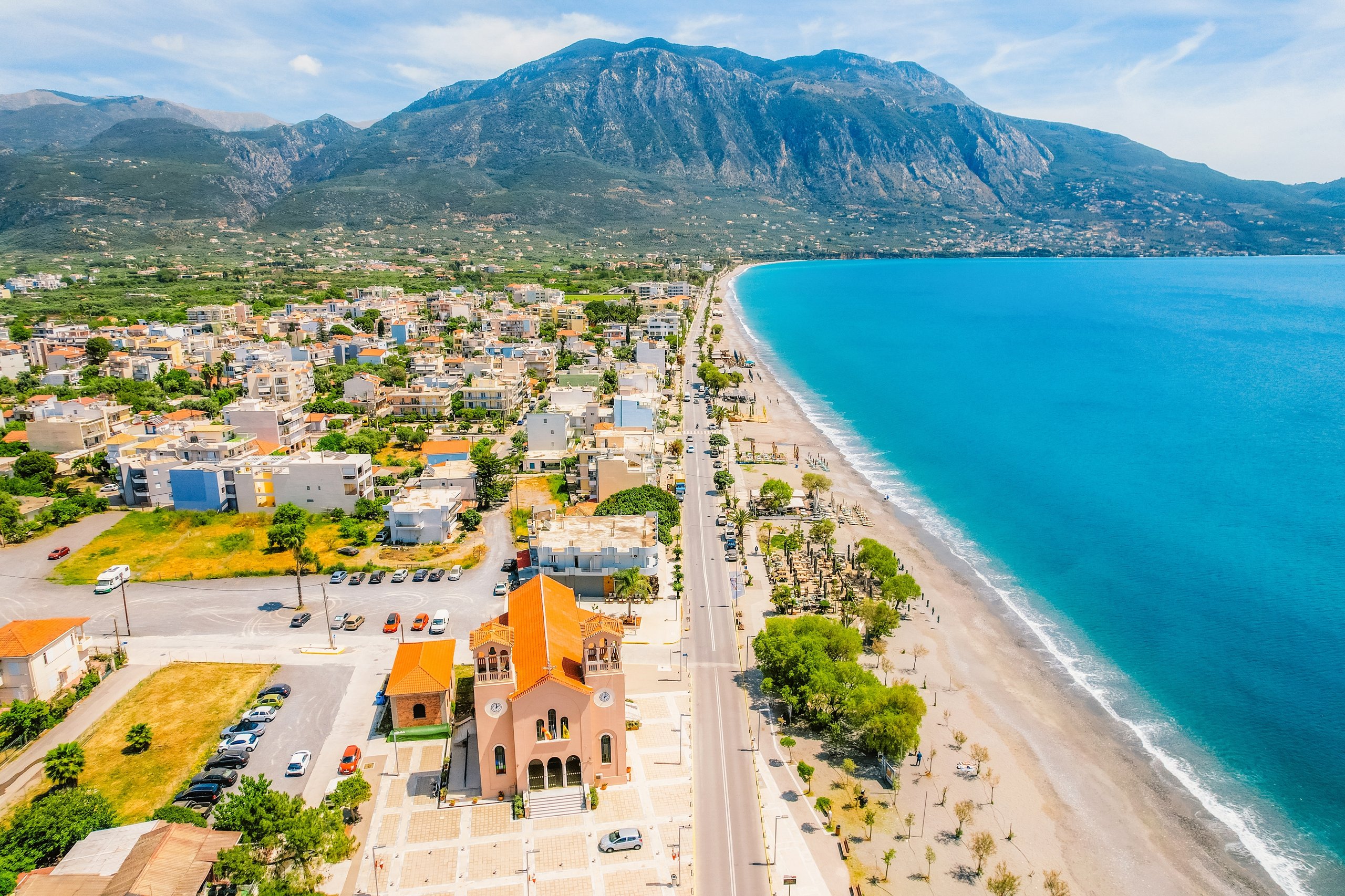
Kalamata has changed a lot in recent years. The city has a revitalised seafront, a growing food scene and – crucially for overseas buyers – an international airport that is expanding fast. For 2026, Kalamata Airport is operating 22 destinations across 31 direct routes, with new flights from London Gatwick, Edinburgh, Hamburg and Budapest. Passenger numbers grew by nearly 12% in 2024 and international arrivals rose by more than a quarter in 2025. If you’re planning to travel regularly between the UK and your home here, that connectivity makes a real difference.
It also has a public hospital, a university and the full range of services you’d expect from a regional city – all things that matter for full-time living and that many smaller Mani villages simply can’t offer.
Kalamata is the Peloponnese’s most expensive property market, though that’s relative. The city averages around €2,461 per square metre. Older apartments in less central areas start at €80,000-€150,000; newer builds in the city centre typically ask €2,300-€3,500 per square metre. Seafront properties are at a different level – new maisonettes on the Navarinou waterfront ask €700,000 upwards, and some luxury apartment developments have been listed close to €1 million.
Kalamata is also well known as the home of those olives. The ones sold in every deli back in the UK taste considerably better when you buy them in the market here.
Want to know what buying in Kalamata actually looks like? Read about one reader’s unexpected experience.
Sparti
Modern Sparta – Sparti in Greek – is a straightforward provincial town set on a wide agricultural plain, with the Taygetus mountains to the west and Mount Parnonas to the east. It’s not a tourist destination, which for many buyers is a mark in its favour. The ruined Byzantine city of Mystras is a short drive up into the hills; the weekly market, the kafeneions on the main square and the olive oil festival in August give daily life a pleasantly unhurried rhythm.
Property prices are the lowest of the areas covered here, which makes Sparti worth considering if your budget is tighter or if you want more space for your money. The municipality averages around €1,081 per square metre. A two-bedroom apartment in the town centre typically asks €78,000-€95,000 (£66,000–£81,000); newer builds with parking and solar panels run €120,000-€180,000. Larger detached homes in the surrounding villages are proportionally good value – many four- and five-bedroom properties ask under €300,000.
The village of Kladas, just outside Sparti, has become a draw for buyers who want a bit of distance from the town while staying within easy reach of it. Prices are in line with the broader Sparti market, though larger renovated properties can reach considerably higher.
Monemvasia
Monemvasia is one of those places that takes a moment to process. It’s a medieval town built into and onto a huge sea rock, connected to the mainland by a single narrow causeway – the name means, roughly, “one entrance.” Walking through the tunnel in the outer wall into the village beyond, with Byzantine churches, stone houses and the sea on three sides, is genuinely unlike anything else in Greece.
Property inside the Kastro – the medieval citadel – reflects that uniqueness in its pricing. Well-restored houses within the walls now ask €970,000 upwards, and premium seafront complexes can reach €2.5 million. If that’s beyond your budget but the area appeals, the broader Monemvasia municipality is a very different market. Village houses in the surrounding settlements can be found for €23,000-€60,000 as renovation projects, and well-presented stone homes with sea or castle views ask €170,000-€310,000. The drive to the Kastro is short, and you’d have much of what makes Monemvasia special without the price tag that comes with living inside the walls.
What you need to know about the market right now
Greece’s property market has seen meaningful regulatory changes over the past couple of years, and it’s worth understanding them before you start viewing.
The golden visa programme – which grants EU residency rights in exchange for a qualifying property purchase – was restructured in 2024. The Peloponnese falls into the lower-threshold category, requiring a minimum investment of €400,000 in a single residential property of at least 120 square metres. That’s a significant increase from the old €250,000 threshold, but considerably lower than the €800,000 now required in Athens and the major islands. With Spain’s equivalent programme having closed in April 2025 and Portugal’s real-estate route already gone, Greece is now one of the very few EU countries still offering residency through property investment at this price level.
Download the golden visa guide
One important caveat: Golden visa properties cannot be let on a short-term basis. Airbnb-style rental is explicitly prohibited and can result in the residency permit being revoked at renewal. If rental income is part of your plan, you’ll need specialist legal advice before you commit. Greece also introduced new national regulations for all short-term rentals in October 2025, covering fire safety, insurance and registration requirements.
Property prices across the Peloponnese have continued to rise, though more moderately than a couple of years ago. The region as a whole is running at roughly 7–8% annual growth in asking prices, with Kalamata at the top of that range and the inland Lakonian markets at the lower end. For buyers coming from the UK, currency movements add another variable – locking in your exchange rate through a forward contract before you exchange can remove a significant element of uncertainty from the process.
How to approach your search
The Peloponnese is large enough that it really is worth spending time in different areas before settling on one. Distances between Sparti, Gytheio, Monemvasia and the western Mani villages are manageable, and a week based in different spots will tell you far more about where you’d want to live than any amount of online research.
A good local solicitor is essential – title complications and building permit issues are common, particularly with older rural properties and anything in a designated traditional settlement. Independent legal advice, taken before you sign anything, is not optional here.
If you’d like to explore further, our Greece Buying Guide covers the legal process, costs and financing in detail. Our team can connect you with trusted lawyers and currency specialists who work with buyers in this market regularly.