


Older properties dominate the Greek market – and for buyers willing to roll up their sleeves, that spells opportunity.
Greece has long attracted overseas buyers with its combination of low entry prices, strong rental demand and a way of life that’s hard to replicate elsewhere. But the real story isn’t the glossy new-builds. According to the Athens Times, in 2024, 66.1% of property buyers in Greece purchased a home built more than 20 years ago [1]. For renovation-minded buyers, that’s an important signal.
Download the Greece Buying Guide
Contents
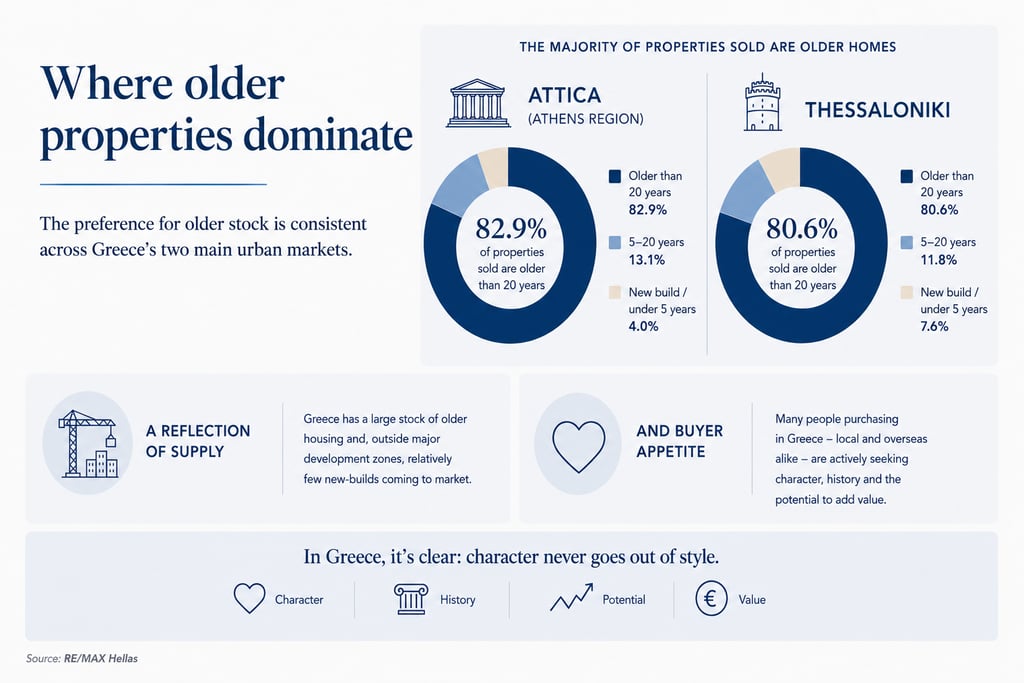
Where older properties dominate
The preference for older stock is consistent across Greece’s two main urban markets. In Attica – the region that encompasses Athens – 82.9% of properties sold could be classified as older homes, with newly built homes and those under five years old accounting for just 4% of transactions. Thessaloniki tells a similar story: 80.6% of sales involved homes older than 20 years, with newer properties making up 7.6% of the market.
Part of this is simply a reflection of supply. Greece has a large stock of older housing and, outside major development zones, relatively few new-builds coming to market. But it also speaks to buyer appetite. Many people purchasing in Greece – local and overseas alike – are actively seeking character, history and the potential to add value.
New-build or resale? What suits you best
There are genuine advantages to buying new. A property under five years old will typically come with modern finishes, energy-efficient systems and air conditioning already installed – a practical consideration in a country where summer temperatures regularly exceed 35°C. Some developers offer off-plan properties, where you purchase from plans and pay in staged instalments through to completion, which can ease the financial pressure. If you want to move in with minimal fuss, a new-build may well be the right choice.
Older properties, however, offer something different: the chance to buy below market value and create a home that suits your exact vision. In Athens and across the Greek mainland and islands, well-located older homes can be acquired at a significant discount – and a well-executed renovation can substantially increase their value. The key is going in with your eyes open.
One further consideration when comparing the two: developers of qualifying new-builds can currently elect to suspend the standard 24% VAT on the sale, a measure extended by the Greek government until the end of 2026. Where this applies, buyers pay only the 3.09% property transfer tax rather than VAT – a saving worth factoring into your calculations. Not every development qualifies, as it depends on the developer’s election, so ask your lawyer to confirm the VAT position on any new-build you’re considering.
Renovation costs
The renovation opportunity in Greece is real, but it requires careful budgeting. As a guide, a standard turnkey renovation in Greece currently runs at around €1,000 to €1,600 per square metre – and on the islands, where logistics add complexity, costs can push toward €2,000 per square metre or beyond. A well-located 80 sq m Athens apartment could therefore require €80,000-€130,000 of work before it’s ready to sell or let. That’s not a reason to walk away, but it does mean the numbers need to be stress-tested before you commit.
The profit potential only materialises if you go in with a realistic budget. Get detailed quotes from local contractors before you exchange – and factor in architect and permit fees, which can add meaningfully to the total.
Tips for a successful renovation in Greece
Calculate the full costs before you buy
A low asking price can be deceptive. Factor in structural repairs, rewiring, plumbing upgrades and any professional fees before deciding whether the numbers work. If you’re planning to do some of the work yourself – decorating, tiling, landscaping – that can meaningfully reduce costs, but be honest about your skills and the time you can commit.
Confirm what’s permitted before you sign
Greece has planning rules that can catch buyers off guard. Certain renovations and structural changes require a building permit, and what’s permitted can depend on the property’s age, its listed status and its location within a specific zone. Discuss your plans with your estate agent and a qualified Greek lawyer early in the process – before you fall in love with a property you can’t modify.
Speak to a Greece property expert
Prioritise the changes that add real value
If budget or time is limited, focus on the improvements that buyers and renters value most: energy efficiency upgrades, a functional modern kitchen and air conditioning. These are the changes that shift a property from unlettable to lettable, and from difficult to sell to genuinely desirable.
Protect the features that make it special
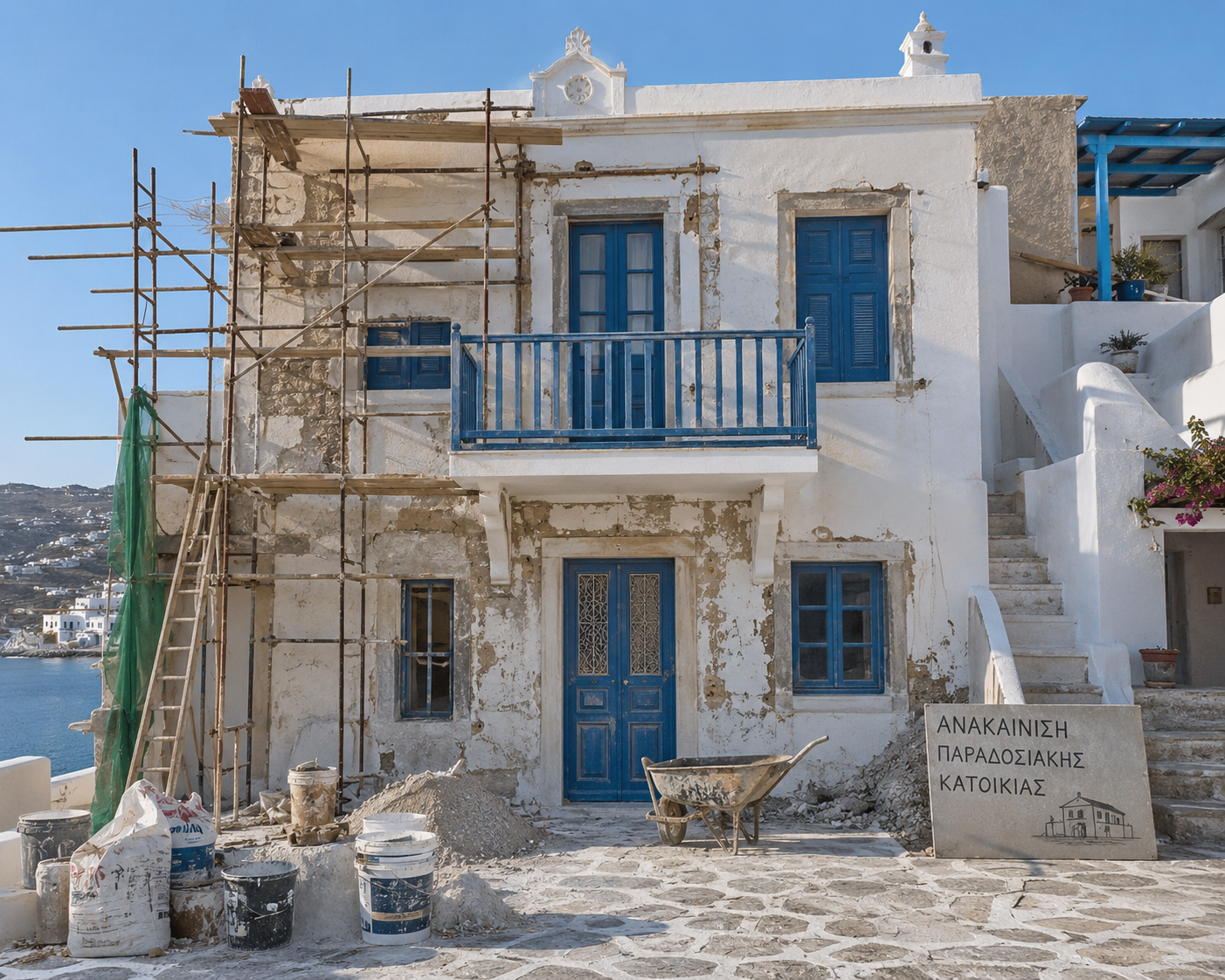
On the Greek islands and across rural mainland Greece, older properties often have architectural character that simply can’t be replicated in a new-build: stone facades, exposed wooden beams, whitewashed walls and the deep blue accents associated with Aegean architecture. Buyers seeking a “proper” Greek home are often specifically looking for these details. Where they exist, preserve them – they are frequently the feature that justifies a higher sale or rental price.
Check for an Electronic Building Identity
There is one further legal requirement that catches some buyers of older properties off guard. Every property transfer in Greece now requires an Electronic Building Identity – a digital record that must match the property’s actual layout. For homes built in the 1970s or 1980s, the original plans often differ from how the property looks today: enclosed balconies, added rooms, altered layouts. Where discrepancies exist, they need to be resolved before the sale can proceed, which can delay completion by weeks or months. Your lawyer and a qualified civil engineer should check this early in the process, not at the last minute.
Ready to start your search?
The Greek property market rewards buyers who do their homework. Whether you’re drawn to an Athens apartment with urban potential or a weathered stone house on a quieter island, the renovation route can offer a meaningful return – alongside a project that is, at its best, genuinely rewarding.
Sources:
[1]: https://athens-times.com/why-greeks-prefer-older-properties-a-market-trend-analysis/