
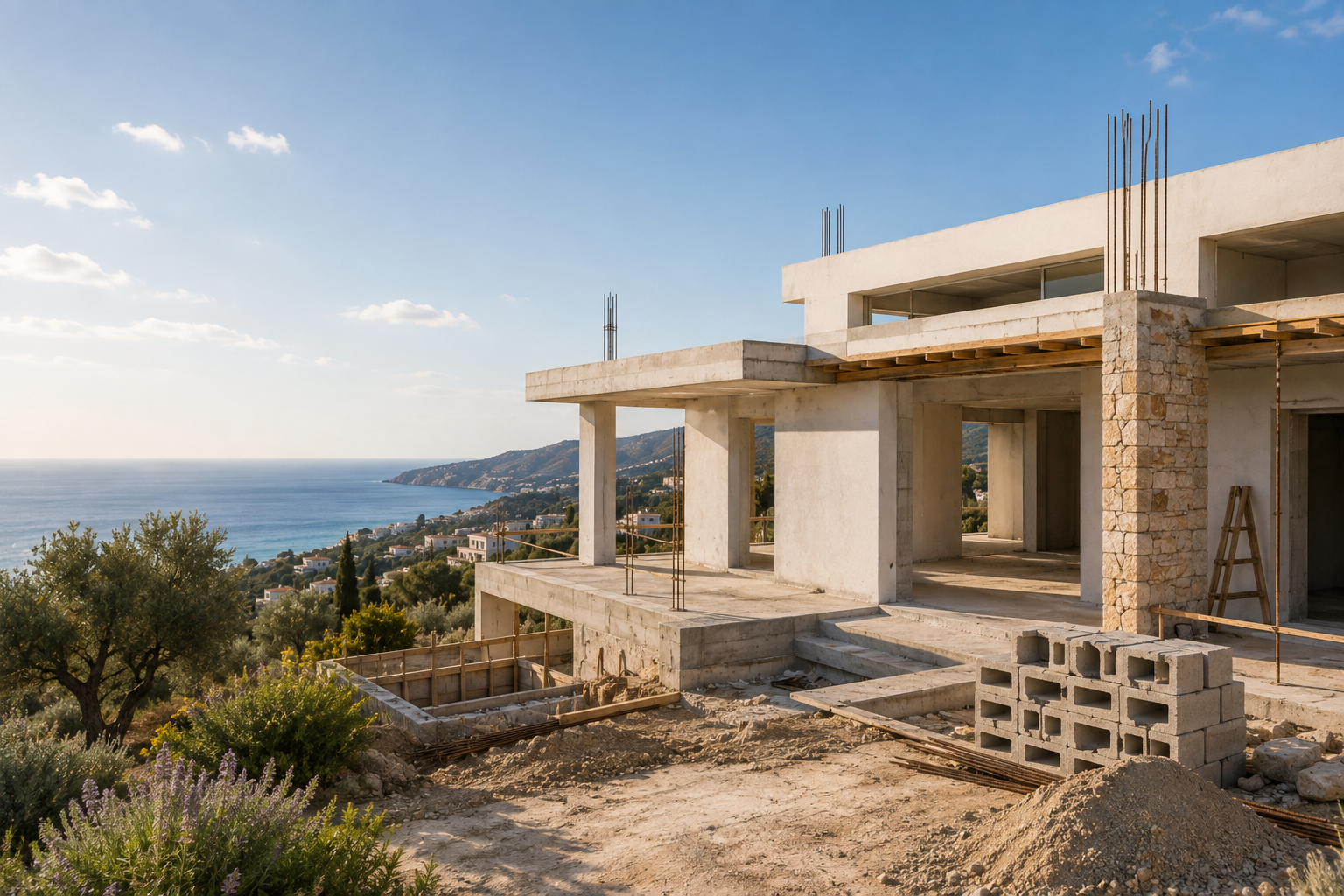
Building costs remain the biggest pressure on a Cyprus self-build budget and financing has crept back up in 2026 after two years of falling rates – though it’s still cheaper than the 2023–24 peak and permit waiting times have come down sharply. Here’s what to plan for.
Cyprus has long appealed to international buyers who want to design a home from scratch rather than take on someone else’s choices. Building costs are climbing, but the government has cut planning permit waiting times dramatically, and financing – while it’s ticked back up in 2026 after two years of falls – remains below the highs of 2023 and 2024. If you’re weighing up a self-build in Cyprus, here’s what the current picture actually looks like.
In short: Building your own home in Cyprus in 2026 typically costs €1,700-€2,500 per square metre for the construction itself, excluding land. Add land, fees and finishes, and a self-build still tends to work out cheaper than buying an equivalent turnkey new-build from a developer, though not necessarily cheaper than a comparable resale home. Planning permits for a standard house are now targeted at around 40 working days, though financing has become more expensive again in 2026 after two years of falling rates, so it’s worth checking current mortgage pricing before you budget.
Contents
- What Cyprus’s property market looks like today
- New-build activity across Cyprus
- What it costs to build in 2026
- Getting a building permit
- The 5% VAT scheme – and how it works
- Building to Cyprus’s seismic and energy standards
- Self-build versus buying resale
- Getting the foundations right
- Frequently asked questions
What Cyprus’s property market looks like today
Interest rates fell steadily through 2024 and 2025 but have since turned back up. The European Central Bank raised its deposit rate to 2.25% in June 2026 – its first increase since 2023 – as conflict in the Middle East pushed eurozone inflation higher. Cyprus mortgage rates have followed the same path: the Central Bank of Cyprus recorded a weighted average rate on new housing loans of 3.09% in March 2026, before it climbed to 3.73% in April and 4.06% in May. However, financing is still considerably cheaper than the highs of 2023–24.
Demand from international buyers – who tend to purchase in cash and are less exposed to rate movements – has kept the wider market moving regardless. Cyprus’s Property Price Index rose 7.1% year-on-year in the final quarter of 2025, which the Central Bank attributes to strong demand from both local and overseas buyers, gradual supply growth, and construction costs that remain historically high.
For anyone planning to buy land and self-build, rising finance costs alongside rising build costs make it more important than ever to get your budget right from the outset. Our guide to how to buy property in Cyprus covers mortgages, costs and legal steps in more detail.
Download the Cyprus Buying Guide
New-build activity across Cyprus
Cyprus’s wider new-build sector – which includes developer-led projects as well as individual self-builds – had a record year in 2025. According to the Cyprus Statistical Service, 8,159 building permits were authorised across the year, with the total value of permitted projects up by more than a third and the number of dwelling units up over 40%. A sharp mid-year dip in permit numbers was largely down to the transfer of licensing authority from municipalities to new district organisations rather than any drop in underlying demand; activity recovered strongly in the second half of the year.
Property sales were also up by around 13% in the first eight months of 2025. Limassol and Paphos continue to lead demand from overseas buyers. If you haven’t yet settled on a location, our region-by-region guide to where to buy property in Cyprus is worth reading before you commit to a plot.
What it costs to build in 2026
Budget around €1,700–€2,500 per square metre for the build itself, excluding land. That’s the realistic range Cyprus-based builders quote in 2025–26 for a full job, including outdoor spaces and external work such as driveways, boundary walls and landscaping. If you see a quote well below €1,700/m², check what’s missing – it usually means some of that scope has been left out.
| Specification | Cost per m² (excl. land) | GBP equivalent* |
|---|---|---|
| Standard finish | €1,700 | £1,445 |
| Higher specification | €2,500 | £2,125 |
*Approximate, based on €1 = £0.85. Figures exclude land, which varies enormously by location.
You may also come across a lower official government average, of around €1,200/m². That figure comes from the Cyprus Statistical Service’s data on projects completed in 2023, and doesn’t include the external works above – useful as a benchmark, but not what to budget against.
Materials have got steadily more expensive since 2021, though the pace has slowed since the sharp spike in 2022.
Getting a building permit
All planning and building permit applications in Cyprus go through a digital system, with authority for issuing permits held by five district organisations. For a standard private home, the official target is around forty working days combined for planning and building permission. If no decision is issued within the window, the permit is automatically granted.
That said, buyers should treat the 40-day figure as an official target rather than a guarantee. The system is still bedding in, and some backlogs have been reported since the reform launched. Appointing an ETEK-registered architect early, and building in some contingency time, remains sensible. As with the buying process generally, having the right professionals in place from the start makes a real difference – our guide to the Cyprus property buying process explains how to build that team.
The 5% VAT scheme – and how it works
A reduced 5% VAT rate is available on a first primary residence. Under the current rules, it applies to the first 130 square metres of a home valued up to €350,000, provided the total buildable area doesn’t exceed 190 square metres and the total value doesn’t exceed €475,000 – exceed either limit and the whole property is taxed at the standard 19% rate. Buyers with certified disabilities and large families get more generous allowances. If your planning application predates November 2023, the older and more generous scheme – 5% on the first 200 square metres with no value cap – may still apply under transitional rules, which have recently been extended to the end of 2026.
VAT rules are one of the more complex parts of a Cyprus self-build, and they interact with your residency status and how the property is used. Claiming the 5% rate also means declaring you’ll use the property as your primary residence for at least ten years – sell it, rent it out or stop living there earlier than that, and you’ll face a pro-rata clawback of the VAT you saved. If you’re also weighing up how a Cyprus purchase fits your wider move, our guide to visa and residency options in Cyprus is a must-read, and we’d always recommend confirming your VAT position with a Cyprus-qualified tax adviser before signing anything.
Building to Cyprus’s seismic and energy standards
Cyprus sits in a moderate earthquake zone, and new residential construction must comply with Eurocode 8, the EU’s earthquake-resistant design standard, as adapted for Cyprus. Your architect and structural engineer will handle this as a matter of course, but it’s worth knowing it’s built into the process rather than an optional extra.
On the energy side, every new home must meet the EU’s Nearly Zero-Energy Building standard, and needs an Energy Performance Certificate before it can be sold or let. Beyond the regulatory minimum, there’s a genuinely good reason to build efficiently: a well-insulated, well-orientated home costs noticeably less to heat and cool through Cyprus’s hot summers and cooler winters, and some lenders now offer small rate discounts for highly rated green homes.
Self-build versus buying resale
It’s often said that self-building in Cyprus works out considerably cheaper than buying an equivalent ready-built home. We looked hard for a reliable source for that claim and couldn’t find one – it appears mainly in estate agency marketing, with wildly inconsistent figures attached, and some recent market commentary actually suggests new-build asking prices can run higher than comparable resale properties in popular areas.
What we can say with more confidence is this: building from scratch on your own land generally avoids paying a developer’s profit margin on a turnkey unit and lets you stage payments as the build progresses rather than committing a lump sum upfront. Against that, you’re taking on more risk, more decisions and a longer timeline than buying something that already exists. If certainty and speed matter more to you than customisation, a resale property may suit you better.
Getting the foundations right
Whichever route you choose, the same basic principle holds: the success of a self-build rests heavily on the land you buy before you build on it. Check for groundwater, which can add significantly to foundation costs; get a clear sketch of how you want the home to work before you approach an architect; and remember that in Cyprus, your architect – not a general contractor – takes overall responsibility for the design, the cost estimate and the permit application. Working with a registered professional from day one also tends to give the authorities more confidence in the viability of your project, which can smooth the permit process.
None of this changes the basic appeal of building your own place in the Cypriot sun: a home that’s genuinely yours, designed around how you actually want to live, built to modern earthquake and energy standards, and – if you get the budget and the paperwork right – deliverable within a realistic, well-defined timeframe.
Whatever your build costs turn out to be, they’ll be in euros – so protecting your budget against currency movements matters as much as getting your construction quote right. Talk to Smart Currency Exchange about locking in a rate before you transfer funds for land, permits or staged payments to your builder.
Frequently asked questions
Budget for around €1,700–€2,500 per square metre, excluding land – roughly £1,445–£2,125. Official figures put the average lower, at around €1,214/m², but that’s based on 2023 data and excludes developer margins and finishing costs.
Yes. Since Brexit, UK nationals are treated as non-EU buyers, so you can purchase one property – up to around 4,000 square metres of land – subject to Council of Ministers permission. This is largely a formality for buyers with a clean source of funds, and refusals are rare.
A compact, single-storey home with a simple footprint and standard finishes will bring your cost per square metre down the most. Complex layouts, extra storeys and higher-spec materials push costs toward the top of the range.