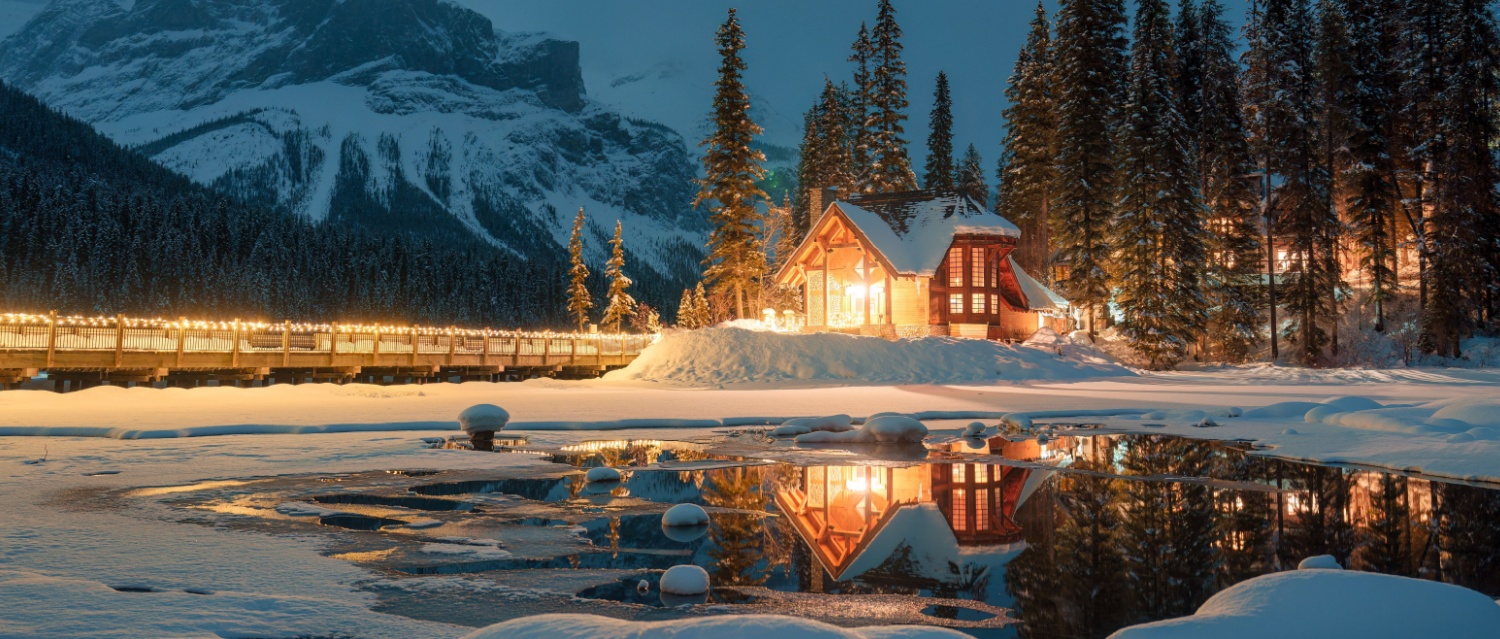




Canada’s property market has its own vocabulary – and if you’re planning a move across the Atlantic, getting to grips with it early will save you a lot of confusion. From downtown condos to mountain chalets, here’s a plain-English guide to the types of property in Canada.
Whether you’re planning a full relocation or buying a second home, the Canadian market offers more variety than most British buyers expect. The country’s sheer size means property types shift dramatically by region – what’s typical in Montreal is very different from what you’ll find in the Rockies or rural Nova Scotia. What stays consistent is the terminology, which has a few distinctly Canadian quirks.
Property types in Canada
Canada’s property market includes condominiums (similar to UK flats), townhouses, row houses, plexes (duplexes, triplexes and fourplexes), bungalows, split-level homes, craftsman houses and mountain chalets. Detached single-family homes make up roughly half the market. In cities such as Montreal and Vancouver, multi-unit plexes and condo towers are the norm. Rural and mountain regions offer more space, with bungalows and log-style chalets at the other end of the spectrum. As a British buyer, understanding these categories will help you match the right type of home to the way you want to live.
Download the Canada Buying Guide
Contents
Can British buyers purchase property in Canada?
Before you start searching, there’s an important legal context to understand. Canada currently has a ban on most foreign nationals purchasing residential property – formally the Prohibition on the Purchase of Residential Property by Non-Canadians Act – which, according to the CMHC, runs until at least January 2027. That said, there are exemptions. If you’re relocating to work in Canada, you may well qualify to buy. Work permit holders can purchase one residential property provided their permit has at least 183 days of validity remaining at the time of purchase. Permanent residents are unaffected by the ban entirely. Note too that some provinces levy their own non-resident property taxes on top of federal rules, so the full picture varies depending on where in Canada you’re buying. It’s worth speaking to a Canadian property lawyer early to understand where you stand.
Condominiums
The condominium – or condo – is one of the most common types of property in Canada, and it’s roughly equivalent to what we’d call a flat or apartment in the UK. A condo is a privately owned unit within a larger multi-unit building or development. In cities, that usually means a floor (or part of a floor) in a high-rise tower, though condos can also take the form of townhouses or sections of a converted building.
Condos are popular for their relative affordability compared to detached homes, particularly in major urban centres like Toronto, Vancouver and Calgary. Many condo buildings include shared facilities – a lobby, gym, rooftop terrace or pool – and the cost of maintaining these common areas is split between all owners through a monthly fee, managed by an elected board.
Before buying a condo, always review the building’s bylaws, financial reserves and fee structure. These vary significantly between buildings and can affect everything from your monthly costs to what you’re allowed to do with the property.
A quick note on terminology: in Canada, the word “apartment” usually refers to a rental unit rather than a property for sale – often one of many owned by a large company or developer. If you see “apartment” in a listing, it’s typically not for sale.
Strata properties
In British Columbia and parts of western Canada, you’ll come across the term “strata” used in place of condo. It means the same thing – a unit within a multi-owner development with shared common areas – but strata is the legal framework used in BC rather than the condominium legislation that applies elsewhere. The practical difference is minimal for buyers, but knowing the term saves confusion when dealing with local agents and solicitors.
Townhouses, row houses and brownstones
These three terms are often used interchangeably, but they’re not quite the same thing.
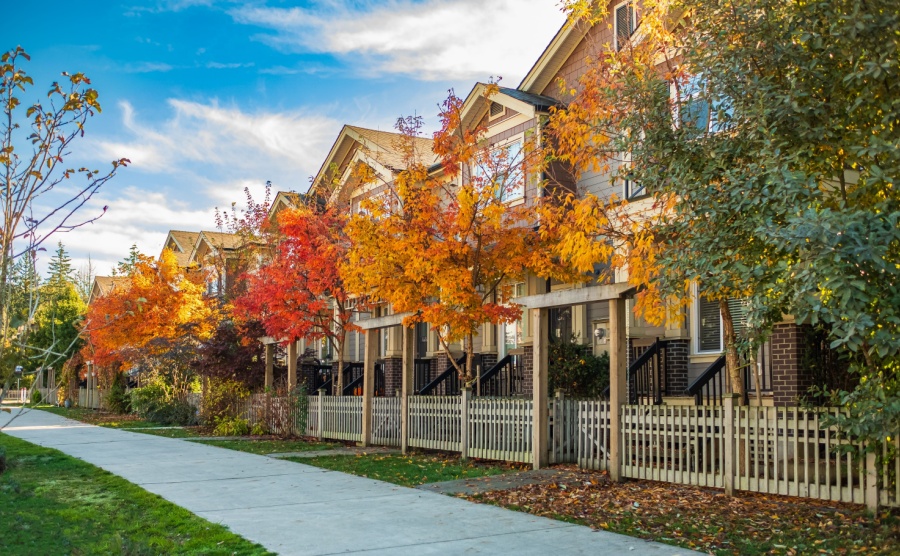
- A townhouse is a broad term for any house attached to another property on one or both sides. The adjoining buildings don’t have to match in style or size, and some townhouses are stacked – meaning two dwellings occupy the same footprint, one above the other, each with its own separate entrance.
- A row house is more specific: a series of single-family homes built wall-to-wall in a continuous row, typically two storeys, with a uniform or near-uniform design. This is what we’d call a terraced house in the UK, and it’s probably the closest equivalent to what many British buyers will be familiar with.
- A brownstone is a period townhouse clad in brown sandstone, predominantly found in cities like Toronto and Montreal and – even more so – across the border in US cities. Built mainly in the late 19th and early 20th centuries, brownstones tend to be spacious, full of original features and priced to reflect their heritage status.
Plexes
Plexes are a distinctly Canadian urban housing type, and they’re especially prevalent in Montreal. The idea is simple: a single building divided into two (duplex), three (triplex) or four (fourplex) separate dwellings, each spread over one or more floors and each with its own front door.
For buyers, plexes offer an interesting option: live in one unit and rent the others, or buy purely as an investment. They’re built to maximise space on narrow urban plots, which is why they’re so common in dense city neighbourhoods. If you’re considering a plex as a rental income play, bear in mind that the foreign buyer ban’s exemptions don’t extend to purchasing property purely for rental investment – so legal advice is particularly important here.
Bungalows and split-level homes
Single-family detached homes account for around half of Canada’s housing stock, and they come in quite different forms depending on the region.
Bungalows – single-storey detached homes, usually with a generous plot – are common across the country, particularly in smaller towns and rural areas. They tend to be more affordable than larger detached homes and suit buyers looking for space without the maintenance of a multi-storey house. A variation is the ranch bungalow, which typically has a more spread-out footprint and is associated with rural and agricultural settings.
Split-level homes are more of a mid-20th-century phenomenon, particularly common in hilly or sloping terrain. Rather than having floors stacked directly above one another, a split-level uses the natural gradient of the land to arrange living spaces across staggered half-levels connected by short staircases. The result is a home that feels spacious without needing to build upward, and they can be surprisingly well-suited to multigenerational living.
Craftsman homes
For buyers drawn to character and history, the craftsman is a distinctly North American style worth knowing about. Taking its cues from the Arts and Crafts movement of the early 20th century, craftsman homes prioritise natural materials and honest construction – lots of wood and stone, handcrafted details and a warmth that sets them apart from newer builds.
You’ll find craftsman houses concentrated in Vancouver and along Canada’s Pacific coast, as well as around the Great Lakes. Key features include low-pitched roofs with wide overhanging eaves, a covered porch or veranda running the width of the front, exposed wooden beams, double-hung windows and exterior cladding in natural timber. They come in both single-storey bungalow form and two-storey versions.
Well-maintained craftsman homes in desirable neighbourhoods tend to command a premium, and they’re popular with buyers who want something with more soul than a modern estate property.
Mountain chalets and log cabins
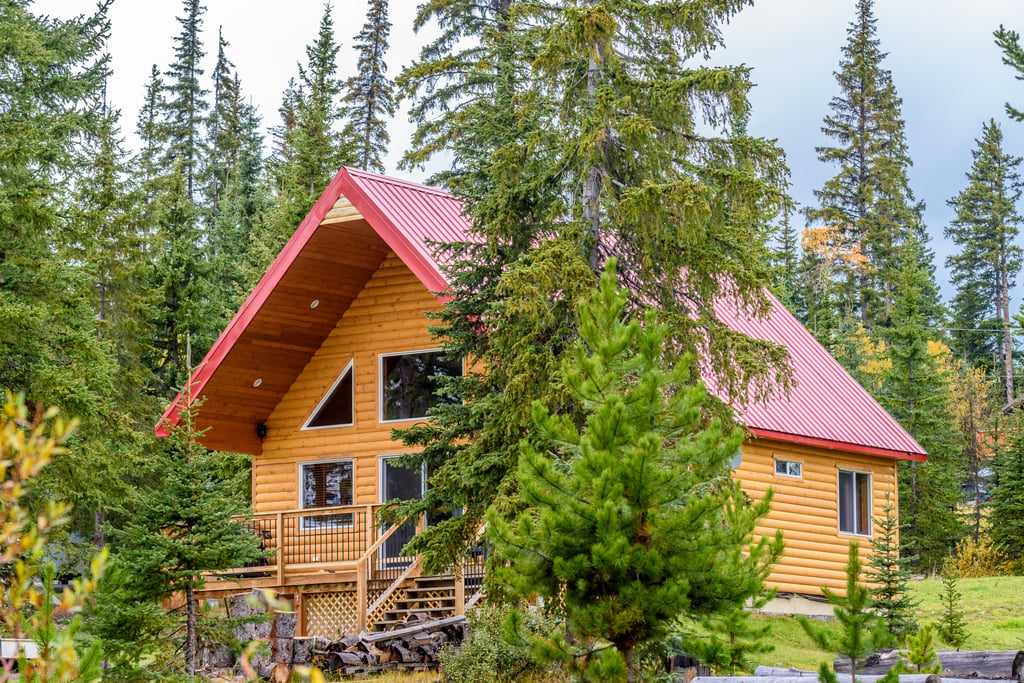
Canada’s mountain and lake resort regions – Whistler in British Columbia and Mont-Tremblant in Quebec being the two most well-known – have their own property type entirely. The chalet or log cabin is the signature home here, and while the category has evolved considerably over the decades, the appeal is essentially unchanged: a base from which to ski, hike, paddle or simply sit by the fire looking out at the landscape.
Modern chalets still use traditional materials – logs, stone, timber frames – but the interiors have moved on considerably. Open-plan living spaces, floor-to-ceiling glazing and contemporary kitchens are standard in higher-end builds, designed to make the most of the mountain views. If you’re considering a purchase in a ski resort area, it’s worth looking at the rental potential too – properties in established resorts can generate strong short-term rental income during the ski season.
What about currency?
Whether you’re buying a city condo or a mountain retreat, moving money between pounds and Canadian dollars is one of the most significant financial decisions you’ll make in the process. Exchange rates fluctuate, and the difference between a good rate and a poor one can add up to thousands of pounds on a property purchase. Our partner, Smart Currency Exchange, works with British buyers purchasing property abroad every day, helping them plan their currency strategy and reduce the risk of rate movements affecting their budget.
Frequently asked questions
Not without meeting specific criteria, at present. Canada’s foreign buyer ban – formally the Prohibition on the Purchase of Residential Property by Non-Canadians Act – runs until at least January 2027 and restricts most non-Canadians from buying residential property in cities and large towns. However, there are exemptions. If you hold a valid Canadian work permit with at least 183 days of validity remaining, you can purchase one residential property. Permanent residents are unaffected by the ban. Always take legal advice before proceeding.
In Canada, a condo is a unit you own within a multi-unit development, while an apartment typically refers to a unit available to rent. The two words are not interchangeable in the way they might be in British English – if you’re looking to buy rather than rent, you’ll be looking at condos, not apartments.
Strata is the term used in British Columbia for what the rest of Canada calls a condominium. It describes a property where individual units are privately owned and common areas are managed collectively. The strata corporation (equivalent to a condo board) handles maintenance and sets the rules for the development.
A plex is a building divided into multiple self-contained dwellings – two units makes it a duplex, three a triplex, four a fourplex. Each has its own entrance and is spread over one or more floors. Plexes are particularly common in Montreal and other Quebec cities. Buyers sometimes purchase a plex to live in one unit while renting out the others.
A craftsman house is a style of home that emerged in North America in the early 20th century, influenced by the Arts and Crafts movement. Key characteristics include natural materials (wood and stone), a wide covered porch, low-pitched roof with overhanging eaves, exposed timber detailing and double-hung windows. The style is particularly associated with Vancouver and Canada’s Pacific coast.
The main differences are in terminology. What Canadians call a condo, we’d call a flat. What they call a row house is roughly equivalent to a terrace. Plexes don’t have a direct UK equivalent, though they’re conceptually similar to a converted house split into flats. Detached homes are broadly similar in concept, though Canadian bungalows and split-level homes often come with much larger plots than you’d expect in the UK.
Properties in established Canadian ski resorts such as Whistler and Mont-Tremblant have historically held their value well and can generate strong rental returns during the ski season. As with any property investment, location within the resort matters significantly, as do local short-term rental regulations, which vary by municipality. Take specialist advice before buying in a resort area.