


A swimming pool for the long summer days or a guest annex for visiting family is often the difference between a simple holiday home and a “forever” home. But while the vision is romantic, the reality of French bureaucracy is rigid.
The planning system in France is logical, yet it strictly punishes those who take shortcuts. Before you commission a builder or order materials, you must understand exactly which permit applies to your project and why a quick chat with the Maire is rarely sufficient anymore.
Contents
Understanding French planning permission
Before you begin any work, understanding the hierarchy of French planning is vital. Unlike the UK or US, where rules can sometimes feel open to interpretation, French urbanisme (town planning) is codified and strict. Every commune has specific regulations, often detailed in the Plan Local d’Urbanisme (PLU), which you can view at your local Mairie (town hall).
In our experience, assuming a project is “too small to notice” is a common mistake. Almost all external changes require paperwork. Whether you are installing a Velux window, erecting a carport or extending a terrace, the authorities will expect a formal application. These rules exist to preserve the visual harmony of French villages, and they are enforced.
It is risky to rely on precedents set by neighbours. Regulations evolve, and your property might sit in a different zone to the house across the street. We always suggest booking an appointment with your Maire or the town planning clerk (service d’urbanisme) with photos and sketches before you commit to any costs. A proactive approach here can prevent months of administrative deadlock.
For a closer look at purchasing a home in France, claim your free copy of our France Buying Guide:
Download the France Buying Guide
Can you get grants for renovating property in France?
If you’re renovating an older property in France, you may be able to reduce your costs through France’s energy-renovation support schemes.
The best-known programme is MaPrimeRénov’, the French government’s flagship grant for improving a property’s energy efficiency. Depending on your income level and the scope of the work, the scheme can cover part of the cost of:
- insulation
- heat pumps
- ventilation systems
- replacing oil or gas boilers
- energy-efficient windows and doors
- whole-home energy renovations
The system has evolved significantly in recent years and now places greater emphasis on “renovation d’ampleur” — larger renovation projects that improve the home’s overall energy rating, rather than one-off upgrades.
In many cases, grants can also be combined with:
- the Eco-PTZ zero-interest renovation loan
- reduced 5.5% TVA on eligible works
- supplier-funded energy bonuses known as CEE grants
However, there are important conditions. Most subsidised work must be carried out by an RGE-certified contractor (“Reconnu Garant de l’Environnement”), and larger projects may require support from an approved adviser called a Mon Accompagnateur Rénov’.
For overseas buyers renovating older French farmhouses or village homes, these schemes can make a substantial difference to overall renovation costs. But eligibility rules, grant levels and application procedures change regularly, so it’s important to check the latest guidance before starting work.
Useful official resources include:
- France Rénov’: https://france-renov.gouv.fr/
- MaPrimeRénov’: https://www.service-public.fr/particuliers/vosdroits/F35083
Why energy ratings matter when renovating property in France
If you’re buying a renovation project in France, it’s important to understand the country’s DPE system (“Diagnostic de Performance Énergétique”) before you commit.
The DPE is France’s official energy-efficiency rating for residential property, grading homes from A (most efficient) to G (least efficient). Older stone farmhouses, village houses and rural properties often fall into the lower F or G categories because of poor insulation, outdated heating systems or single-glazed windows.
In recent years, France has tightened regulations on low-rated homes as part of its national energy-efficiency strategy. Properties with the worst energy ratings are increasingly referred to as “passoires thermiques” — literally “thermal sieves”.
This now has real implications for buyers and renovators:
- since January 2025, many G-rated properties can no longer legally be rented out
- further restrictions on F-rated homes are planned from 2028
- energy ratings can affect resale values and buyer demand
- mortgage lenders are paying closer attention to renovation costs linked to poor efficiency ratings
For overseas buyers, this means that a cheap character property may require substantial additional spending on:
- insulation
- heating systems
- ventilation
- roofing improvements
- double glazing
The good news is that many energy-improvement works may qualify for French renovation grants such as MaPrimeRénov’, particularly when they improve the home’s overall DPE rating.
Before buying a renovation property, it’s worth commissioning a detailed survey and carefully reviewing the DPE report to understand the likely cost of bringing the home up to modern standards.
Useful official resources include:
- French government guidance on DPE regulations: https://www.ecologie.gouv.fr/
- Service Public’s explanation of rental restrictions and DPE timelines: https://www.service-public.fr/
Do interior renovations need permission?
If you plan to refresh a tired interior without altering the layout, you are generally free to proceed without paperwork. Repainting walls, upgrading a kitchen or tiling a bathroom rarely interests the planning office. However, if your renovation changes the use of a space or increases the “habitable surface” area, the rules change immediately.
Converting a garage into a living room or turning an attic into a bedroom requires authorisation. This is because you are creating new taxable living space (surface taxable). Even knocking down an internal wall can be complex if it alters the structural integrity of the building.
When upgrading electrical or water systems, it is worth employing certified artisans. While DIY is popular, ensuring your work meets French norms (Norme NF C 15-100 for electricity) is critical for your insurance and future resale value. A non-compliant system can be a major stumbling block during the diagnostic surveys required when you eventually sell. Connecting previously unheated areas to central heating systems can also influence your tax assessment and need to be declared.
Making changes to the exterior
The exterior of your French home is considered part of the public landscape, so almost any modification triggers a paper trail. Changing traditional wooden shutters to electric rollers, rendering a façade in a new colour, or even changing your roof tiles will likely require a Déclaration Préalable.
If your property is located near a historic monument—which includes many village churches—you fall under the jurisdiction of the Architecte des Bâtiments de France (ABF). In these zones, the rules on materials and aesthetics are incredibly specific. You may be told exactly which shade of beige you must use for your façade or that you cannot use PVC windows.
Never assume that because a change is an “improvement” it will be permitted. Local councils have the power to halt works and can force you to reverse unauthorised changes at your own expense.
Installing or restoring a swimming pool in France
For many overseas buyers, adding a swimming pool is part of the dream of owning property in France. However, pool installations and restorations are subject to planning rules, tax implications and, in some areas, strict local controls.
Whether you need permission depends largely on the size and type of pool:
- small above-ground pools may not require formal approval
- many in-ground pools require a prior declaration (“déclaration préalable”)
- larger pools or enclosed pool structures may require full planning permission (“permis de construire”)
As a general rule, pools larger than 10m² but under 100m² usually require a declaration préalable, particularly if they are permanent installations.
If your property is located in a protected heritage zone or near a listed building, stricter rules often apply. Local authorities and the Architecte des Bâtiments de France (ABF) may impose conditions on location, surrounding terraces, fencing, pool houses and equipment.
This is especially likely to happen in historic villages and areas where modern installations may be considered visually intrusive.
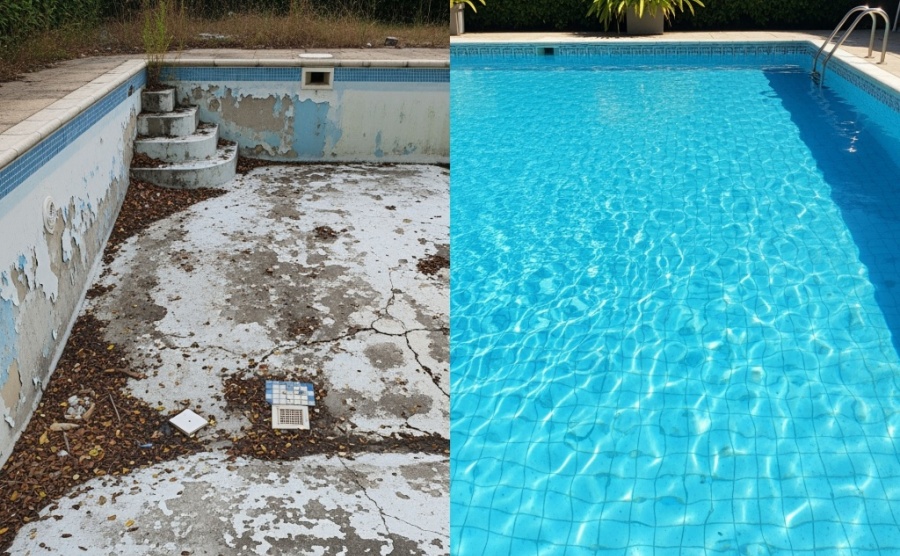
Older French homes sometimes already have neglected or disused pools. Restoring an existing pool can still require approval if you are significantly changing the structure or enlarging the pool. And pool houses and other landscaping changes may also be affected. Beware too, about rules on managing a pool and protecting younger guests from falling in.
Buyers should also budget for ongoing compliance and maintenance costs. In France, swimming pools can increase your property’s taxable value and may affect:
- taxe foncière
- insurance premiums
- water and electricity bills
Before starting any work, it is advisable to check requirements with the local mairie and confirm whether previous permissions exist for older pools on the property.
Useful official resources include:
- Service Public France: https://www.service-public.fr/
- French government planning guidance: https://www.service-public.fr/particuliers/vosdroits/F31404
The three types of planning permission
France categorises planning applications into three main streams. Submitting the correct form is the first step to a successful renovation.
- Déclaration préalable de travaux (DP): This “prior declaration” covers smaller projects. It is typically used for extensions under 20m² (or 40m² in urban zones with a PLU), installing a pool, changing windows, or redoing a roof. While it is lighter than a full permit, it still requires detailed drawings and a location plan.
- Permis de construire (Building Permit): You will need this for major works. This applies to new builds, extensions over 20m² (or 40m² in urban zones), or renovations that change the building’s exterior and its use (e.g., turning a barn into a house). The review period is usually two to three months.
- Permis de démolir (Demolition Permit): If you plan to demolish a structure, even a ruin, you often need this specific permit. In many cases, it is filed alongside your building permit.
Timeframes vary depending on the complexity of the request and the commune’s capacity. Always allow a buffer in your project timeline. It’s also worth noting that permission usually remains valid for up to three years, giving you flexibility if you need to plan in phases.
Should you hire an architect?
For minor cosmetic updates, an architect is optional. However, if your total habitable floor area (after works) will exceed 150m², French law requires you to use a registered architect.
Even for smaller projects, an architect can be a wise investment. They understand the nuances of the PLU and have existing relationships with the planning office. A good architect does more than draw plans; they act as a bridge between your vision and French regulations, often suggesting solutions that maximise space while staying compliant.
Furthermore, registered architects in France carry professional liability insurance. If a structural issue arises later, or if there is a dispute regarding boundaries, having a professional on record provides a layer of legal protection that a casual builder arrangement does not.
Keeping your build on the right side of the law
Once your permit is granted, the administration is not over. You must display your planning notice (panneau d’affichage) on the street-facing boundary of your property for the duration of the works. This alerts neighbours and gives them a two-month window to contest the permit. Failure to display this sign can technically invalidate your permission.
Upon completion, you must file a “Declaration Attesting the Completion and Compliance of Works” (DAACT). This document certifies that what you built matches what was approved. The authorities have the right to inspect the property within three to five months to verify this.
Financially, large renovations also carry currency risk. If your funds are in pounds, dollars, or yen, exchange rate volatility can drastically change the final cost of your project. A shift in the GBP/EUR rate could effectively increase the cost of a €50,000 (£42,000) renovation by thousands overnight. We recommend speaking to a specialist at Smart Currency Exchange to lock in a rate for your renovation budget.
Be aware of stricter rules in protected heritage zones
Many of France’s most attractive renovation properties are located in historic villages, conservation areas or near listed buildings. While these locations can offer charm and long-term value, they often come with much stricter renovation controls.
If your property falls within a protected heritage zone, your project may need approval from the Architecte des Bâtiments de France (ABF), the authority responsible for preserving France’s architectural heritage.
In recent years, enforcement has become stricter in some areas, particularly where energy-efficiency upgrades affect the external appearance of older buildings. Buyers are increasingly finding that projects involving solar panels, external insulation, replacement windows, roof alterations, shutters or visible heat pumps face tighter scrutiny or require specific materials and designs.
For example, you may be required to use traditional timber windows instead of PVC and match original roof tiles and colours. This is, of course, no different to the UK. And while every country wants to go greener, it has to be in character, such as positioning solar panels out of public view and installing less visually intrusive heating systems.
This can significantly affect both renovation costs and project timelines. So before buying a property in a historic area, it’s worth checking:
- whether the property lies within a protected zone (“site patrimonial remarquable”)
- whether previous renovation approvals exist
- what restrictions apply to exterior works
Your local mairie can usually confirm whether the property falls under ABF supervision, but other useful official resources include:
- French government planning guidance: https://www.service-public.fr/
- Ministry of Culture guidance on protected heritage areas: https://www.culture.gouv.fr/
Finding reliable builders and tradespeople
Securing a reliable artisan is often the biggest challenge for international buyers. While France has highly skilled tradespeople, the best ones are often booked months in advance. In popular regions and rural areas, it is now common for reputable builders to have waiting lists of six to 12 months, particularly for specialist renovation work.
This is especially important if you are hoping to complete works before the summer season or shortly after purchase. Delays can affect everything from move-in dates to rental plans and overall renovation budgets.
Check registration: Always ask for a SIRET number (business registration). You can check this online to ensure the business is active.
Verify insurance: It is non-negotiable that your builder has assurance décennale. This 10-year insurance covers major structural defects after the work is finished. Ask to see the certificate before paying a deposit.
Check for RGE certification: If you are carrying out energy-efficiency improvements and hoping to access French renovation grants such as MaPrimeRénov’, your contractor will usually need to be certified as RGE (Reconnu Garant de l’Environnement). Without this certification, you may not qualify for certain grants or subsidised loans.
Get detailed quotes: A French quote (devis) is legally binding once signed. Ensure it details labour, materials, and VAT (TVA).
Start your journey today. Book your free consultation with our French property experts for tailored advice on renovating overseas.
FAQs about renovating a property in France
Yes, provided you do your due diligence. Always include a condition suspensive in your purchase contract regarding planning permission. This means if you cannot get the permit for your pool or extension, you can withdraw from the purchase and get your deposit back.
French banks are generally cautious about lending for renovations alone. However, you can often include the cost of works in your initial acquisition mortgage (prêt acquisition-amélioration). You will need detailed estimates (devis) from registered French builders to secure this.
You do not strictly need a lawyer for the build itself, but having a legal advisor check your contracts with builders can save significant stress. If you are a “third-country national” (including UK citizens post-Brexit), a lawyer can also help you navigate how renovation timelines interact with the 90/180-day visa rules.
It’s a legal requirement for any build over 150m² of habitable space. Even for smaller projects, an architect can streamline planning, improve design, and help navigate local regulations more smoothly.
Ask for recommendations, check SIRET registration and insurance documents, and always request a written quote. Make staged payments and work only with professionals who understand French legal requirements.