


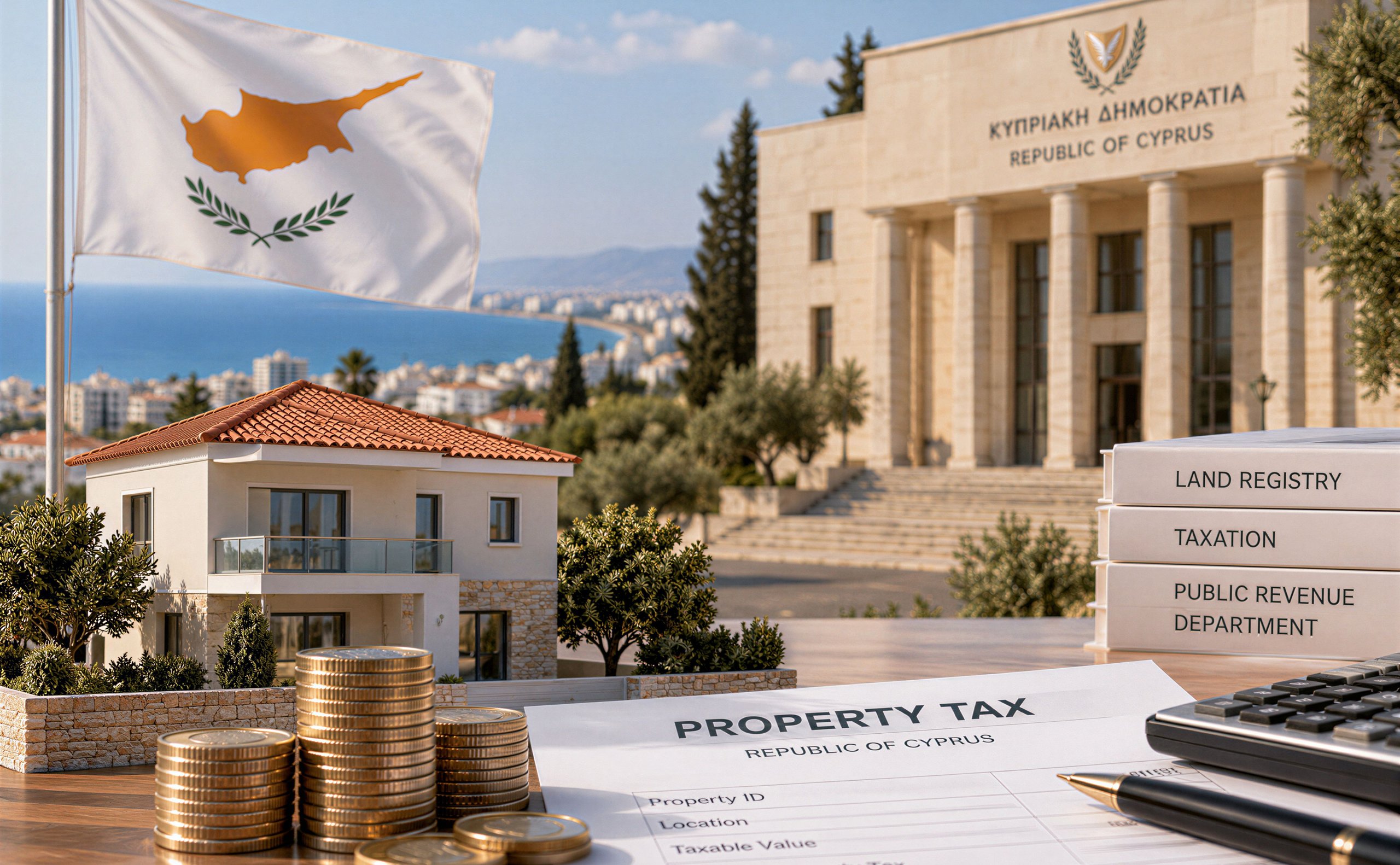
Buying a home in Cyprus comes with some financial responsibilities, but the country’s recent tax reforms have made several aspects of property ownership more favourable. From annual local charges to rental income and capital gains tax, understanding what you’ll pay can help you plan your purchase with confidence.
Whether you’re buying a holiday home, moving permanently or planning to rent out your property, here’s what you need to know about property taxes in Cyprus.
Buying a home in Cyprus comes with some financial responsibilities, but the country’s recent tax reforms have made several aspects of property ownership more favourable.
Whether you’re buying a holiday home, moving permanently or planning to rent out your property, here’s what you need to know about property taxes in Cyprus.
What property taxes do you pay in Cyprus? Cyprus has no nationwide annual property tax, but homeowners still pay local charges for services such as refuse collection and sewerage. Rental income may be subject to income tax, while capital gains tax is generally charged at 20% when you sell. Recent reforms have made ownership more affordable, with higher tax allowances, the abolition of stamp duty and more generous exemptions for property sellers.
Contents
What property taxes do you pay in Cyprus?
Cyprus abolished its nationwide annual Immovable Property Tax (IPT) in 2017, removing a significant expense for homeowners. However, you’ll still need to budget for certain local taxes and charges.
If you rent out your property, you may also pay income tax on your earnings. And when you eventually sell, capital gains tax could apply.
The good news is that reforms introduced in January 2026 have reduced several of these costs. The changes include:
- An increase in the income tax-free threshold to €22,000.
- The abolition of Special Defence Contribution on rental income.
- Higher capital gains tax exemptions, including up to €150,000 for qualifying main residences.
- The abolition of stamp duty on new property purchase contracts.
- More flexible rules for qualifying as a Cyprus tax resident.
Let’s look at what these mean for you.
Annual property taxes in Cyprus
Although there’s no longer a national annual property tax, local authorities can still charge homeowners for services and infrastructure.
Municipal property taxes
Municipalities may charge annual property taxes, generally calculated using official property valuations rather than the price you paid.
The amount varies depending on the municipality and the property concerned. Your estate agent or lawyer should be able to confirm the charges for a particular home before you buy.
Refuse collection and local services
Homeowners normally pay an annual charge for refuse collection and other municipal services. Charges vary according to the local authority, property type and how the property is used.
Sewerage charges
If your property is within a designated sewerage area, you may also pay an annual charge to the local sewerage authority.
These charges are generally based on official property valuations, although the rates differ between districts.
If you’re buying an apartment or a property on a managed development, you may also have communal maintenance charges. These aren’t taxes, but they should be included in your annual budget.
Before completing your purchase, ask your lawyer to check that all outstanding local taxes and service charges have been paid.
Are you a tax resident in Cyprus?
Your tax obligations depend partly on whether you’re considered a Cyprus tax resident.
Importantly, owning a property in Cyprus doesn’t automatically make you a tax resident. You can own a holiday home there while remaining tax resident in the UK or another country.
Cyprus has two main routes to individual tax residency.
The 183-day rule
If you spend more than 183 days in Cyprus during a calendar year, you’ll generally be considered a Cyprus tax resident.
Cyprus tax residents are normally liable for tax on their worldwide taxable income, although exemptions and double taxation agreements may affect what they actually pay.
The 60-day rule
Cyprus also offers a shorter route to tax residency for people with qualifying connections to the country.
To qualify under the 60-day rule, you must generally:
- Spend at least 60 days in Cyprus during the calendar year.
- Spend no more than 183 days in any other single country.
- Maintain a permanent home in Cyprus, either owned or rented.
- Have qualifying employment, business activities or a directorship in Cyprus, subject to the relevant conditions.
Previously, you also had to demonstrate that you weren’t tax resident in any other country. This requirement was removed in January 2026.
However, qualifying as a Cyprus tax resident doesn’t automatically mean you’ve stopped being tax resident elsewhere.
For example, if you spend part of the year in Cyprus and part in Britain, the UK’s statutory residence test and the UK–Cyprus double taxation agreement may still affect your position.
Tax residency is also different from immigration residency. Having permission to live in Cyprus doesn’t necessarily make you resident there for tax purposes.
If you’re planning to divide your time between countries, professional advice can help you establish where your income should be taxed.
Income tax on rental property
If you’re planning to rent out your Cyprus home, either to holidaymakers or long-term tenants, you’ll generally need to pay tax on the rental income.
The amount depends on your total taxable income, residency status and any available deductions.
How much income tax will you pay?
Rental income from Cyprus property is generally subject to Cyprus income tax, even if you live elsewhere.
For Cyprus tax residents, rental earnings are normally included alongside other taxable income and assessed using the country’s progressive income tax bands.
The current income tax rates are:
| Annual taxable income | Tax rate |
|---|---|
| Up to €22,000 | 0% |
| €22,001–€32,000 | 20% |
| €32,001–€42,000 | 25% |
| €42,001–€72,000 | 30% |
| Over €72,000 | 35% |
The rates apply progressively, so you only pay the higher rate on income falling within that band.
For example, someone with €30,000 in total taxable income would pay 20% on the €8,000 above the tax-free threshold, giving an income tax bill of €1,600 before any further applicable reliefs.
Rental income may also qualify for deductions, including a statutory deduction for certain rental earnings and other allowable expenses.
Special Defence Contribution has been abolished
One of the most beneficial changes for some landlords is the abolition of Special Defence Contribution (SDC) on rental income.
Previously, qualifying landlords could pay SDC at 3% on 75% of their gross rental income, effectively an additional 2.25% charge.
This was abolished from January 2026.
The change particularly benefits landlords who previously paid SDC. Non-domiciled Cyprus tax residents were generally already exempt from this contribution.
Rental income may still attract contributions to Cyprus’s General Healthcare System (GeSY/GHS), where applicable.
What if you’re not a Cyprus tax resident?
If you live in the UK but rent out your Cyprus holiday home, the rental income is generally taxable in Cyprus.
You may also need to declare that income in the UK. However, double taxation relief may prevent you from paying tax twice on the same income without credit for tax already paid.
Keep accurate records of rental payments, expenses and tenancy agreements, and speak to a tax adviser familiar with both countries.
If you’re planning to offer short-term holiday lets, remember that separate registration and licensing requirements may apply.
Capital gains tax when selling property in Cyprus
If you eventually sell your Cyprus property for more than you paid, you may have to pay capital gains tax (CGT).
The standard Cyprus capital gains tax rate is 20% of the taxable gain, rather than 20% of the entire selling price.
However, homeowners can benefit from several exemptions, which became more generous following the recent tax reforms.
How much capital gains tax do you not need to pay?
The principal lifetime exemptions for individuals are:
- General exemption: Up to €30,000.
- Qualifying main residence: Up to €150,000.
- Qualifying agricultural land: Up to €50,000.
The general exemption applies over your lifetime, rather than being available afresh every time you sell.
The higher main residence exemption is subject to qualifying ownership and occupation requirements, including a minimum period of use as your main home.
The agricultural land exemption also has specific eligibility conditions.
You cannot simply add all the exemptions together. A tax adviser can establish which reliefs apply to your circumstances.
What costs can you deduct?
When calculating the taxable gain, you can generally take account of certain qualifying expenses, potentially including:
- The original purchase price.
- Eligible improvements to the property.
- Allowable inflation adjustments.
- Qualifying legal and estate agent fees.
- Certain acquisition and disposal expenses.
You’ll need documentary evidence to support these deductions, so keep your original purchase contract, invoices and receipts.
The additional 0.4% property sale levy
Sellers should also budget for a separate levy of 0.4% on the sale proceeds of qualifying property transactions.
This levy supports Cyprus’s Central Agency for Equal Distribution of Burdens and is separate from capital gains tax.
For example, on a qualifying property sale of €300,000, the levy would be €1,200.
Unlike capital gains tax, this levy is generally calculated on the sale consideration rather than the profit made. Certain transactions are exempt.
If you’re selling a property, ask your lawyer to calculate both potential liabilities before agreeing a price.
Has Cyprus abolished stamp duty?
Yes. Cyprus abolished stamp duty on new property purchase contracts from 1 January 2026.
Previously, buyers generally paid stamp duty on qualifying purchase contracts, calculated according to the contract value.
Its abolition removes one of the transaction costs for new buyers.
However, stamp duty shouldn’t be confused with Land Registry transfer fees, which can still apply depending on the transaction.
VAT may also be payable on certain new-build property purchases.
Cyprus property tax FAQs
Cyprus abolished its nationwide Immovable Property Tax in 2017. However, homeowners may still pay municipal property taxes, refuse collection charges and sewerage fees. The amounts depend on the property and its location.
Yes. Rental income from property in Cyprus is generally taxable there, even if the owner lives abroad. The amount payable depends on taxable income, available deductions and any applicable double taxation agreement.
Capital gains tax is generally charged at 20% of the taxable gain on qualifying Cyprus property disposals. The general individual lifetime exemption is €30,000, with a higher exemption of up to €150,000 for qualifying main residences.
No. Simply buying a home in Cyprus doesn’t make you tax resident. Residency generally depends on the time you spend in the country and whether you meet the conditions of the 183-day or 60-day rules.
Stamp duty was abolished for new contracts signed from 1 January 2026. Other purchase costs, including legal fees, applicable transfer fees and potentially VAT, may still apply.
Plan ahead for your Cyprus property purchase
Cyprus offers several tax advantages for international property buyers, particularly following the recent reforms. However, understanding your likely costs before buying is essential.
Annual local charges, rental income tax and potential taxes on resale should all be included in your financial planning.
If you’re buying with a partner, planning to retire in Cyprus or hoping to earn rental income, professional advice can help you avoid expensive surprises.
Our property experts can help you understand the buying process and connect you with English-speaking lawyers, accountants and other specialists.
Ready to take the next step? Download your free Cyprus Buying Guide for practical advice on finding, buying and owning your home overseas.
This article provides general information about Cyprus property taxation. Tax liabilities depend on individual circumstances and may be affected by double taxation agreements. Always seek independent professional tax and legal advice before making financial decisions.