




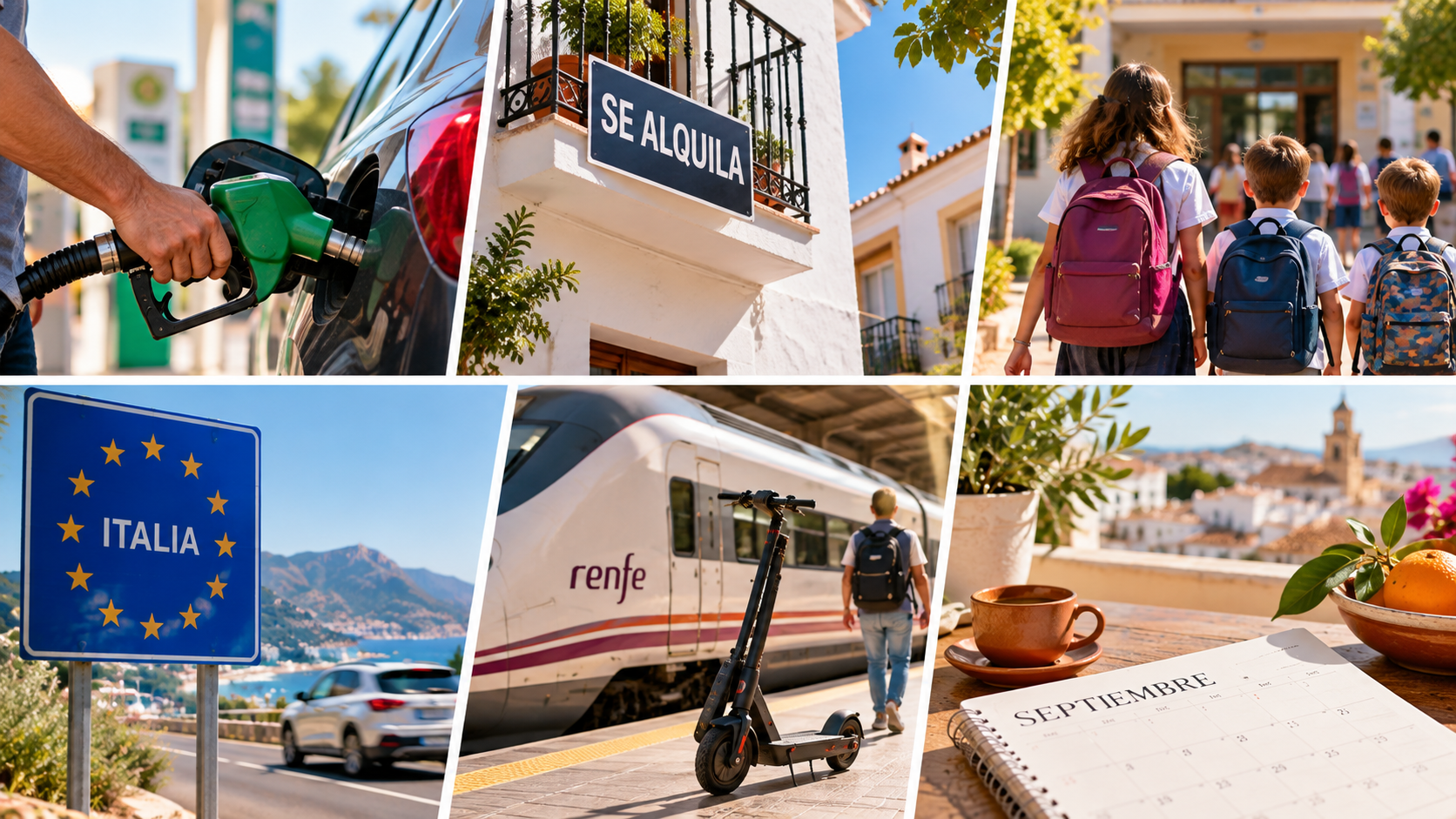
A round-up of what’s changing in Spain this September, from fuel duty and rental law to school term dates and border checks with Italy.
September always feels like a bit of a turning point in Spain. The summer holidays are winding down, the children are going back to school, shops and businesses are returning to their normal routines and the temperatures are starting to ease.
But September is also a good time to look at what is happening in Spain more generally. There are new rules to be aware of, changes which are coming later in the year and a few developments that could affect everyday life.
September brings a mix of administrative and practical changes in Spain: reduced fuel duty, a new cognitive accessibility rule (in force January 2027), proposed rental law changes, digital Social Security notices, the start of the school year, temporary Italy border checks and the return of e-scooters on Renfe trains. Most require no action now, but they’re worth a look if any apply to you.
Contents
- Fuel prices – and another change for drivers
- A new accessibility rule is on its way
- Renting remains a hot topic
- Social Security is becoming increasingly digital
- Back to school
- Travelling between Spain and Italy?
- Electric scooters are back on some trains
- September also means regional holidays
- What does all this mean for you?
Fuel prices – and another change for drivers
If you drive in Spain, you will probably have noticed that fuel prices have been something of a talking point this year.
The government’s temporary measures to cushion the effect of higher energy prices mean that the tax reduction on diesel is 20 cents a litre during September, while the reduction on petrol is 5 cents a litre.
Of course, that does not necessarily mean you will see exactly that amount disappear from the price on the forecourt. The final price depends on the underlying cost of fuel, refining, distribution and IVA (VAT) as well.
It is one of those changes that is worth knowing about if you are filling up regularly, particularly if you are heading off on an autumn road trip.
A new accessibility rule is on its way
Spain has also introduced a new regulation on the basic conditions of cognitive accessibility.
The idea is a simple one: information and services should be easier to understand and use, particularly for people who have difficulty processing complicated information.
It covers things such as public information, documents, signs, communications and access to services.
There is a slight catch, though. Although the regulation was published in the BOE (Boletín Oficial del Estado) on 3 September 2026, it does not actually come into force until 2 January 2027.
It’s one to keep in mind for next year. Anything that makes dealing with Spanish officialdom a little easier has to be a good thing, especially when you are trying to navigate the bureaucracy in another language.
Renting remains a hot topic

Housing continues to be one of Spain’s biggest talking points, and September is likely to bring more discussion about changes to the rental market.
The government is pursuing proposals to change aspects of the Urban Leases Law, including temporary rentals, room rentals, extensions to rental contracts and some proposals concerning repairs and tax deductions.
However – and this is important – these are proposals, not rules that are already in force.
If you own a property that you rent out, or rent a home yourself, it is worth keeping an eye on developments rather than relying on something you read online and assuming it has already become law.
Spain’s rental regulations are becoming increasingly complicated, particularly where tourist and short-term rentals are concerned.
Social Security is becoming increasingly digital
Another change that may affect some residents is the move towards digital communications from Social Security.
From 1 September, communications relating to certain procedures, including sick leave, permanent disability and non-disabling permanent injury, are being handled digitally.
For many people this will be another example of Spanish bureaucracy moving online. But if you are used to waiting for an official letter through the post, it is worth making sure that you can access the relevant Social Security online services and don’t miss an important notification.
It is becoming increasingly important to keep an eye on your digital mailbox in Spain.
Back to school
September means one thing for families everywhere: the school holidays are over!
There isn’t one national return-to-school date because education is largely organised by the autonomous communities. In most regions, children return during the first part of September.
For parents, it is definitely worth checking the latest information from your child’s school or autonomous community.
Travelling between Spain and Italy?
If you are planning an autumn trip to Italy, there is another change worth knowing about.
Spain has temporarily reintroduced controls on passengers arriving from Italy. The original period was due to end on 7 September, but the controls have been extended from 8 to 22 September.
This does not mean that Spain has abandoned the Schengen system or introduced permanent border controls. It is a temporary measure.
Nevertheless, if you are travelling between Spain and Italy during this period, take your travel documents with you and allow a little extra time at the airport or port.
Electric scooters are back on some trains
There is better news if you use an electric scooter to get around.
From 7 September, Renfe is once again allowing electric scooters on its Cercanías, Media Distancia and Larga Distancia services.
There are conditions, including requirements concerning registration, insurance and identification, and the scooter must be switched off and stored appropriately during the journey.
There is an important regional exception: Rodalies and Cercanías Euskadi are not included at present.
For anyone who uses a scooter to get to and from the station, however, this could make combining different forms of transport considerably easier.
September also means regional holidays
And then there are the dates that make Spain, well, Spain.
11 September is La Diada in Catalonia, while 8 September is a regional holiday in both Asturias and Extremadura. Other parts of Spain have their own local and regional celebrations during the month.
If you are new to Spain, these holidays can occasionally catch you out. Your local bank, town hall, supermarket or doctor’s surgery may have different opening arrangements, so it is always worth checking locally.
What does all this mean for you?
The good news is that most of the changes happening around September don’t require you to panic, fill in a form or queue up at the town hall! Though September is actually a very good time for a little administrative housekeeping.
Check that you can access the government services you use online, make sure your contact details are up to date and, if you own or rent property, keep an eye on any changes to the rules affecting you.
And remember that Spain is not one set of rules. The autonomous communities have considerable powers, so something that applies in Catalonia may not apply in Andalusia, Galicia or Valencia.
That is one of the joys, and occasionally one of the frustrations, of living in Spain.
September may signal the end of the long summer, but it is also the beginning of a new season. And with new rules, new regulations and plenty going on, it is worth knowing what is happening around you.
After all, living in Spain is about much more than sunshine, tapas and sitting outside with a glass of something cold. There is the small matter of understanding how the country actually works, too!