

Most people who move to Portugal get the big decisions right. They choose a region they like, find a property they can afford and pick a date to travel. The expensive problems tend to appear in the gaps between those three decisions.
That is where the things not to do in Portugal really matter. Ownership and residence are separate processes. A purchase price is not a moving budget. And a week in August tells you very little about a town in February.
In our experience, the buyers who have the smoothest moves are not the ones who did the most research. They are the ones who did things in the right order.
Key takeaway: Five mistakes cost buyers most when moving to Portugal: assuming a purchase brings residency, budgeting on the asking price alone, signing before independent checks are finished, choosing an area from a holiday visit and leaving the administration until after arrival. The right sequence depends on your nationality, your residence route and whether you buy or rent first.
Contents
- 1. Do not assume buying property gives you residency
- 2. Do not budget only for the purchase price
- 3. Do not sign before independent legal and property checks
- 4. Do not choose an area from a holiday visit alone
- 5. Do not leave the paperwork until after you arrive
- What should you do before moving to Portugal?
- What should I do next?
- Summary
- Frequently asked questions
- Sources
1. Do not assume buying property gives you residency
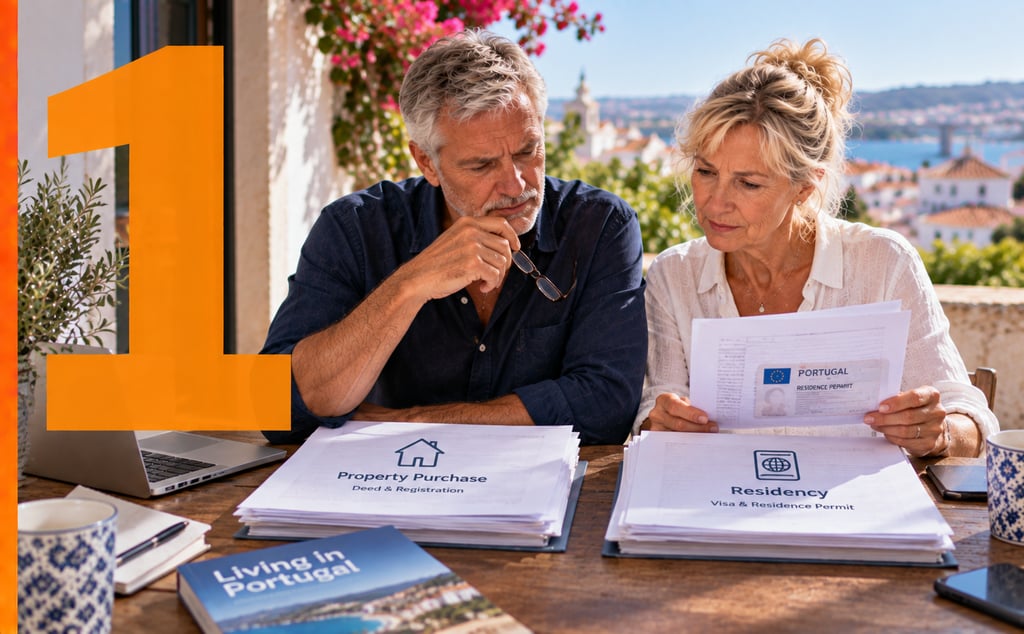
The mistake: treating the purchase as the thing that lets you live in Portugal.
Why it matters: buying a home is a private transaction. It creates no right to stay. Four different statuses are in play and they are easy to confuse:
| Status | What it means | Who grants it |
|---|---|---|
| Ownership | You own a property. No immigration effect | The land registry, via the deed |
| Visitor | Short stays only, capped at 90 days in any 180 across the Schengen area | Border control |
| Residence | The right to live in Portugal long term | A consulate issues the visa, AIMA issues the permit |
| Tax residence | Where you are taxed on your worldwide income | The Portuguese tax authority, by the rules in the tax code |
For non-EU nationals, including British and US citizens, the route runs in two stages. You apply for a long-stay residence visa at a Portuguese consulate before you travel. After arrival you attend an appointment with AIMA to collect the permit itself. Temporary permits are renewed every two to three years, with permanent residence available after five years of legal residence.
Two routes cover most YOH readers. The D7 is for people living on passive income such as pensions, rents or dividends. The D8 is for remote workers. In 2026 the D7 threshold tracks the Portuguese minimum wage of €920 a month (£790). Add 50% for a spouse and 30% for each dependent child. The D8 sits at roughly four times that figure. The golden visa’s property investment route closed some time ago, so a purchase no longer feeds an investment application.
Carrying your residence document is a legal requirement once you live there. The police can fine you if you cannot produce it.
Looking at a move to Portugal?
Browse property listings on our portal or speak to an expert who knows the country.
Do this instead:
- Settle your residence route before you commit to a completion date
- Read our guide to visa and residency options for non-residents in Portugal and the detail on residency requirements for property buyers
- If your stays will stay short, track your days carefully. The EU Entry/Exit System now records non-EU entries and exits digitally, so the 90-day count is no longer a matter of passport stamps
2. Do not budget only for the purchase price
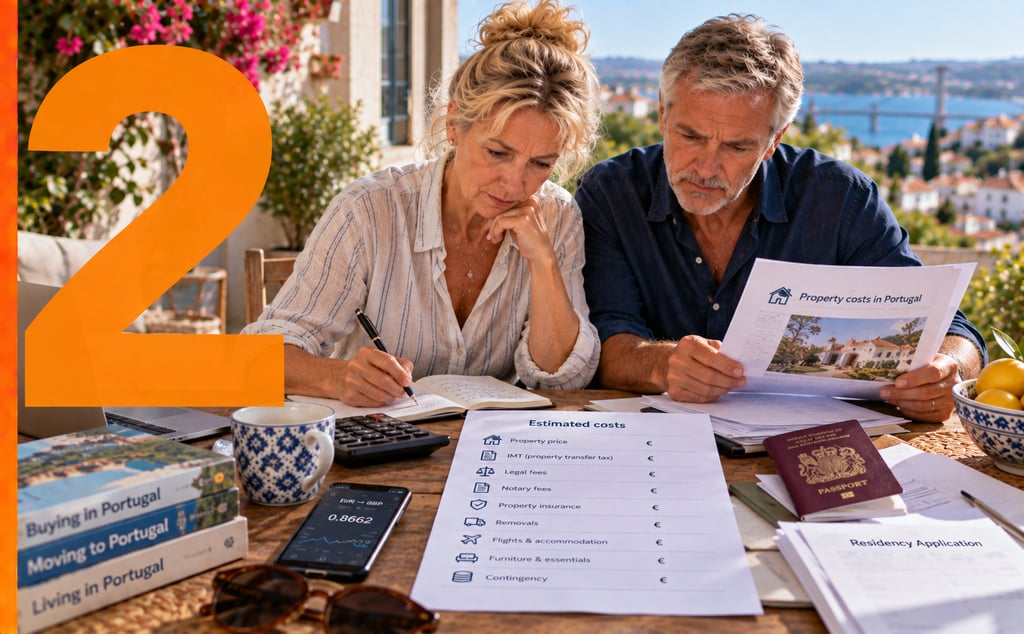
The mistake: working to the asking price and treating everything else as a rounding error.
Why it matters: the gap between the price and the money that leaves your account is the biggest surprise in the process. Two of those costs are fixed by law. IMT, the property transfer tax, is not charged on a main home valued at or below €106,346 in 2026. A second home is taxed from the first euro and rates step up with value. Stamp duty is charged at 0.8% of the value used for IMT.
Everything else varies by property, by region and by how you pay.
| Cost | What it covers | When you pay |
|---|---|---|
| IMT and stamp duty | Purchase taxes | Before the deed |
| Legal fees | Your own independent lawyer | Staged through the purchase |
| Notary and registration | Deed and land registry entry | At completion |
| Survey | Building condition, where you commission one | Before the promissory contract |
| Removals and storage | Getting your belongings there | On the move |
| Insurance | Buildings, contents and health cover | From completion |
| Furnishing and first repairs | Making the place usable | First few months |
| Utility connections and deposits | Water, power, internet | First weeks |
| Travel during the purchase | Viewing trips, deed, handover | Throughout |
| Currency movement | The change between agreeing a euro price and transferring the money | Between contract and completion |
| Annual running costs | IMI, condominium charges, maintenance, tax filing | Every year afterwards |
That last-but-one line catches people out most often. You agree a price in euros and pay from a sterling account. The number in pounds is not settled until the money moves. On a purchase of a few hundred thousand euros, a modest rate move is a meaningful sum. The timing is rarely in your hands. Our guide to currency transfer and property purchases explains how buyers fix a rate in advance.
Do this instead:
- Ask your lawyer for a written total to complete for your specific property and buyer profile, rather than a percentage rule of thumb
- Work through the costs of buying property in Portugal, the 2026 IMT rates and the annual running costs of owning property in Portugal
- Set a sterling ceiling as well as a euro budget and plan the transfers as staged payments rather than one lump
3. Do not sign before independent legal and property checks
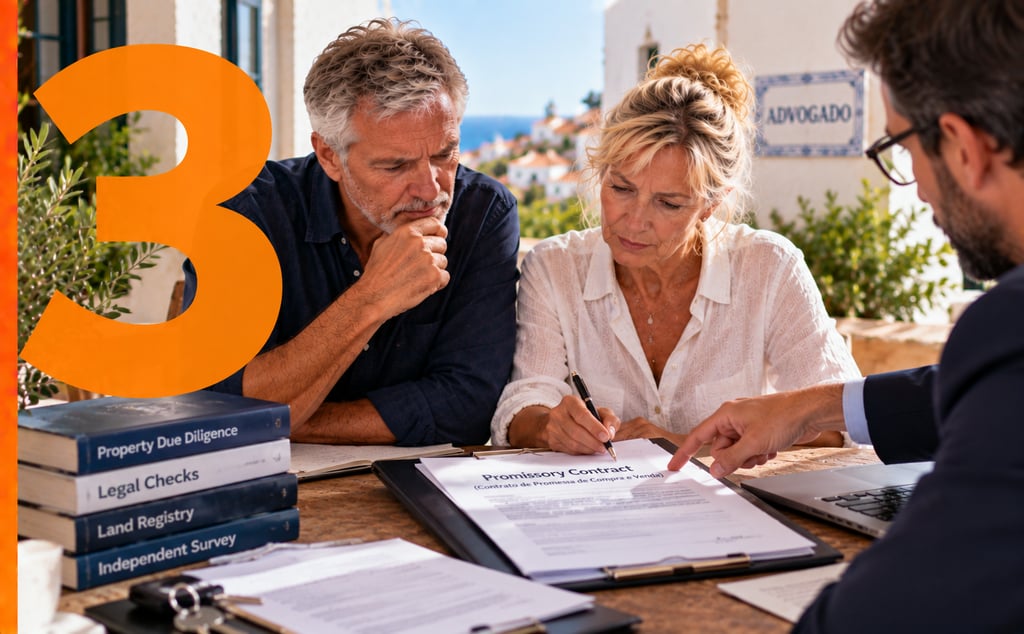
The mistake: paying a reservation fee or signing the promissory contract because the process feels like it is moving and you do not want to lose the house.
Why it matters: the promissory contract, the contrato-promessa de compra e venda or CPCV, is the point of commitment. The deposit, the sinal, is commonly 10% on a resale and 20% to 30% on a new build. Under the Portuguese civil code, a buyer who walks away without grounds forfeits it. A seller who walks away owes double. Many seller-drafted contracts water down that second half. Spotting it is one of the more valuable things your own lawyer does.
The checks that belong before that signature, not after, include:
- Title and ownership, through the permanent land registry certificate
- Any debts, mortgages or charges registered against the property
- The licence of use and whether it matches how the property is actually used
- Boundaries and registered plot size, which matter a great deal on rural land
- Alterations and extensions and whether they appear on the approved plans
- Condominium accounts and any outstanding charges on an apartment
- Building condition, where you commission a property survey
Two Portuguese rules catch overseas buyers in particular. Coastal, river and lakeside properties can be affected by the 2005 water resources law, which governs public water domain land. Rural properties carry obligations under the forest fire prevention rules, including clearance around buildings. Both are worth asking about before you fall for a plot.
Do this instead:
- Appoint your own lawyer, not one introduced by the selling agent. Check they are registered with the Portuguese bar, the Ordem dos Advogados
- Ask for conditions in the CPCV that let you withdraw without penalty if a mortgage, a document or a specific check fails
- Read our guides to finding a property lawyer in Portugal and the step-by-step buying process
Portuguese notaries also offer an independent purchasing service called Casa Simples, Casa Segura. Some buyers use it alongside a lawyer. The full legal picture sits in our legal requirements guide rather than here.
4. Do not choose an area from a holiday visit alone

The mistake: buying the town you had a good week in.
Why it matters: a holiday tests a place at its best. You arrive in good weather, you have no errands and everything is open. Living there tests different things entirely. The gap shows up in the second winter rather than the first summer.
The undecided share is larger than most buyers assume. Among prospective buyers surveyed by Your Overseas Home who named Portugal, “don’t know” was the most common answer on region. It came from 24 of 107 respondents. Nearly seven in ten prospective buyers (686 of 990) also want to walk to shops and cafés. That sits awkwardly beside the strong preference for village and countryside homes. Those two answers pull in opposite directions, so resolve the tension before you commit.
Try the normal Tuesday test on your next trip. Book a viewing trip that includes some ordinary life:
- Visit outside peak season, ideally in winter
- Register the journey time to the nearest hospital and health centre, not just the distance
- Do a full supermarket shop and see what the everyday prices look like
- Drive or take the train to the airport at a realistic hour
- Check the bus or rail timetable on a Sunday
- Test the broadband and mobile signal inside the property, not on the terrace
- Walk the hill between the house and the nearest shop, twice
- Sit outside in the evening and listen
- Find out what is open in January
Overseas property search
Find properties that fit your plans
Choose where you want to buy, your budget and how many bedrooms you need. We’ll take you straight to matching properties on the Your Overseas Home Property Portal.
Start your property search
Your selections carry through to the results
Our Portugal viewing trip guide sets out how to structure a trip that answers these questions. The region-by-region guide to where to buy is a better starting point than a single holiday. If the Algarve is your instinct, read how it compares with the Silver Coast before you narrow down. The cost of living comparison with the UK helps if the sums are part of the decision.
5. Do not leave the paperwork until after you arrive

The mistake: treating residency, healthcare, banking and utilities as things to sort out once the boxes are unpacked.
Why it matters: these steps depend on each other. The NIF, your Portuguese tax number, is needed for almost everything else, including the purchase itself. Healthcare registration needs your residence certificate. Your driving licence registration is tied to the date on that certificate. Miss the order and you spend your first months chasing appointments instead of settling in.
Here is the sequence that works:
| Stage | What to arrange |
|---|---|
| Before you offer | NIF, residence route chosen, independent lawyer appointed, sterling budget set |
| Before completion | Legal checks finished, Portuguese bank account where needed, currency transfers planned, buildings insurance quoted |
| Before you travel | Residence visa issued, removals booked, healthcare cover in place, pet paperwork if relevant |
| First weeks after arrival | AIMA appointment attended, SNS registration, utilities transferred, driving licence registered with IMT, tax status updated |
A few details are worth knowing in advance. Once you are a registered resident, you sign up with the Portuguese health service at your local centro de saúde. That gives you a health user number. Bring your residence certificate, passport and NIF. If you draw a UK State Pension you may qualify for an S1 form, under which the UK funds your Portuguese state healthcare. Your UK GHIC stops covering you in Portugal once you live there. Private cover is optional, but it does not replace state registration.
On driving, a UK to Portugal agreement lets residents keep using a valid UK licence. It has to be registered with IMT within 60 days of the date on your residence certificate. You cannot renew a UK licence once you live in Portugal, so most people exchange it at some point. An international driving permit is not an alternative.
Tax residence deserves its own note. There are two tests. You become a Portuguese tax resident if you spend more than 183 days there in any 12-month period beginning or ending in the tax year. You also qualify if you keep a home there in conditions suggesting you intend to occupy it as your habitual residence. That second test does not depend on a day count. It catches people who assume a holiday home is automatically neutral. Update your status with the tax authority within 60 days of meeting either condition. This is general guidance, not advice on your own position, so speak to a specialist about your pensions and income first.
Do this instead: build an administration timeline before the removal date, working backwards. Our guides to utilities, healthcare in Portugal and removals from the UK cover the practical steps. If pension income matters to you, start with the UK to Portugal double tax treaty guide.
What should you do before moving to Portugal?
Knowing what not to do in Portugal is only half the job. Turn the five warnings into a short list and work through it in order:
- Establish your residence route and check you meet the income test
- Set a full euro budget and a sterling ceiling, including moving and first-year costs
- Get your NIF
- Appoint independent legal support, chosen by you
- Test the area outside holiday mode, in winter if you can
- Map the administrative steps and their deadlines
- Plan healthcare cover and check your S1 position if you draw a UK pension
- Plan the currency transfers as staged payments
- Keep certified copies of key documents in both countries
None of this makes the move harder. It front-loads the decisions that are expensive to reverse.
Portugal viewing trip guide
Make your property viewing trip count
Plan your time in Portugal, organise effective viewings and arrive ready to compare properties with confidence.
What should I do next?
Still deciding where to look? Start with the Portugal buying guide. Then browse property for sale in Portugal to see what your budget buys in each region.
If you have a region in mind and are working on numbers, speak to a currency specialist about planning the transfers. Doing that before you agree a price is what keeps your sterling budget intact.
If you are close to making an offer, ask us to introduce you to a Portugal expert. Many buyers we help want a lawyer and a tax adviser lined up before the promissory contract, not after it.
Summary
Buying a home in Portugal and gaining the right to live there are two separate processes. The purchase does not deliver the second. Budget for the full cost of moving, not the asking price. Treat the exchange rate as a live figure until the money has moved. The promissory contract is the point of commitment, so the legal and property checks belong before it. Test your chosen area outside holiday season, on a normal week, before you narrow down. Sequence the administration before the removal date, starting with the NIF and the residence route. Get specialist advice on residence, tax and law for your own circumstances rather than relying on general guidance.
Frequently asked questions
No. Owning a property in Portugal carries no immigration rights. Non-EU nationals apply for a long-stay residence visa at a Portuguese consulate. They then collect a residence permit from AIMA after arrival. The golden visa’s property investment route has closed, so a purchase no longer supports an investment application.
More than the purchase price. Beyond IMT and stamp duty, allow for your lawyer, notary and registration, any survey, removals, insurance and furnishing. Add utility connections, travel during the purchase and the first year of running costs. Ask your lawyer for a written total to complete for your specific property rather than working from a percentage.
Not always, but most buyers open one. A Portuguese account makes utility direct debits, IMI payments and condominium charges straightforward. Some residence applications also expect savings held locally. You will need a NIF first. Discuss the timing with your lawyer, because the account is easier to open at some stages than others.
Almost every buyer does. Appoint one you chose yourself rather than one introduced by the selling agent. Your lawyer checks title, debts, licences, boundaries and any unapproved alterations. They also negotiate the promissory contract so the withdrawal terms are not weighted against you. Check they are registered with the Ordem dos Advogados.
Long enough to see it out of season. A winter visit and a full week of ordinary errands tell you more than three summer holidays. Test the journey to the hospital, the supermarket prices, the broadband inside the house and what stays open in January. A structured viewing trip is the cheapest research you will do.
Once you register as a resident, sign up with the Portuguese health service at your local health centre. You will need your residence certificate, passport and NIF. If you draw a UK State Pension you may qualify for an S1 form, under which the UK funds your Portuguese state healthcare. Your UK GHIC will not cover you once you live there.
Sources
- Foreign, Commonwealth and Development Office, Living in Portugal (updated 10 July 2026) – residence registration, healthcare, driving, property and tax
- Agency for Integration, Migration and Asylum, AIMA – residence permits and renewals
- GOV.UK, Healthcare for UK nationals living in Portugal – SNS registration and the S1 form
- GOV.UK, EU Entry/Exit System – how Schengen stays are now recorded
- Portuguese Tax and Customs Authority, IMT rate tables and Ofício Circulado 40129/2026 – 2026 transfer tax brackets and stamp duty
- Portuguese Tax and Customs Authority, Personal Income Tax Code, article 16 – the tax residence tests
- Diário da República, Civil Code, article 442 – the sinal deposit regime
- Institute for Mobility and Transport, exchanging a foreign driving licence
- Portuguese government, applying for a NIF and NISS as a foreign citizen
How ready are you to move to Portugal?
Answer five quick questions to see which parts of your move are already taking shape – and what you may want to sort out next.
Your next steps
You’ve made a start – now tighten up the gaps
You don’t need every detail finalised before you start looking at property. But sorting these areas early can make the buying process much easier.
Your result
Your Portugal plans are taking shape
You’ve covered the main planning areas. The next step is turning that preparation into a realistic property search and purchase budget.
The free Portugal Buying Guide takes you through the property search, costs, legal process and preparations in more detail.
Get the free Portugal Buying GuideThis check is a planning tool rather than legal, tax or financial advice. Your requirements will depend on your circumstances.