

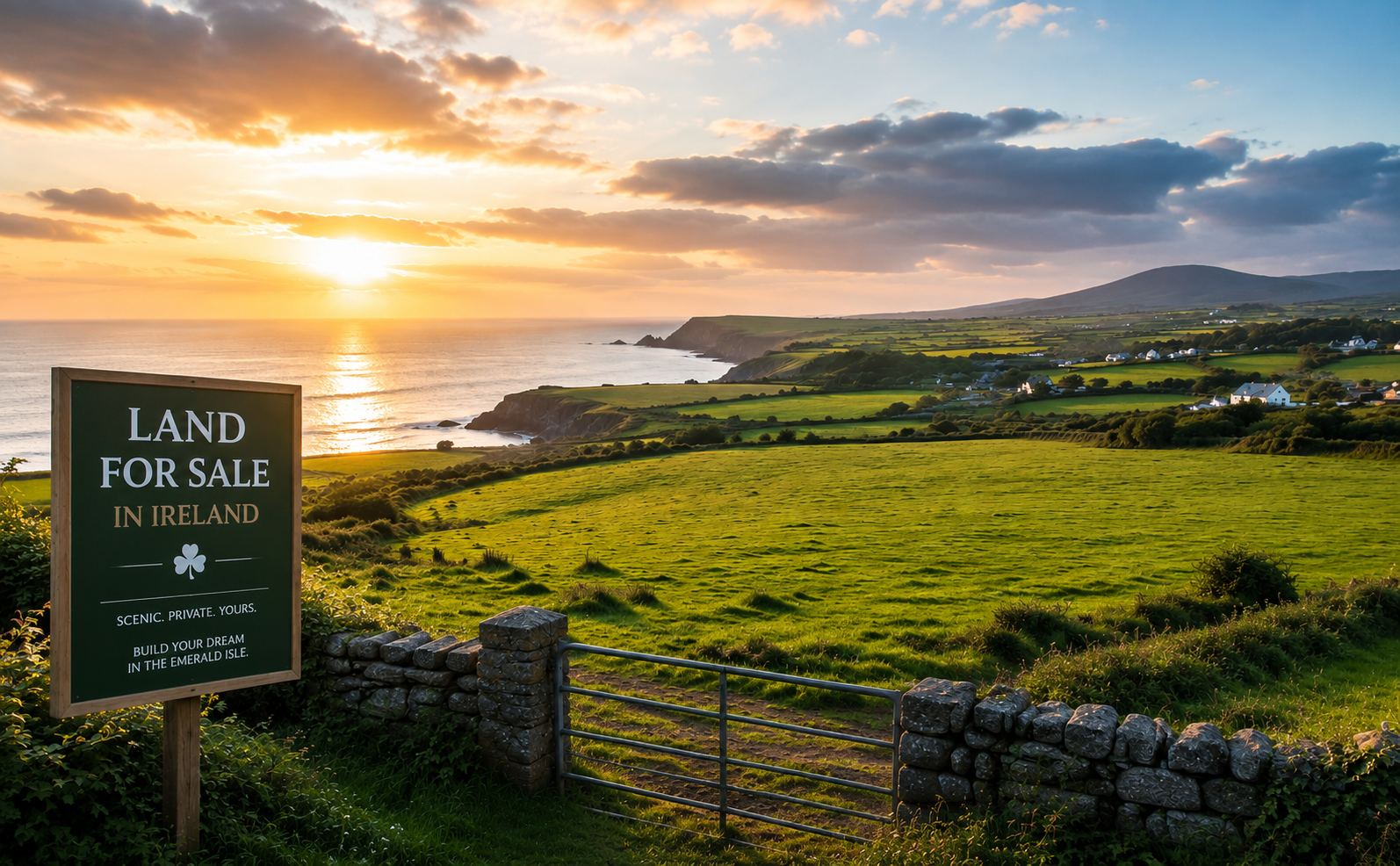
Thinking of buying land so you can build your own home in Ireland? It’s entirely possible – even as a foreign buyer. Here’s what you need to know before you start searching for the perfect plot.
There’s something deeply appealing about the idea of a self-build. A home designed around your life, your tastes, your view – rather than whoever happened to own it before you. In Ireland, that dream is genuinely within reach, and for buyers relocating from the UK, the familiarity of the language, legal system and culture makes the process feel far less daunting than self-building in, say, France or Spain. But there are still plenty of details to get right. This guide walks you through the key steps, from finding land to securing planning permission and managing costs.
Download the Ireland Buying Guide
Contents
Can foreign buyers purchase land to build on in Ireland?
Yes, and without restriction. There are no limitations on foreign nationals – EU or non-EU – buying land or property in Ireland. You don’t need to be a resident or citizen to purchase a plot and commission a build. It’s one of the reasons Ireland remains an accessible destination for UK buyers in particular, especially since many are already familiar with how property transactions work closer to home.
How to find the right plot
Start by settling on a location. Ireland’s regions vary enormously – from the dramatic coastlines of the west to the more accessible commuter towns within striking distance of Dublin. Once you have a rough idea of where you want to be, contact local land agents and estate agents directly and tell them what you’re looking for. Many good plots never make it to the mainstream portals, so a conversation early on can give you a head start.
There are also specialist land-finding agencies operating in Ireland who focus exclusively on sourcing plots for self-builders. Your local council can be another useful contact – they’ll sometimes know of land that’s about to come to market. And it’s worth approaching property developers too. Some will sell you a site and build on it for you, which can simplify the process considerably. If you go down that route, make sure the contract for the plot and the contract for the build are kept as entirely separate documents.
Keep an open mind when you’re viewing. A plot that looks uninspiring at first glance – perhaps with a derelict structure on it – might be exactly what you need once the existing building is cleared and a fresh set of plans takes shape.
Building your team
Unless you’re going via a developer, you’ll need to pull together a team of professionals before anything else happens. Your first appointment should be an architect. In Ireland, look for someone who is a member of the Royal Institute of Architects of Ireland (RIAI) – this ensures they meet the professional standards required for a legitimate build. A good architect will also be able to recommend builders, though it’s always worth gathering your own quotes and speaking to past clients before you commit to anyone.
Your builder should be a member of the Irish Home Builders’ Association (IHBA). IHBA membership means automatic registration with Homebond, a structural warranty scheme that protects you if your builder becomes insolvent, if major structural defects emerge within ten years of completion, or if water or smoke damage occurs within the first two years.
You’ll also need a solicitor experienced in Irish property law. They’ll check the title deeds for any restrictions, covenants or easements that could affect how you use the land, and guide you through the purchase process. Finally, before you exchange, employ a chartered surveyor registered with the Society of Chartered Surveyors Ireland (SCSI) to assess the site’s suitability for building. Old foundations, underground infrastructure, unstable soil – these are the kinds of issues that can derail a project entirely if they’re not identified early.
| Professional | Role | Accreditation to look for |
|---|---|---|
| Architect | Designs your home and leads the planning application | Member of the Royal Institute of Architects of Ireland (RIAI) |
| Builder | Carries out the construction work | Member of the Irish Home Builders’ Association (IHBA) – ensures Homebond registration |
| Solicitor | Handles the legal side of your purchase and checks title deeds | Experience in Irish property law |
| Chartered surveyor | Assesses whether the site is suitable to build on | Registered with the Society of Chartered Surveyors Ireland (SCSI) |
Building regulations and compliance
One step you can’t afford to overlook is compliance with Ireland’s Building Control Amendment Regulations, known as BCAR. Under BCAR, most new builds require you to appoint an Assigned Certifier – typically your architect or a chartered surveyor – who inspects the build at key stages and certifies that it meets the required standards. Without a Certificate of Compliance on Completion, you cannot legally occupy the property or sell it in the future. Make sure your architect is across this from day one.
What to look for in a plot
Beyond the obvious question of whether you like the location, there are several practical factors worth examining carefully before you make an offer.
The first is zoning. In Ireland, land is designated for specific uses – residential, commercial, industrial or amenity – and your build must align with how the plot is zoned. Mixed-use zoning can also accommodate residential development, but always confirm this before proceeding. Your solicitor and architect can help you interpret the local authority’s development plan.
Check whether there are any restrictions on the type of building permitted on the plot. Some areas impose limits on height, footprint or how close a structure can be to neighbouring properties or power lines. You can review the title deeds for the land via the Land Registry’s online portal at landdirect.ie.
Think carefully about access and infrastructure too. A rural plot with sweeping views might be perfect on paper, but if there’s no established right of way and the road runs across a neighbour’s land, you could face significant costs before a single brick is laid. Equally, check whether the plot has connections to mains water, electricity, sewerage and gas – or, if not, get an early estimate of what connection costs are likely to be. These figures need to be in your budget from the start.
The quality of the land itself also matters. Soil that’s unstable, too steep or concealing underground obstacles can make building expensive or, in some cases, impractical. A good surveyor will identify these issues. It’s also worth checking whether the plot supports any protected wildlife. If protected species are present, the cost of relocation or mitigation can be substantial.
Understanding planning permission
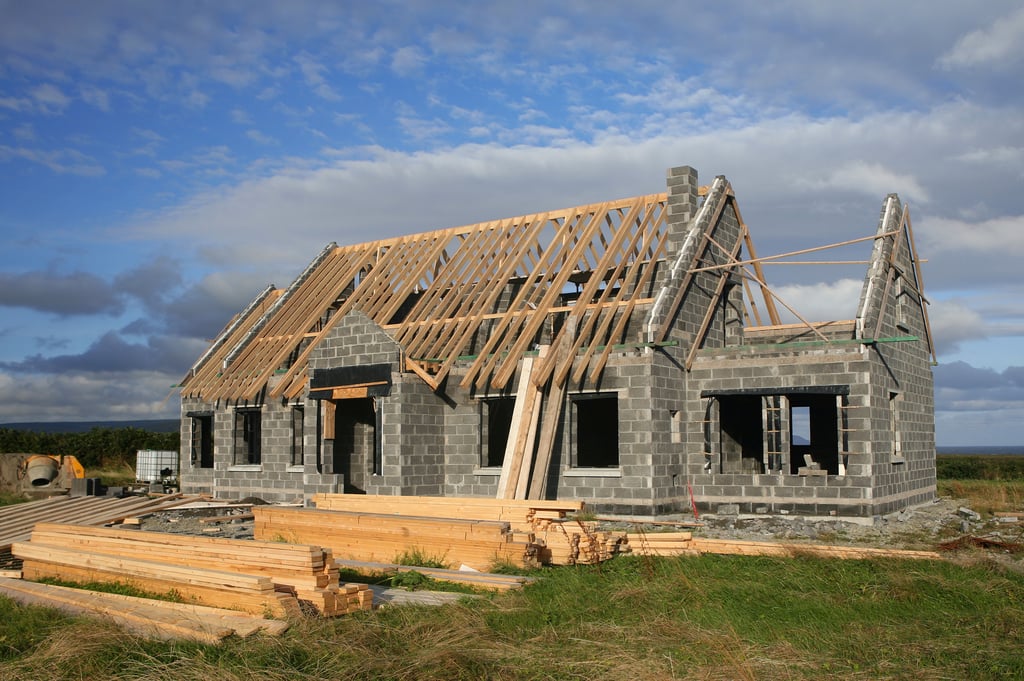
This is where many self-builds in Ireland run into difficulty, and it’s worth being realistic about the process from the outset.
As a general rule, Irish planning authorities favour development close to existing services and infrastructure. The more rural your chosen location, the more scrutiny your application is likely to receive. In parts of the southwest, planning permission for one-off rural builds can be particularly hard to obtain. That said, it’s not impossible – and the process is far more navigable if you approach it correctly.
Before you make an offer on any plot, arrange a pre-planning meeting with the relevant local authority. Each council has its own development plan and its own priorities, and this meeting will give you a clear picture of what’s likely to be approved and what isn’t. In rural areas, the picture is more complex. Ireland’s “local needs” criteria – which require applicants to demonstrate a genuine connection to an area – have been challenged at European Court of Justice level as potentially discriminatory, and the rules are gradually being reviewed. In practice, however, many local councils still enforce local links strictly. If you have no established connection to a rural area, securing permission for a new one-off build there is currently very difficult.
Always make any offer to purchase subject to planning permission being granted. This protects your investment if the application is ultimately refused. Once permission is in place, you have five years to complete the build before you’d need to apply again.
For the best chance of approval, work with an architect from the start of your planning application – not just to produce drawings, but to ensure the design is sympathetic to its surroundings and as sustainable as possible. Planning authorities across Ireland have become increasingly receptive to energy-efficient and low-impact designs in recent years.
What will it cost?
Land prices in Ireland vary enormously depending on location, zoning and proximity to services. Traditionally, the cost of your plot accounted for around 50% of your total budget – but that ratio has shifted in recent years. Construction inflation has pushed build costs up significantly, and all new builds must now meet NZEB (Nearly Zero Energy Building) standards, which adds to both material and labour costs. In some regions, the build itself will comfortably outweigh the land cost. Treat any percentage split as a starting point and get detailed quotes early.
There is no VAT on the purchase of the land itself. The build, however, is subject to VAT at the reduced rate of 13.5%, which should be included within any quote you receive from your builder. Architect’s fees are typically calculated at around 10% of the total build cost.
It’s also worth factoring in survey costs, legal fees, planning application fees and any infrastructure connection costs if the plot isn’t already serviced. These can add up, so build in a contingency from the start rather than treating them as surprises.
The good news is that for buyers willing to take on the process, a self-build can still represent strong value compared to buying an equivalent finished property in the same area – particularly in parts of Ireland where demand for existing homes is pushing prices up. The build is more work, but the result is a home that fits you precisely.
FAQs about buying land to build in Ireland
It varies significantly by location. High-quality agricultural land averages around €14,000–€15,000 per acre, though in premium areas like Wexford or Kildare it can exceed €19,000. Serviced building plots are typically sold by the site rather than the acre, and near Dublin or popular coastlines can cost considerably more.
Not quite — it’s a reimbursement for renovation costs, not a relocation payment. Ireland’s “Our Living Islands” scheme offers grants of up to €84,000 ($92,000) towards restoring a vacant or derelict property on one of its offshore islands.
Demand remains strong due to Ireland’s chronic housing shortage. That said, the Planning and Development Act 2024 has made zoning more strategic, meaning land with planning permission already in place is considerably more valuable than agricultural land bought speculatively. Independent legal and financial advice is essential before committing.
Rural counties in the midlands and northwest – Roscommon, Leitrim and Longford among them – tend to offer the lowest land prices. Bear in mind that these areas are further from services and employment, and planning permission for one-off rural builds can be harder to obtain.
Thinking about making the move to Ireland? Our team of Ireland property experts is on hand to help – whether you’re buying land, finding an existing home or simply working out where to start.