


You’ve found your property, signed the deed and paid the taxes. But what does it actually cost to own a home in Portugal year after year? It’s a question many buyers don’t ask early enough – and the answer varies enormously depending on what you’ve bought and where.
A two-bedroom apartment in Porto with low condominium fees might cost you €2,500 (£2,100) a year to run. A four-bedroom villa with a pool in the Algarve could easily reach €10,000–€15,000 (£8,400–£12,600). The difference comes down to property taxes, utilities, maintenance, insurance and whether you’re paying someone to look after the place while you’re not there.
This guide breaks down every recurring cost you’ll face as a property owner in Portugal, with real figures in euros and pounds, organised by property type so you can build an accurate annual budget.
Key takeaway: Annual running costs for a Portuguese property typically range from €2,000 to €5,000 (£1,680–£4,200) for an apartment, €4,000 to €8,000 (£3,360–£6,720) for a detached house, and €8,000 to €15,000+ (£6,720–£12,600+) for a villa with pool and garden. The biggest variables are property tax (IMI), condominium fees, pool and garden maintenance, and whether you use a property management company.
Property tax – IMI
IMI (Imposto Municipal sobre Imóveis) is Portugal’s equivalent of council tax. Every property owner pays it, regardless of residency status. The rate is set by your local municipality and ranges from 0.3% to 0.45% of the property’s tax value (known as the VPT – Valor Patrimonial Tributário) for urban properties.
The important thing to understand is that the VPT is almost always lower than the market value. A property you paid €400,000 (£336,000) for might have a VPT of €200,000–€300,000. Your IMI bill on that property would be roughly €600–€1,350 (£500–£1,130) per year.
Payment is collected in instalments depending on the amount: one payment in May if under €250, two payments (May and August) if between €250 and €500, or three payments (May, August and November) if over €500. The Portal das Finanças handles billing – you can check your VPT and payment schedule there.
For a fuller explanation of how property taxes work across the board, our guide to Portuguese property taxes covers purchase taxes as well as the annual ones.
Wealth tax – AIMI
AIMI (Adicional ao Imposto Municipal sobre Imóveis) is an additional annual tax that applies if the combined VPT of all your Portuguese property exceeds €600,000 (£504,000). It’s per person, so a couple who jointly own a single property won’t pay AIMI unless the VPT exceeds €1.2m (£1,008,000).
Key facts
| ▸ Portugal national median | €2,111/sqm (£1,770) |
| ▸ Comporta prime range | €6,800–€10,700/sqm (£5,700–£9,000) |
| ▸ Top-end beachfront | €15,000+/sqm (£12,600+) |
| ▸ Alentejo annual growth | 13.8% (2024) |
Most UK buyers with a single holiday home won’t trigger AIMI. But if you own multiple properties in Portugal, or a high-value villa whose VPT exceeds the threshold, it’s worth factoring in. AIMI is billed in June and payable in September in a single instalment.
Utilities
Utility costs in Portugal are broadly comparable to the UK, though electricity can be surprisingly expensive – Portugal’s per-kWh rate is around 22% higher than the UK’s. Water, on the other hand, is generally cheaper.
| Utility | Typical monthly cost | Notes |
|---|---|---|
| Electricity | €50–€120 (£42–£100) | Higher in winter (heating) and summer (air conditioning). Off-peak tariffs can reduce costs significantly. |
| Water and sewage | €15–€40 (£13–£34) | Varies by municipality. Charged on consumption tiers. |
| Gas (if connected) | €20–€40 (£17–£34) | Many newer properties are all-electric. Gas cylinders cost ~€25–€30 each and last roughly two months. |
| Internet, TV and phone | €30–€60 (£25–£50) | Bundled packages from NOS, MEO or Vodafone. |
| Waste collection | €5–€10 (£4–£8) | Usually included in the water bill or charged by the municipality. |
| Total (typical two-bedroom) | €120–€270 (£100–£225) | €1,440–€3,240 per year |
If your property is a holiday home that sits empty for months at a time, your utility bills will be lower – but you’ll still pay standing charges. Our guide to getting utilities connected in Portugal covers the setup process.
Condominium fees
If you own an apartment or a property within a managed development or resort, you’ll pay condominium fees (condomínio). These cover shared costs: cleaning of communal areas, building insurance, lift maintenance, garden and pool upkeep, security and sometimes a reserve fund for major repairs.
The range is wide:
| Property type | Typical monthly condominium fee |
|---|---|
| Basic apartment (older building, no lift) | €25–€60 (£21–£50) |
| Modern apartment with lift and shared pool | €80–€200 (£67–£168) |
| Luxury resort apartment (concierge, gym, multiple pools) | €200–€600 (£168–£504) |
| Villa in a gated community | €50–€500 (£42–£420) |
These fees are mandatory and set by the homeowners’ association (assembleia de condóminos). Before you buy, ask to see the most recent meeting minutes, annual accounts and reserve fund balance. Non-payment of condominium fees in Portugal is taken seriously – in extreme cases, the property can be seized.
Before buying in any managed development, ask to see the meeting minutes, annual accounts and reserve fund balance. Non-payment of condominium fees can have serious consequences.
Home insurance
Building insurance isn’t legally required in Portugal unless you have a mortgage – but it’s wise to have it regardless. If you’re in a condominium, the building’s structural insurance is typically covered by the communal fees. Contents and personal liability insurance is your responsibility.
| Cover level | Typical annual cost |
|---|---|
| Basic fire and flood (apartment) | €75–€150 (£63–£126) |
| Multi-risk policy (apartment) | €120–€250 (£100–£210) |
| Comprehensive cover (villa) | €300–€600+ (£252–£504+) |
If your property is in an area with earthquake risk (Lisbon region, parts of the Algarve), you may want to add seismic cover, which increases the premium. Coastal properties may also attract higher rates for storm damage.
Garden and pool maintenance
This is the cost category that catches many first-time overseas buyers off guard – particularly those moving from apartment ownership in the UK to a detached villa with outdoor space.
| Service | Typical cost |
|---|---|
| Garden maintenance (small/medium garden) | €100–€160 (£84–£134) per month |
| Garden maintenance (large or landscaped) | €200–€400 (£168–£336) per month |
| Pool maintenance | €60–€90 (£50–£76) per month |
| Pool electricity (pump and filtration) | €30–€50 (£25–£42) per month |
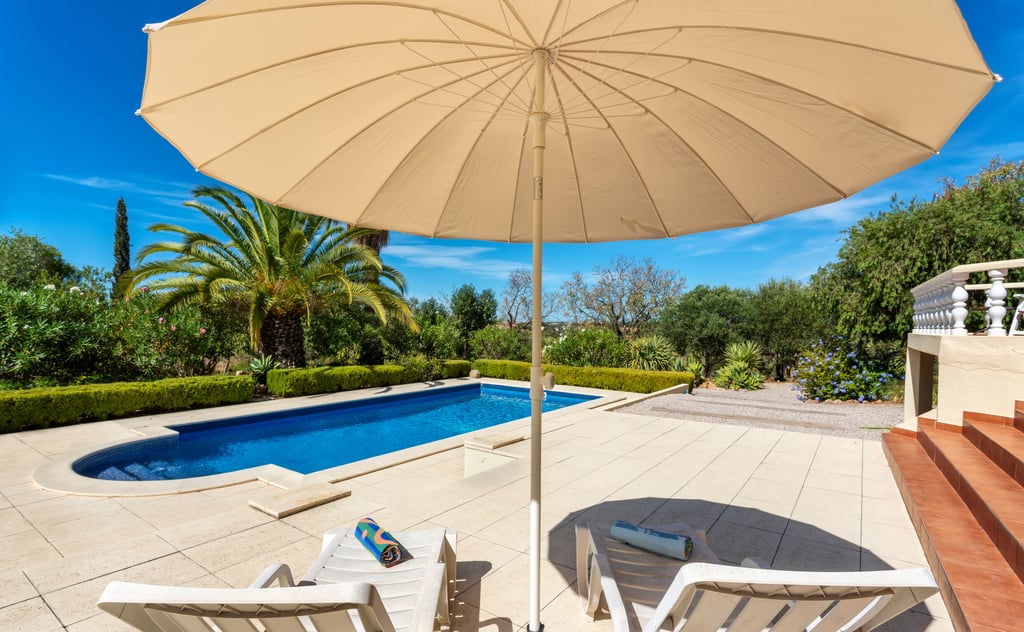
A villa with a medium garden and pool will typically cost €200–€300 (£168–£252) per month to maintain outdoors – that’s €2,400–€3,600 (£2,016–£3,024) a year. Portugal’s climate means the garden needs year-round attention, and pools require maintenance even outside the swimming season to avoid damage and algae build-up.
If you’re buying a property with a pool for the first time, our guide to managing your Portuguese property covers how to find reliable local contractors.
Property management
If you’re not living in Portugal full-time, you’ll probably want someone keeping an eye on the place. Property management services range from basic key-holding and monthly checks to full-service packages that cover everything from paying your bills to handling rental guests.
| Service level | Typical cost |
|---|---|
| Key-holding and monthly inspection | €50–€100 (£42–£84) per month |
| Mid-level (inspections, bill payments, minor repairs, mail) | €100–€250 (£84–£210) per month |
| Full service (all of the above plus cleaning, laundry, garden/pool oversight) | €250–€500+ (£210–£420+) per month |
If you plan to rent your property out through an Alojamento Local licence, most management companies charge 20–35% of rental income on top of or instead of the monthly fee. Our guide to renting out your property in Portugal covers the licensing and tax requirements.
General repairs and upkeep
Beyond the predictable costs, every property needs repairs. The general rule of thumb is to set aside 1–2% of the property’s value per year for maintenance and unexpected work. That means €2,000–€4,000 (£1,680–£3,360) a year on a €200,000 apartment, or €5,000–€10,000 (£4,200–£8,400) on a €500,000 villa.
Common costs include:
- Plumbing repairs: €50–€200 (£42–£168) for minor work
- Electrical work: €60–€250 (£50–£210) for small jobs
- Exterior painting/rendering: €1,500–€5,000 (£1,260–£4,200) depending on property size
- Air conditioning servicing: €60–€200 (£50–£168) per unit per year
- Roof/terrace waterproofing: €500–€3,000 (£420–£2,520) as needed
Older properties and renovation projects will naturally cost more to maintain. If you’re considering buying something that needs work, our guide to the potential pitfalls of buying in Portugal is worth reading first.
The full picture – costs by property type
Here’s what a realistic annual budget looks like for three common property types, assuming you’re a non-resident using the property as a holiday home:
| Annual cost | Two-bed apartment (Lisbon/Porto) | Three-bed house (Silver Coast) | Four-bed villa with pool (Algarve) |
|---|---|---|---|
| IMI | €400–€800 (£336–£672) | €600–€1,200 (£504–£1,008) | €1,000–€2,000 (£840–£1,680) |
| AIMI | Usually nil | Usually nil | Depends on VPT – may apply |
| Utilities | €1,400–€2,400 (£1,176–£2,016) | €1,800–€3,000 (£1,512–£2,520) | €2,400–€4,000 (£2,016–£3,360) |
| Condominium fees | €600–€2,400 (£504–£2,016) | Nil (unless in a development) | €600–€3,600 (£504–£3,024) |
| Insurance | €100–€250 (£84–£210) | €150–€350 (£126–£294) | €300–€600 (£252–£504) |
| Garden/pool | Nil | €600–€1,200 (£504–£1,008) | €2,400–€3,600 (£2,016–£3,024) |
| Property management | Nil–€1,200 (£0–£1,008) | €600–€1,800 (£504–£1,512) | €1,200–€3,000 (£1,008–£2,520) |
| Repairs reserve | €1,000–€2,000 (£840–£1,680) | €1,500–€3,000 (£1,260–£2,520) | €2,500–€5,000 (£2,100–£4,200) |
| Total annual estimate | €3,500–€9,000 (£2,940–£7,560) | €5,250–€10,550 (£4,410–£8,860) | €10,400–€21,800 (£8,736–£18,312) |
A four-bedroom villa with pool in the Algarve can cost €10,000–€20,000 a year to run – before you factor in any mortgage payments. Budget honestly from the start.
These figures assume moderate use (roughly 8–12 weeks per year) with the property empty the rest of the time. If you live there full-time, utility costs will be higher but you may save on property management. If you rent the property out in summer, rental income can offset a large portion of these costs – but you’ll add management fees and potentially higher wear-and-tear.
How to keep running costs manageable
A few practical steps can make a real difference to your annual bill:
Get the right energy tariff. Portugal offers bi-hourly and tri-hourly electricity tariffs that charge less during off-peak hours. Running your washing machine, dishwasher and water heater overnight can cut your electricity bill by 20–30%.
Review your condominium fees annually. Attend the homeowners’ assembly (or send a representative) and review the accounts. Fees should reflect actual costs, not habit.
Pay your IMI on time. Late payment attracts interest. Set up a direct debit through the Portal das Finanças to avoid missing the deadline.
Use a currency specialist for regular transfers. If you’re sending money from the UK monthly to cover running costs, the exchange rate matters. A regular payment plan through a specialist broker can lock in a rate and save you hundreds over a year compared to using your bank. It’s the same principle as protecting a large purchase – the cost of buying property in Portugal is where most people first encounter this, but it applies just as much to ongoing costs.
What should I do next?
If you’re budgeting for your Portuguese property, here are the next steps:
- Work out your IMI bill by checking the VPT on the Portal das Finanças or asking your lawyer.
- Speak to a currency specialist about setting up a regular payment plan for your running costs – it could save you hundreds a year on exchange rates.
- Read our guide to Portuguese property taxes for the full picture on IMI, AIMI and rental income tax.
- Join our next Portugal webinar for practical advice from buyers and experts who’ve been through the process. See upcoming events.
- Talk to a Portugal specialist who can advise on property management, tax planning and ongoing costs – find an expert through our matching service.
Summary
The annual running costs of owning property in Portugal range from around €3,500 for a modest apartment to €20,000+ for a large villa with pool. The main recurring costs are IMI (property tax at 0.3–0.45% of the tax value), utilities (€1,400–€4,000 per year), condominium fees (if applicable), home insurance, garden and pool maintenance, and property management for holiday-home owners.
AIMI applies only if your combined Portuguese property value exceeds €600,000. Budget honestly, set aside 1–2% of the property’s value for repairs, and use a currency specialist for regular transfers from the UK to Portugal. With realistic planning, the costs are manageable – and considerably lower than maintaining an equivalent property in much of the UK.
Frequently asked questions
A small apartment in an older building without a lift or shared pool will have the lowest running costs. You’ll pay IMI, utilities, basic insurance and modest condominium fees – typically €2,000–€4,000 (£1,680–£3,360) per year in total. Properties without outdoor space avoid the garden and pool costs that push villa budgets significantly higher.
Yes. IMI is payable by all property owners regardless of residency status. If you’re a non-resident, you’ll also pay 28% tax on any rental income earned in Portugal, although you can deduct costs like IMI, insurance and maintenance from the rental income. For more on how tax works for non-residents, see our introduction to Portuguese property taxes.
Pool maintenance typically costs €60–€90 (£50–£76) per month for cleaning and chemical treatment, plus €30–€50 (£25–£42) per month in electricity for the pump and filtration system. That’s roughly €1,000–€1,700 (£840–£1,430) per year. Pools need year-round maintenance even outside the swimming season to prevent damage and algae.
It depends on the property and location, but in many cases, yes. A well-located Algarve villa rented for 10–14 weeks in summer at €2,000–€5,000 per week could generate €20,000–€70,000 in gross income – more than enough to cover running costs. Management fees (20–35% of income) and rental income tax (28% for non-residents) will reduce the net figure. Our guide to renting out your property in Portugal covers the full picture.
Running costs are in euros, so if your income is in pounds, the exchange rate directly affects your annual bill. A 5% swing in the GBP/EUR rate on €10,000 of annual costs means a difference of roughly £420. Using a specialist currency broker to set up a regular payment plan or forward contract can protect you from unfavourable moves. It’s worth speaking to a currency specialist early – the same advice applies whether you’re paying for your property purchase or covering ongoing costs.
AIMI (Adicional ao IMI) is an additional annual tax on Portuguese property owners whose combined tax-registered property value (VPT) exceeds €600,000 (£504,000). For individuals, the rate is 0.7% on the portion between €600,000 and €1m, rising to 1% above €1m. If you jointly own one property with a partner, the threshold doubles to €1.2m. Most UK buyers with a single holiday home won’t trigger it – but those with high-value properties or multiple Portuguese holdings should factor it in.