

In Spain 23rd April is an important day culturally which combines the joy of books and roses in some regions and celebrates books and reading throughout the country.
Sant Jordi’s Day falls on 23rd April – a date that’s significant for more reasons than one. It’s World Book Day, the anniversary of both Spanish author Miguel de Cervantes and playwright William Shakespeare’s deaths, and in Catalonia, where – like England – Saint George (Sant Jordi) is the patron saint, it functions as the region’s version of Valentine’s Day.
Saint George is also the patron saint of Aragon, and 23rd April is a regional holiday there and in Castilla y León. But across most of Spain it isn’t a public holiday – though you’d hardly know it. Town squares fill with book stalls and rose sellers, independent bookshops see their busiest day of the year and in Barcelona the atmosphere is particularly hard to miss – authors sign copies, castellers build their famous human towers and the ramblas fill with browsers of all ages.
For anyone living in or planning a move to Spain, Sant Jordi’s Day is one of those occasions that makes it easy to feel part of local life. Here’s what to expect and how to join in.
Contents
What happens in Spain on 23rd April?
Town squares and ramblas become lively markets full of book stalls. Normally, books are expensive here, so this is an opportunity to buy some at lower prices. Some stalls just have children’s books and you will see grandparents and parents eagerly buying several at a time.
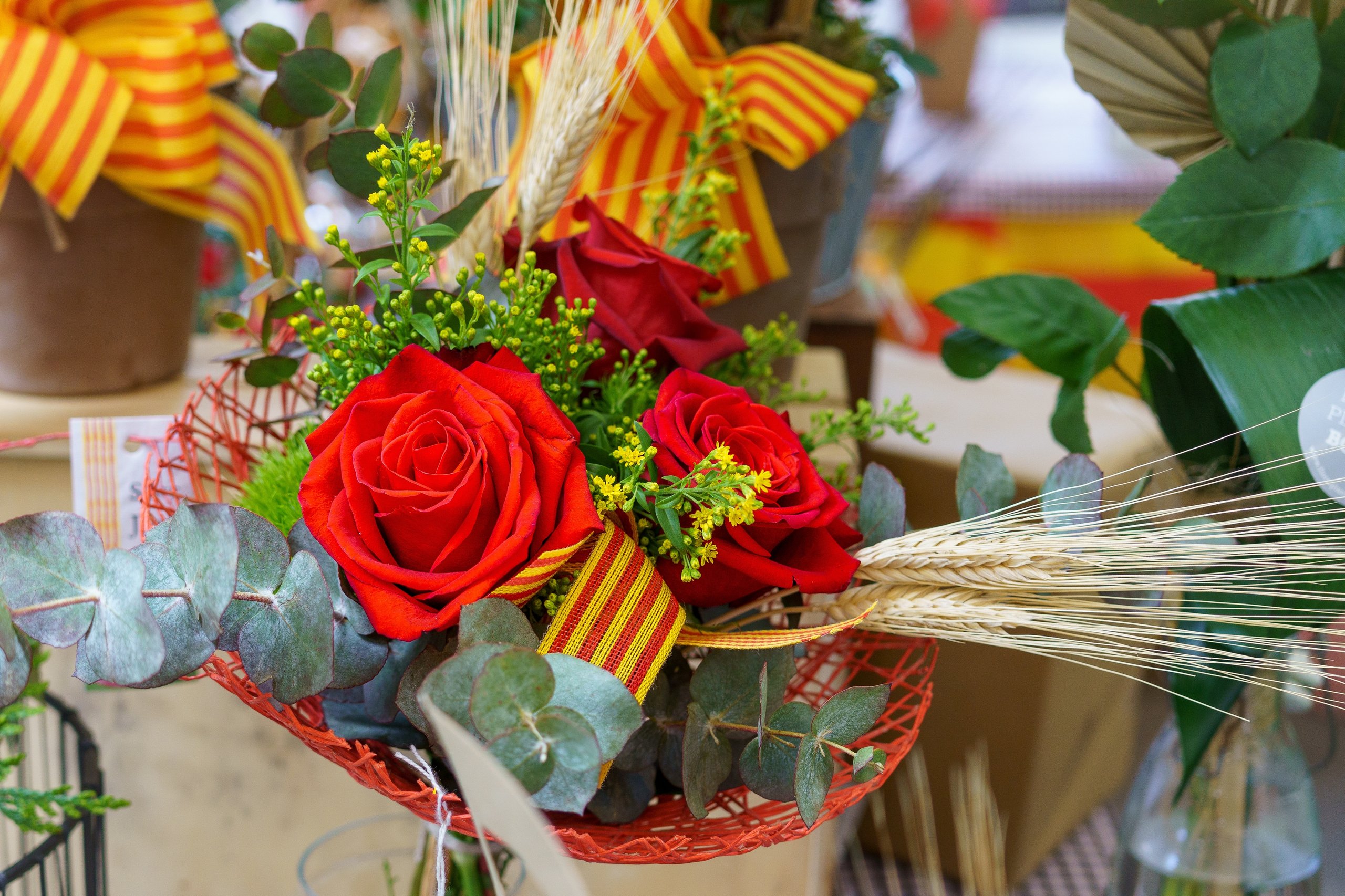
In Catalonia, La Diada de Sant Jordi (St. George’s Day) is particularly interesting as amongst the many book stalls are a similar number of stalls selling red roses, either bunches of three or just a single rose, often with a sheaf of wheat. Traditionally, ladies buy a book for a man, be it husband, father, brother or friend and men buy roses for a lady (wife, mother, sister, or daughter) but nowadays gifts of either are given.
Why roses?
Roses are tied to the legend of Sant Jordi. According to tradition, after Saint George slew the dragon to save a princess, a rose bush grew from the dragon’s blood, and he gifted a red rose to the princess.
It is a mix of medieval legend, culture and love. It is sometimes considered the Catalan equivalent of Valentine’s Day, often with the slogan “a book and a rose”.
The practice of giving roses stems from a 15th century “lovers’ fair” held near the Palace of the Generalitat in Barcelona on 23rd April.
What about the rest of Spain?
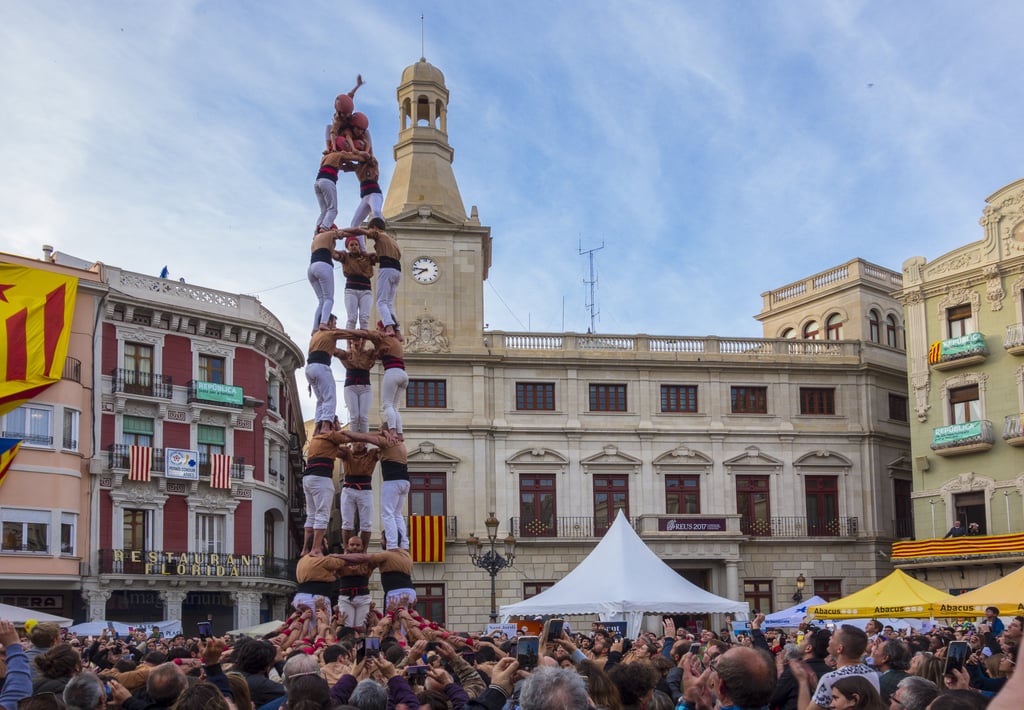
World Book Day, a UNESCO-recognised cultural day, is celebrated widely in Spain, though perhaps more quietly than in Barcelona, the capital of Catalonia, where you will see authors signing books and crowds watching castells (human towers) or participating in dancing sardanas (Catalan traditional dance). It’s a cultural festival too. If you have never seen the famous “human towers”, they are worth seeking out. Castells are spectacular, often six to ten stories high, as part of a 200-year-old tradition, again recognised by UNESCO. Performed by teams called colles, they involve people standing on shoulders to form a tower, usually during local festivals, symbolising unity and community strength.
Schools across Spain organise outings and special events with an emphasis on books and reading.
What to expect
Everyone is welcome and town centres will be crowded. Local independent bookshops will be busier than usual but may well have some interesting discounts.
If you can find a table in a café, it’s fun to watch the activities over a café con leche or a vaso de vino. In the days of Kindle and other online ways to read, it is a chance for booksellers to remind us of the pleasure of holding a book and actually turning the pages.
How to join in
Buy a book by a Spanish author. Or, if your Spanish is limited, buy a children’s book which will help your vocabulary. Purchase a single rose. Visit a local bookshop. Learn more about Sant Jordi in Catalonia and in your region. You will be part of your local culture on what is an enjoyable festival for all ages.
A word of advice: it’s probably not a good idea to join in dancing a sardana despite seeing the circles of dancers expanding as new people participate. The steps are complicated and if you don’t know them, you could send the whole circle out of kilter! The Cobla is a traditional 11-musician Catalan ensemble that plays 12 wind and string instruments to accompany the sardana. As a cornerstone of Catalan identity, this unique band consists of specialised instruments.
Books to buy if you’re starting a life in Spain
Here are some really amusing and useful books about experiences when first moving to Spain:
- ‘Driving Over Lemons’ by Chris Stewart – a humorous memoir about leaving a music career to start a new life on a remote sheep farm, El Valero, in the Alpujarras mountains of Spain.
- ‘Snowball Oranges’ by Peter Kerr – The book follows Peter Kerr, his wife and their two sons as they abandon their secure life in Scotland to manage a small orange farm in a secluded valley in the Mallorcan mountains.
- ‘The Sun Also Rises’ by Ernest Hemingway – A book to enjoy for the cultural flavour rather than for relocation insight. It portrays American and British expats who travel from Paris to the Festival of San Fermin, Pamplona and watch the running of the bulls and the bullfights.
- ‘Spanish Lessons’ by Derek Lambert – After a long career as a jetsetting journalist, Derek Lambert decided to settle with his family in a white “casita” on Spain’s Mediterranean Costa Blanca.
- ‘No Going Back and Shaking the Tree’ by Martin Kirby – A funny, heartfelt memoir about an ordinary family starting over in Catalonia, about gambling everything and making it work.
- ‘Ghosts of Spain’ by Giles Tremlett – A captivating exploration of Spain’s complex history and the lingering impact of its turbulent past.
- ‘The New Spaniards’ by John Hooper – A comprehensive analysis of Spain’s rapid transformation from a rural dictatorship to a modern, urban democracy.
Summary
Hopefully, the sun will be shining on 23rd April. Take home a rose and a book, and you’ll have done more than enjoy a festival – you’ll have spent a day living like a local.
You might also like: